










































In certain ancient Greek tombs, a piece of gold was meant to accompany the dead far beyond their funeral. It was neither a coin nor an ornamental jewel. A few centimeters of metal bore a Greek inscription that seemed to address a soul on its journey through Hades. The words spoke of guardians, a spring to recognize, the memory to preserve, or words to speak before the queen of the underworld. A text entrusted to someone who could no longer read it.
These small gold leaves, generally called Orphic or Orphico-Dionysiac tablets, have been discovered in several regions of the Greek world, notably southern Italy, Thessaly, and Crete. They are not scattered pages from a book whose structure we possess. Each example belongs to a tomb, a period, and a tradition whose particular features must be examined. The texts are similar, but their differences are as informative as their repeated expressions.
The idea that a soul could receive directions for the afterlife immediately captures the imagination. Death is not presented merely as a definitive end. It becomes a passage in which recognition, memory, and connection to certain deities play a decisive role. The Greeks held several conceptions of the world of the dead: the tablets offer insight into certain communities that hoped their dead would have a different fate from that of an anonymous shade.
These inscriptions offer access to ancient knowledge passed down in a materially fragile yet intellectually demanding form. We must trace where they were found, their texts, their connections to Mnemosyne, Persephone, and Dionysus, then understand what it really means to attribute these documents to Orpheus. This dossier reproduces no ceremony: it recounts the history of funerary words and the religious world that gave them meaning.
Gold leaves entrusted to actual deceased people
The first defining feature of the tablets is their archaeological reality. They are known not only from later accounts or treatises attributed to vanished masters. Archaeologists have discovered inscribed leaves in funerary contexts, near the people who were buried. The metal is generally extremely thin, and the writing covers a small area. Some pieces were folded before being deposited. This handling may have protected the text, made it easier to place, or followed a convention whose full details are no longer known to us.
The discovery area covers several Mediterranean regions where Greek was spoken. In Magna Graecia, the Greek cities of southern Italy had active religious lives, with local traditions and maritime exchanges. Examples come from Hipponion, Thurii, and Petelia. Others come from Thessaly or Crete. The evidence spans several centuries, from the Classical period to later times; it therefore cannot automatically be attributed to a single generation of initiates.
The Hipponion tablet is particularly instructive. It was discovered in 1969 in a necropolis near present-day Vibo Valentia, in Calabria. Rachele Cera, in a study published by Ca' Foscari University, explains that it is dated to around the 5th and 4th centuries BCE. The leaf was folded four times and bore an inscription of sixteen lines. The text is therefore not an isolated word on a medal: it is a genuine message arranged on a surface only a few centimeters across.
The same research shows how important it is to place the inscription in context. There is a difference between a thin tablet found during a documented excavation and another that passed through the 19th-century antiquities market. The object itself attests to its material, alphabet, and part of its dating; the discovery context helps us understand who received it and among which grave goods. When this documentation is missing, interpretations of its function become more uncertain.
The British Museum holds a leaf from Petelia, acquired in 1843 and catalogued as 1843,0724.3. The museum dates it to the 3rd or 2nd centuries BCE. Its current display includes a chain and a case that are later, however, dating to the 2nd or 3rd centuries CE. The display as a whole therefore does not necessarily correspond to an intact ancient burial deposit. This example shows why a curator must distinguish the Greek piece from its later reuses.
The tablets do not all have the same shape. Some are elongated and rectangular; others resemble leaves. The writing also varies, allowing specialists to study regional traditions. These features are not mere museum details. A leaf shaped like ivy, such as those from Pelinna, bears an iconographic association that may shed light on its religious context. Another, folded several times, attests to a method of depositing it that kept the message hidden from visitors.
The use of gold is clearly significant. It is a prized, durable metal that can bear a fine inscription. But we should resist the temptation to assign it a definite astrological meaning that the objects themselves do not support. The ancients attributed many symbolic values to gold, and its resistance to deterioration may have suited it for a funerary deposit. However, no surviving text allows us to say for certain that all those who commissioned these objects had exactly the same reason for choosing it.
The tombs also show that these objects were not intended for permanent public display. The message accompanied a person on their journey. The inscription was addressed less to passersby than to an imagined recipient beyond life. This distinguishes it from an epitaph carved on a monument, which informs the living about the deceased. The tablet speaks to the person who has just left their world. Its small size reflects the private nature of its destination.
The archaeologist is thus faced with a fascinating question: what might it have meant to a family to place an inscribed message beside a body? A means of passing something on, an assurance of being recognized, a reminder of instruction received, perhaps several functions at once. Excavations and inscriptions provide some clues, but not a complete account of the actions and intentions involved. This documentary boundary makes research necessary and prevents overly easy certainties.
At the Edge of the Spring of Memory
A family of tablets evokes a journey through the realm of the dead. The deceased is invited to recognize an underworld landscape where a spring, a cypress, and guardians appear. One body of water is best avoided, while another is associated with Mnemosyne, Memory. The soul must show that it knows the right path and belongs to a class capable of making the passage. These are places imagined within a specific religious tradition, not directions based on observed geography.
The Petelia tablet is a major witness. The British Museum's description explains that the inscription directs its bearer to the spring of Memory and advises them to avoid a different water. It mentions a dialogue with guardians of the underworld. The piece thus gives concrete form to an ancient idea: dying alone is not enough to know where to go. Some of the dead were thought to possess teachings received during their lifetime.
The mention of Mnemosyne is remarkable. In Greek tradition, she personifies Memory and, according to Hesiod, is the mother of the Muses. Her name evokes the ability to retain what must not be lost. On funerary tablets, this quality becomes a resource for the journey through Hades. The water of Memory seems to preserve or confirm something of the identity of the person seeking it. A connection emerges between the knowledge acquired during life and the fate expected after death.
It would be tempting to tell the same story everywhere of the opposition between Lethe, the river of forgetfulness, and the spring of Mnemosyne. Greek authors did indeed develop several accounts of the souls' forgetfulness. But some tablets do not name Lethe directly. Historians must therefore start with the details engraved on each tablet rather than automatically impose a map of Hades drawn from another text. The underworld landscapes of the Greek world do not follow precisely the same layout in every tradition.
The role of the guardians reinforces the initiatory nature of the scene. The dead person is not merely invited to find water; they must also be recognized. In some versions, the soul declares that it comes from the Earth and the starry Sky. This formula expresses an origin beyond the ordinary condition, even if its precise interpretation remains debated. This language brings knowledge and identity together. To receive a special welcome, one must recall who one is in the traditional sense.
The texts in the Memory group are not all the same length. A few words may replace a longer version; some variants are known from pieces found in distant places. Richard Janko studied the textual links between these witnesses and proposed a reconstruction of their transmission. The investigation reminds us that a funerary inscription may bear a text older than the object itself. The date of the metal and the date when the words originated are not necessarily the same.
Memory can also be understood as a defense against the dissolution of the individual. In many depictions of Hades, the dead become shades whose condition differs radically from that of the living. The leaves of Memory hint at a particular hope: a prepared soul might retain a word, an origin, and a place. We must be cautious about the exact nature of this promise. Not all the documents speak of reincarnation, and none offers a complete, systematic teaching on the fate of souls.
The engraved text should not be confused with a grimoire intended to command invisible beings. The recipients are the dead themselves, not a living reader seeking to influence someone else. This distinction is essential. It sets these inscriptions apart from the words of power studied in later magical traditions, even if several traditions share the principle that precise words possess a particular authority.
The tablets thus show us that the afterlife could be understood as a passage requiring discernment and knowledge. The spring, the guardian, and the expected response give death an almost dramatic structure. The soul becomes a traveler equipped with information intended to help it find its place. The Greeks who entrusted these messages to the dead gave material form to this hope through a few lines inscribed on a gold leaf.
Before Persephone and Dionysus
Other tablets convey a noticeably different message. Instead of describing a road and two springs at length, they present the soul before the powers of the underworld and emphasize its purity. The examples from Thurii, in Greek Italy, are among the most studied in this group. Their vocabulary has been analyzed in relation to purification, the status of initiates, and the promises made after death. The inscriptions do not directly describe the ceremonies performed before the funeral.
Andrej Petrovic and Ivana Petrovic analyzed several of these texts in a study published by Oxford University Press in 2016. They show that the purity claimed by the souls is linked to the special status that religious instruction or preparation could confer on them. This is not necessarily a claim about the deceased's moral virtue according to contemporary standards. Purity belongs to an ancient religious language that must be studied in its specific context.
The female power addressed in these messages is the queen of the dead, identified with Persephone. Daughter of Demeter and wife of Hades, she holds a central place in Greek mythology concerning death and return. Her story is connected to the seasons, fertility, and relations between the visible world and that of the dead. In the tablets, her role concerns the reception and status of the soul that appears before her.
The leaves discovered at Pelinna, in Thessaly, add another divine relationship. Two ivy-leaf-shaped tablets were found in a woman’s sarcophagus, then published in 1987. Their writing and context date them to around the end of the 4th century BCE. Scholars have emphasized their Dionysian character: ivy is associated with Dionysus, and the inscriptions evoke Bacchus in language of liberation and rebirth.
Charles Segal devoted a study to these texts in Greek, Roman, and Byzantine Studies. The inscription addresses the deceased directly and invites them to recount before Persephone the liberating intervention of Bacchus. This association between the queen of the dead and Dionysus shows that some religious traditions could conceive of a passage of the soul in which several deities played complementary roles. It cannot be inferred that all Greeks shared the same conception.
The name Dionysus evokes a power of transformation, vitality, and passage between states of existence. His cults may have given rise to forms of initiation that promised a special relationship with the god. In the Pelinna leaves, this relationship is expressed at the moment when the deceased is supposed to change condition. Scholars debate the interpretation of the images of milk, wine, and metamorphosis in the text, but it is not possible to reconstruct an entire ceremony with certainty from these verses.
The Thurii tablets and those from Pelinna should not be mechanically grouped into a single school. Their locations, chronology, and wording differ. Yet studying them together sheds light on an important subject: some Greek communities believed that bonds established with divine powers could retain their value after death. Purification, recognition, or release could then influence the fate hoped for by the deceased’s loved ones.
The title given to the deities is as important as their name. Some inscriptions refer to the queen of the underworld without consistently using the name Persephone. Scholars seek to identify these references based on language, region, and religious parallels. It would be unwise to replace all ancient titles with a modern list of gods and goddesses, as though the texts were perfectly transparent. Precision requires respecting their vocabulary.
The archaeological evidence also cautions against assigning the owners an institutional role that their tombs cannot prove. The woman buried at Pelinna may have received some form of religious instruction, but her full social identity remains unknown. The tablets attest to a hope and its transmission; they reveal neither a fraternity’s membership register nor an initiation program. Their significance endures within these limits.
Orpheus and the Problem of a Uniform Tradition
The name of Orpheus dominates the modern reception of the tablets. In mythology, this poet and musician descends to the land of the dead in search of Eurydice. He is also associated with teachings concerning the gods, the origin of the world, and the fate of the soul. Ancient authors mention rites and stories placed under his authority. It was therefore tempting for early scholars encountering the inscribed leaves to classify them under the name of Orphism.
The comparison is instructive, but it calls for an essential caveat. Most of these leaves do not bear Orpheus’s signature. Nor do they present themselves as identifiable fragments of a work whose author and circulation we know. Calling them all Orphic is a historiographical interpretation, not an attribution supplied by each object. The British Museum acknowledges this nuance in its presentation of Petelia, describing the inscription as Orphic in character according to some interpretations.
Radcliffe G. Edmonds III played a major role in the modern discussion of the subject. His research on the underworld journey compares funerary inscriptions with depictions found in Plato and Aristophanes, while also emphasizing the differences between the texts. He refuses to assume that a centralized, perfectly reconstructable system lies behind every account of the afterlife. Traditions could share figures, words, and images while adapting them to their own concerns.
The expression Orphic religion does not necessarily refer to an institution comparable to a modern religious order, with registered members, fixed authorities, and a standardized set of teachings. The ancient Greek world encompassed various forms of restricted transmission, communities, and cults. The name of Orpheus may have served as a point of reference for authors and groups whose practices were not identical. Terminological caution helps preserve the richness of what has actually survived.
The role of Dionysian cults remains central to this discussion. Some leaves name Bacchus, while others speak of Persephone or Memory. The presence of a god in an inscription points to a religious relationship, but it is not enough to identify every stage of a rite. The Eleusinian Mysteries, Dionysian practices, and Pythagorean traditions each have their own histories; merging them indiscriminately would erase the diversity of Greek communities.
Literary accounts of Hades provide useful context. Homer describes the realm of the dead; Plato depicts judgments and the journeys of souls; poets offer images of the blessed and the punishments of the afterlife. The gold leaves differ from these works because they were placed with people who were actually buried. Their message was not primarily intended to be admired by an audience; it was meant for the journey of the deceased, as imagined by the tradition that had received it.
The difference from necromantic practices is also decisive. The tablets do not seem intended to bring back the dead to obtain information. They accompany someone leaving the world of the living. Their recipient is the one walking toward the powers of the underworld, not a spirit summoned by loved ones. The engraved words express the hope of being welcomed and recognized, not a consultation intended to bring about an apparition.
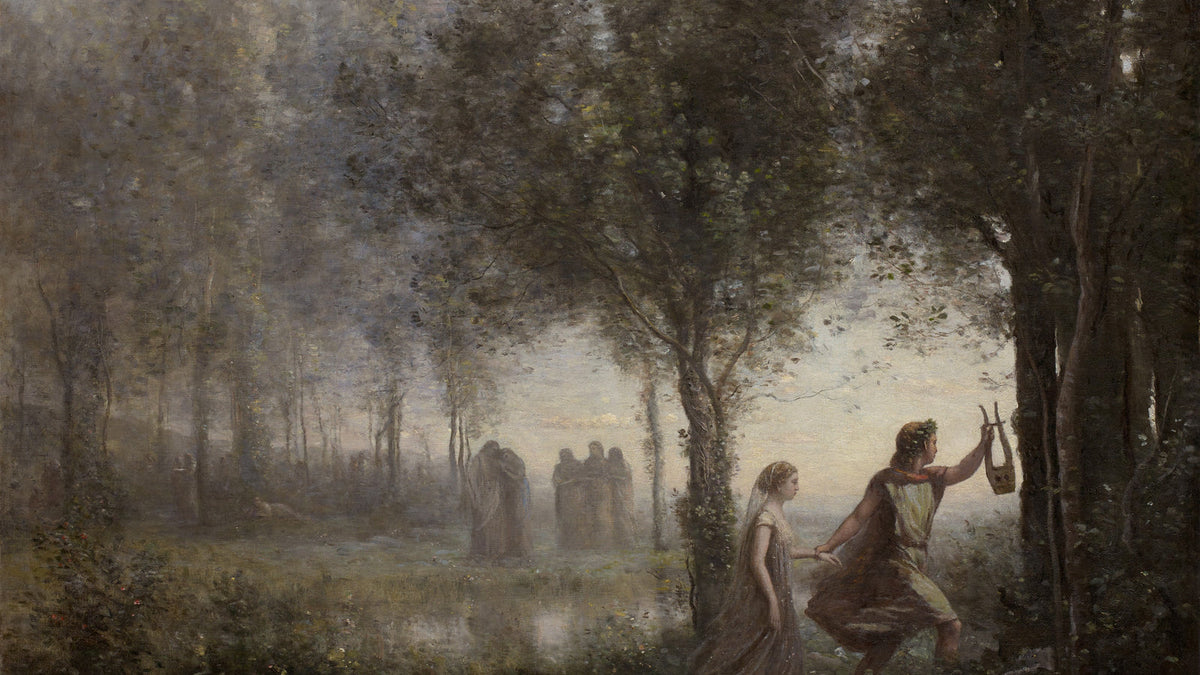
Western art has given the image of Orpheus crossing into the world of the dead a long afterlife. In the 19th century, Camille Corot painted Orpheus Leading Eurydice from the Underworld, set in a dark, wooded landscape. This work gives visual form to the passage between worlds, but it does not depict an archaeological event documented by the tablets. Clearly distinguishing it from Greek objects allows it to retain its proper role: an artistic evocation of a great mythical tradition.
Orpheus’s authority thus remains an open and fruitful question. It connects accounts of initiations, journeys underground, and the soul’s destiny, without making close study of the tablets unnecessary. Current research prefers to examine their contexts and variations rather than impose a uniform answer. Traditional knowledge gains credibility when it recognizes the distinctions that the sources actually allow us to establish.
The enduring words the Greeks placed in the tomb
The thinness of these gold leaves contrasts with the significance of the messages they preserve. An object that weighs almost nothing is placed with the deceased for a journey believed to be decisive. The engraved signs are meant to survive the separation of the living from the dead, at least in the religious worldview of those who placed them there. This is a very particular conception of writing: its primary purpose is not to instruct the living, but to serve as a memory aid for someone who can no longer speak among them.
Their production required precise work. A sheet had to be made thin enough to be placed with a body, then inscribed with legible Greek letters. The handwriting can provide information about the region and date. It also reveals variations in transmission. Specialists compare letter forms, verse order, and shared expressions. A formula found on several tablets does not necessarily reproduce word for word an original that has been preserved.
Studying the texts requires careful attention to the gaps. Some tablets have been folded, damaged, or distorted. Letters are difficult to make out, and the restorations proposed by scholars may change. Contemporary French translations therefore depend on precise philological choices. A symbolic interpretation built on a single incorrectly restored word can prove fragile. That is why scholarly editions, even when they do not agree on everything, remain essential to transmitting this corpus.
The differences between the documents are just as instructive as their similarities. Some tablets describe routes and guardians; others focus on purity or the relationship with a god. Very short inscriptions appear alongside more extensive texts. Comparison may reveal a shared tradition, but it does not justify erasing local differences. The tablets do not present a complete theology; they offer windows onto several ways of preparing religiously for death.
Historians of religion have also debated beliefs concerning reincarnation, happiness in the afterlife, and escape from the ordinary fate of the dead. These questions appear in several Greek sources, but they are not always answered in the same way. It would be wrong to assume that every owner of a tablet expected exactly the same form of salvation. The texts attest to hopes of recognition, purity, or favor, but do not allow us to reconstruct all the teachings the deceased had received.
The material world of the tomb must remain in mind. The objects were found in burials, in some cases alongside other offerings, not in a philosopher’s library. The leaf’s position near the body, the material chosen, and the burial context are all part of its meaning. An enlarged photograph in a museum can make it look like a monumental inscription, when in fact it is a tiny document entrusted to an individual. Its significance does not come from its size.
Modern discoveries have changed our view of Greek religion. They show that groups or individuals held expectations about the afterlife that are not equally evident in major literary works. Religious life in antiquity cannot be reduced to civic processions and public sacrifices. It also included restricted teachings, particular devotions, and promises made to those who committed themselves to them.
The tablets preserve the idea that certain words could retain their authority after death. The deceased had to recognize a path, affirm their origin, or present themselves before a deity. This link between language and passage has parallels in other traditions, but it must be studied in its Greek context. Comparisons with later systems cannot replace analysis of the authentic inscriptions. Elsewhere, we have discussed forms of speech invested with authority in magic; here, the purpose is funerary, and the practice belongs to another era.
In this ancient world, memory was not merely what remained with the living after someone’s passing. The texts of Memory suggest that it could also be what the dead had to take with them. The gold leaves give this idea a tangible form: a message needed to keep one’s place at the entrance to Hades. Behind each piece are a person, a burial, and a community whose names we do not all know, but whose spiritual expectations have endured through the centuries.
Sources and References
British Museum, Petelia tablet, 1843,0724.3, object and description of the sources of Memory, provenance, and dating.
Rachele Cera, “Orphic Tablet from Hipponion,” Axon, Ca' Foscari University, 2018, on the discovery at Hipponion, the folded support, and the inscription.
Richard Janko, “Going Beyond Multitexts: The Archetype of the Orphic Gold Leaves,” Classical Quarterly, 2016.
Andrej and Ivana Petrovic, “Inner Purity and Pollution in the Beyond: The Evidence of the Gold Leaves,” Oxford University Press, 2016, on purity inscriptions.
Charles Segal, “Dionysus and the Gold Tablets from Pelinna,” Greek, Roman, and Byzantine Studies, 1990.
Oxford Classical Dictionary, “Persephone/Kore”, the goddess and the fate of the dead in the tablets.
J. Paul Getty Museum, “Passports to a Better Afterlife”, museum presentation of the Greek tablets and landscapes of Hades.
Radcliffe G. Edmonds III, Myths of the Underworld Journey, critical review by Vinciane Pirenne-Delforge in L'Antiquité classique, on the debate about Orphism.
Cover: Jean-Baptiste Camille Corot, Orpheus Leading Eurydice from the Underworld, 1861 painting, Museum of Fine Arts, Houston, public domain reproduction via Wikimedia Commons. Artistic evocation of the passage to the dead, not a depiction of the tablets themselves.

Par Olivier of Aeternum
Passionate about esoteric traditions and the history of the occult from the earliest civilizations to the 18th century, I share some articles on these topics. I am also co-creator of the online esoteric shop Aeternum.