





























































































Contents...
|
1. The symbolism of knots |
In the vast world of Christian devotion, certain themes and figures emerge with particular strength. Among these revered figures, Mary, the mother of Jesus, holds a central place, not only as a maternal and protective figure but also as a powerful intercessor in times of difficulty. One of her less conventional but most poignant invocations is that of Mary who unties knots, whose light was partly shed by Pope Francis. This particular devotion has flourished mainly in the Catholic tradition, offering hope and comfort to those facing metaphorical "knots," in other words, problems and challenges that seem unsolvable.
1. The symbolism of knots
1.1. Knots in Christian tradition
In Christian tradition, the knot often symbolizes complications, obstacles, and sins that mark the human condition. This imagery is deeply rooted in Christian theology and iconography, serving as a powerful metaphor for spiritual and earthly obstacles. In the representation of Mary who unties knots, each knot in the ribbon represents a specific problem—whether sin, conflict, illness, or doubt—that Mary helps to resolve or dissolve through her grace.
This imagery originates from interpretations of sacred scriptures, where original sin is often compared to a knot created by Eve and untied by Mary. Saint Irenaeus, in his writings, elaborates on this analogy by stating that Mary, through her obedience, untied the knot of Eve's disobedience. This idea has been taken up and developed in Catholic theology to emphasize Mary's unique role in the plan of salvation, illustrating how her actions and assent to God's will contributed to humanity's redemption.
1.2. Mary as intercessor and mediator
Mary is venerated not only as the mother of Jesus but also as a powerful intercessor and mediator between Christians and God. This belief is based on the incarnation of Jesus and Mary's role as Theotokos (the Greek term for the Virgin Mary), the one who bore God. As such, she is seen as having a unique and privileged relationship with the Holy Trinity, allowing her to intercede effectively on behalf of the faithful.
In the context of devotion to Mary who unties knots, her role as an intercessor is even more specific and visually represented in the act of untying ribbons. Each untied knot symbolizes a prayer answered, a sin forgiven, a conflict resolved, or an illness healed. This visualization of Mary's intercession helps the faithful conceptualize her active and maternal role in their spiritual life, strengthening their faith in her ability to intervene in a concrete and powerful way.
The effectiveness of Mary as a mediator is also emphasized in this devotion. She is seen as the one who can approach her son, Jesus Christ, with the prayers of the faithful, pleading on their behalf to obtain mercy, grace, and help. This mediation is especially precious in the Catholic tradition, where Mary is often invoked in prayers and rites as a reassuring presence capable of understanding human suffering and offering consolation and hope.
2. How to ask for the help of Mary who Undoes the Knots?
To call on Mary who undoes the knots, the faithful can follow several devotional practices. These practices are designed to ask for Mary’s help in times of difficulty or when faced with "knots" in their lives, whether personal, family, professional, or spiritual problems.
2.1. The prayer to Mary who Undoes the Knots
This prayer is at the heart of the devotion. It is often recited with an open heart and a mind focused on the specific problems one wishes to see resolved:
Virgin Mary, Mother of beautiful Love,
Mother who has never abandoned a child crying for help,
Mother whose hands work tirelessly for your beloved children,
for they are driven by divine Love and the infinite Mercy that overflows from your heart,
Turn your compassionate gaze toward me.
See the bundle of “knots” that suffocate my life.
You know my despair and my pain.
You know how these knots paralyze me.
Mary, Mother whom God has entrusted with undoing the “knots” in the lives of your children,
I place the ribbon of my life in your hands.
No one, not even the Evil One, can take it away from your merciful help.
In your hands, there is not a single knot that cannot be undone.
Almighty Mother, by your grace and by your power of intercession with your Son Jesus,
My Deliverer, receive today this “knot”….. (name it, if possible).
For the glory of God, I ask you to undo it,
and to undo it forever. I hope in You.
You are the only Comforter God has given me,
you are the fortress of my fragile strengths, the wealth of my miseries,
the deliverance from all that prevents me from being with Christ.
Hear my call. Keep me, guide me, protect me.
You are my sure refuge.
Mary who undoes the knots, pray for me.
2.2. The novena of Marie who Undoes the Knots
The candle Marie who Undoes the Knots novena is prepared to be burned for 9 days (hence its name) while reciting a specific prayer:
| Day 1 |
Holy Beloved Mother, Most Holy Mary, You who undo the "knots" that suffocate your children, Extend your merciful hands toward me. Today I give you this "knot"…. (name it), and all the negative consequences it brings into my life. I give you this "knot" that torments me, makes me unhappy and prevents me so much from uniting with You and Your Son Jesus, my Savior. I turn to you, Mary who undo the knots because I trust you and I know you have never scorned a sinful child who begs you to help. I believe you can undo this "knot" because Jesus gives you all power. I trust that you will accept to undo this knot, because you are my Mother. I know you will do it because you love me with the very love of God. Thank you, my beloved Mother. "Mary who undo the knots", pray for me. |
| Day 2 |
Mary, beloved Mother, source of all graces, my heart turns to You today. I acknowledge that I am a sinner and that I need your help. Because of my selfishness, my resentments, for my lack of generosity and my lack of humility, I have often neglected the graces you obtain for me. I turn to You today "Mary who undoes knots", so that you ask, for me, your Son Jesus for purity of heart, detachment, humility, and trust. I will live this day practicing these virtues. I will offer them to you as proof of my love for You. I place this "knot" (name it) in Your hands…. who prevents me from reflecting the glory of God. "Mary who unties the knots", pray for me. |
| Day 3 |
Mother mediator, Queen of Heaven, you whose hands receive and distribute all the riches of the King, turn your merciful eyes toward me. I place this "knot" of my life (name it) in your holy hands, all the resentment, all the bitterness of which it is the source. I ask your forgiveness, God the Father, for my faults. Help me now to forgive all the people who, consciously or unconsciously, caused this "knot." It is in the measure of my surrender that You will be able to undo it. Before You, beloved Mother, and in the name of Your Son Jesus, my Savior, who was so offended, and who knew how to forgive, I now forgive these people (name them), and I also forgive myself, forever. Thank you, "Mary who undoes knots," for undoing in my heart the knot of resentment, and the knot I now present to you. Amen. "Mary who unties the knots", pray for me. |
| Day 4 |
Holy beloved Mother, welcoming to all who seek you, have mercy on me. I place this "knot" (name it) in your hands. It keeps me from being at peace, it paralyzes my soul, prevents me from walking to my Lord and to put my life at His service. Undo this "knot" in my life, oh my Mother. Ask Jesus for the healing of my paralyzed faith who lets herself be brought down by the stones on the path. Walk with me, beloved Mother, so that I become aware that these stones are actually friends, that I stop whispering, and that I learn to give thanks at every moment and to smile, confident in your power. Amen. ""Mary who unties the knots", pray for me. |
| Day 5 |
"Mary who unties the knots", generous and full of compassion, I turn to you once again to restore, this "knot" in your hands (name it) I ask you for the wisdom of God, so that I act under the light of the Holy Spirit to untie all these difficulties. No one has ever seen you angry; on the contrary, your words were so full of gentleness that one could see in you the heart of God. Deliver me from bitterness, anger, and hatred that this "knot" has caused to arise in me. Beloved Mother, give me your gentleness and your wisdom and that I learn to meditate on everything silently in my heart. And, as you did at Pentecost, intercede with Jesus so that I may receive in my life a new outpouring of the Holy Spirit. Spirit of God, come upon me! Amen. ""Mary who unties the knots", pray for me. |
| Day 6 |
Queen to Mercy, I entrust to you this "knot" in my life (name it) and I ask you to give me a heart who knows how to be patient while you untie this "knot". Teach me to persevere in listening to the Word of Your Son, to confess, to receive communion, finally, stay with me. Prepare my heart to celebrate with the angels the grace you are obtaining for me. "Mary who unties the knots", pray for me. Amen |
| Day 7 |
"Mary who unties the knots", Most pure Mother, I turn to you today: I beg you to untie this “knot” in my life (name it), and to free me from the grip of Evil. God has granted you great power over all demons. I renounce today the demons and all the ties I have had with them. I proclaim that Jesus is my only Savior, my only Lord. Oh "Mary who unties the knots", crush the head of the Evil One. Destroy the traps that caused these “knots” in my life. Thank you, most beloved Mother. Lord, free me with your precious Blood! Amen. "Mary who unties the knots", pray for me. |
| Day 8 |
"Virgin Mother of God", rich in mercy, have mercy on your child and untie this "knot" (name it) in my life. I need you to visit me, just as you visited Elizabeth. Bring me Jesus so that He may bring me the Holy Spirit. Teach me to practice the virtues of courage, joy, humility, faith, and, like Elizabeth, obtain for me to be filled with the Holy Spirit. I want you to be my Mother, my Queen, and my friend. I give you my heart and everything that belongs to me: my home, my family, my external and internal possessions. I belong to you forever. Put Your heart in me so that I can do everything Jesus tells me to do. Amen. "Mary who unties the knots", pray for me. |
| Day 9 |
"Most Holy Mother", our Advocate, You who untie the "knots", I come today thank you for kindly untying this "knot" (name it) in my life. You know the pain it causes me. Thank you, oh my Mother, for drying the tears from my eyes with your mercy. Thank you for welcoming me in your arms and for allowing me to receive another grace from God. "Mary who unties the knots", oh my beloved Mother, I thank you for untying the “knots” in my life. Wrap me in your cloak of love, keep me under your protection, enlighten me with your peace. Amen. "Mary who unties the knots", pray for me. |
2.3. Meditation to Mary who Unties Knots
Taking time to meditate on the aspects of your life that seem tangled or complicated can be a form of prayer in itself. Reading spiritual texts or the Scriptures can also help find peace and consider solutions under Mary's guidance. To create an atmosphere conducive to this meditation, you can use a religious incense such as a Mary who Unties Knots incense.
3. The origin of the devotion to Mary
3.1. The work of Johann Georg Melchior Schmidtner
The devotion to Mary who unties knots finds its visual and spiritual origins in a particular artwork created by the German artist Johann Georg Melchior Schmidtner around the end of the 17th century. This painting, now displayed at the St. Peter am Perlach church in Augsburg, Germany, captures the essence of a graceful and attentive Virgin Mary, busy untying a tangled ribbon. The painting, rich in symbolism, reflects the theological and artistic concerns of the Baroque era, a period marked by a strong interest in emotional and dramatic representations of religious figures.
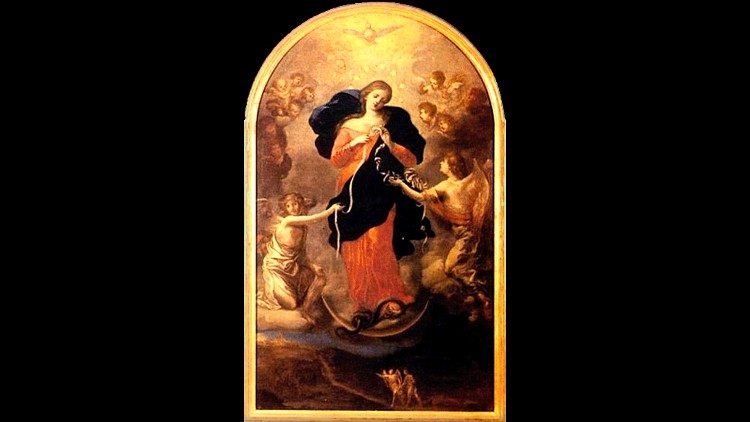
At that time, Europe was going through a period of profound religious and social changes, marked by the Counter-Reformation. Schmidtner's painting, in this context, can be seen as an effort to strengthen the Catholic faith in the face of challenges posed by emerging Protestantism. Mary's act of untying knots then symbolizes the hope for resolution of conflicts and sins troubling the faithful, offering a visual metaphor of divine intervention in human affairs.
3.2. Interpretation of the work
Mary is depicted at the center of the composition, standing on a crescent moon, symbolizing her virginity and immaculate purity, and crushing the serpent under her feet, a reference to Genesis and Revelation where it is said that the woman will crush the serpent's head. She is dressed in a red robe, symbolizing love and passion, topped with a blue mantle, representing her divine truth and faithfulness. Her delicate hands are busy untying a long ribbon, symbolizing the problems and trials of the faithful, which is wrapped around her hands.
Above her head, a group of angels holds a crown of twelve stars, a sign of her royalty and her place as Queen of Heaven. The angels, dressed in softly colored robes, watch and assist Mary in her task, representing her celestial servants.
The background of the canvas shows a cloudy sky, evoking the heavenly realm and the divine presence. The golden light enveloping Mary and the angels seems to emanate from this divine source, highlighting the central figure of Mary and her act of untying.
Here is a summary of the most important elements:
| The tangled ribbon | The ribbon that Mary unties is the central element of the painting. Each knot in the ribbon symbolizes a human problem or difficulty — whether sin, illness, conflict, or emotional distress. By untying these knots, Mary is seen as facilitating healing, conflict resolution, and reconciliation with God. |
| The Crown of Twelve Stars | The crown of stars above Mary's head refers to the text from Revelation (12:1), where it is said that a woman is crowned with twelve stars. The twelve stars symbolize the twelve tribes of Israel and the twelve apostles, thus emphasizing Mary's role in the plan of salvation and her intercession for the entire Church. |
| The Moon under her Feet and the Serpent | The moon under Mary's feet recalls the vision from Revelation, representing her glory and purity exalted above earthly things. The serpent, meanwhile, is a symbol of evil and sin, and by crushing it, Mary is depicted as the new Eve, who, unlike the first Eve, does not succumb to temptation but participates in the victory over sin. |
| The Colors of her Robe | The red of Mary's robe symbolizes passion, sacrificial love, and martyrdom, while the blue of her cloak is often associated with royalty, fidelity, and divine presence. Together, these colors emphasize the human and divine nature of Jesus, as well as Mary's role as Mother of God and Mother of the Church. |
3.3. The legend of Saint Irenaeus and Emperor Augustus
The theological inspiration for this representation of Mary can be traced back to a meditation attributed to Saint Irenaeus of Lyon, a 2nd-century theologian known for his writings against heresies. According to legend, Saint Irenaeus used the image of a knot to compare the actions of Eve and Mary. Eve, through her disobedience, tied humanity's fate in sin and separation from God, while Mary, through her assent to the divine will announced by the angel Gabriel, untied this knot, allowing redemption through her son Jesus.
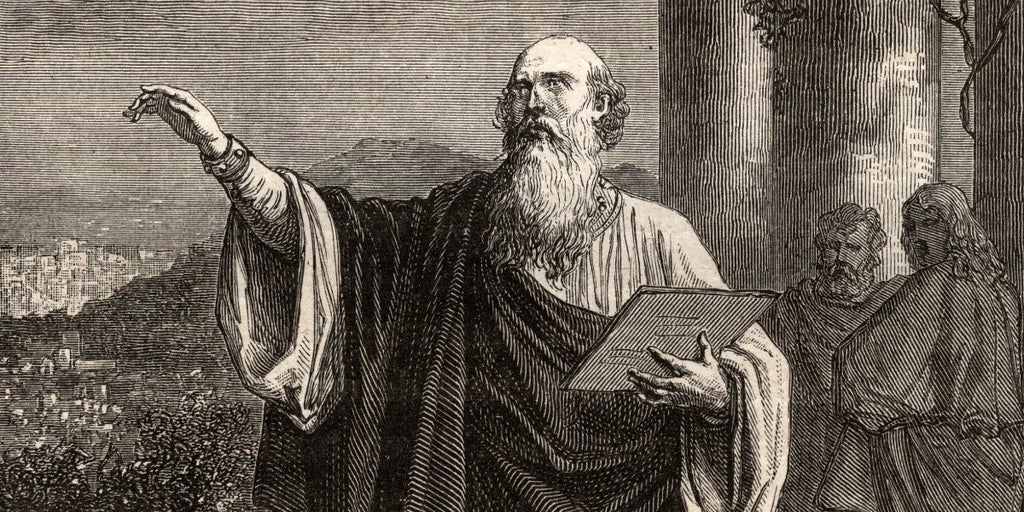
This analogy is reinforced by another story related to the Roman emperor Augustus. According to legend, Augustus consulted the Sibyl of Tibur, a prophetess, who showed him a vision of the Virgin carrying the child Jesus, declaring that this child would reign over a kingdom that would never end. Moved by this prophecy, Augustus is said to have erected the Ara Coeli altar, honoring Christ and his mother. This legend, although less directly related to the specific devotion to Mary who unties knots, contributes to the Christian imagination by highlighting Mary as a central figure in the fulfillment of prophecies and the mediation of divine grace.
These stories, incorporating themes of redemption and divine intervention, intertwine to give birth to the devotion to Mary who unties knots. They enrich Schmidtner’s painting, not only as a work of art but also as a source of spiritual meditation for the faithful seeking help and comfort from Mary in their struggle against the "knots" of their daily and spiritual lives.
4. Popularity thanks to Pope Francis
The relationship between the devotion to Mary who unties knots and Pope Francis is special because it is largely thanks to him that this devotion gained popularity far beyond its origins in Germany. Jorge Mario Bergoglio (who later became Pope Francis) discovered this devotion during his studies in Germany in the 1980s. He was moved by the image of Mary untying this tangled ribbon.
When he was Archbishop of Buenos Aires, Bergoglio promoted this devotion in Argentina. He had copies of the image from the St. Peter am Perlach church in Augsburg imported, where the original painting by Johann Georg Melchior Schmidtner is located. He thus encouraged prayer to Mary who unties knots, especially among the faithful facing insurmountable personal difficulties. This devotion found a special resonance in Christian communities worldwide.
5. The final word
As you have understood, Mary Who Unties Knots is a precious spiritual figure, especially in moments of doubt or when you feel overwhelmed by the weight of responsibilities or life’s trials. Her image, rich in symbolism and compassion, serves as a powerful reminder that we are never alone in our struggles. By addressing Mary in prayer, meditating on her role of intercession and mediation, one can find deep comfort and tangible help.
Mary who unties knots is not simply a temporary help for isolated moments of crisis; she is a constant presence, offering a source of strength and ongoing guidance. In the tangled ribbons of our lives, the knots of our mistakes, fears, and failures, she offers a path of resolution and clarity. This devotion invites us to recognize and accept heavenly help in our journey toward peace and personal and spiritual reconciliation.

Par Olivier of Aeternum
Passionate about esoteric traditions and the history of the occult from the earliest civilizations to the 18th century, I share some articles on these topics. I am also co-creator of the online esoteric shop Aeternum.