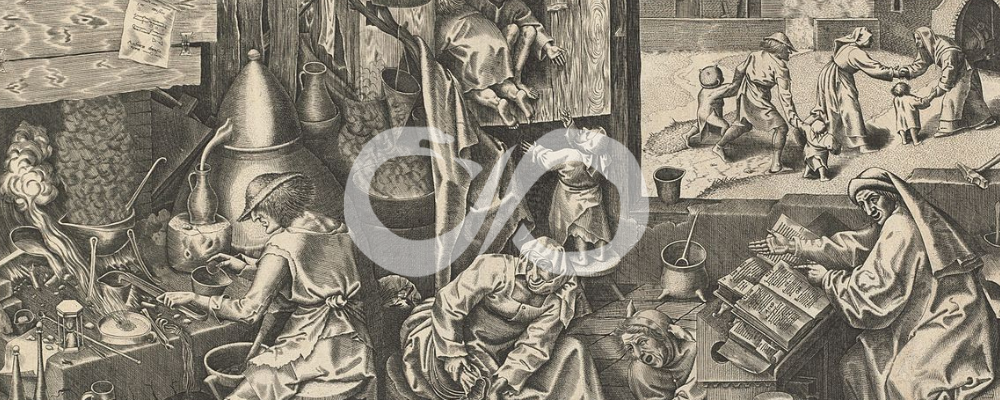
At the crossroads of philosophy and esotericism unfolds a fascinating current: magical Neoplatonism. Let us imagine for a moment a philosopher of late antiquity, in a torchlit temple, invoking the gods through sacred hymns, or a Renaissance sage bent over a talisman engraved with planetary symbols under a favorable astral configuration. In both cases, the guiding idea is the same: the entire cosmos is a great living being, hierarchical and unified, in which each level of reality resonates sympathetically with the others. How can one come into contact with these celestial and divine forces in order to elevate the soul or act upon nature? This is the question that Neoplatonism – the philosophy inspired by Plato – answered through a practice called theurgy, literally “divine magic.” An explanation.
1. Neoplatonic Philosophy and Divine Magic
Neoplatonism emerged in the 3rd century AD with Plotinus and his disciples. It is a philosophical school that extends Plato’s legacy by describing a universe emanating from an indescribable supreme principle (the One) and structured as a hierarchy of beings, from the most spiritual to the most material. Plotinus taught that the human soul, exiled in the sensible world, can rise back toward the One through philosophical purification and mystical contemplation. However, the question arose very early: are reason and meditation sufficient, or can one do something, perform sacred rites, to accelerate or facilitate this union with the divine? Plotinus himself was wary of magical practices, even though he accepted the principle of a “universal sympathy” linking all things in the cosmos. His disciple Porphyry shared this reservation and criticized cults overly focused on material invocations.
It was another Neoplatonic thinker, Iamblichus of Chalcis (c. 250–330), who brought about a decisive turning point. In his work De Mysteriis (later translated into Latin under the title The Theurgy of Iamblichus), he fervently defended the ritual and theurgical dimension of philosophy. Theurgy, Iamblichus explained, is the art of “acting upon higher beings, gods or demons, to compel them to place themselves at the disposal” of human beings. More than magic in the ordinary sense, it is a sacred technique that, through prayers, invocations, offerings, and symbols, elevates the soul toward the gods and allows the divinity to descend into the temple or the practitioner’s soul. According to him, the human soul, too deeply mired in materiality, must pass through these rites to reconnect with the divine world: “The incarnate soul returns to the divine only by performing certain rites, theurgy, literally ‘divine work.’” This ritual apotheosis surpasses mere intellectual abilities: theurgy mobilizes divine powers that purify and transform the initiate’s soul.
Within the Neoplatonic school, a debate then arose between supporters of a purely philosophical and contemplative path and those who favored a theurgical path. A later testimony by Olympiodorus (6th century) summarizes this divergence: “Many, such as Porphyry and Plotinus, prefer philosophy; others, such as Iamblichus, Syrianus, and Proclus, prefer theurgy (divine magic).” Indeed, Iamblichus’s successors – notably Proclus in Athens in the 5th century – fully integrated theurgy into their teaching. Proclus, for example, composed hymns to the planets and performed rituals to attune himself to the tutelary gods of each level of the cosmos. These philosopher-theurgists saw rites as a logical extension of metaphysics: since everything in the universe proceeds from the One and remains mystically connected, it is possible, through appropriate symbols, to enter into sympathy with higher entities. Late Neoplatonic writings – such as the aforementioned De Mysteriis by Iamblichus, or the Chaldean Oracles, which they diligently commented on – testify to a profound belief in the hidden forces of nature and the possibility of employing them through rites to produce supernatural effects. This Neoplatonic “magic” of antiquity differed from malevolent sorcery: it was a theoretical and ceremonial magic aimed at the good of the soul and the contemplation of the gods, which Iamblichus called hieratic or theurgy.
With the advent of Christianity, unfortunately for these practices, magic was increasingly equated with pagan idolatry or demonology. In the 5th century, Saint Augustine categorically condemned every magical operation, asserting that the wonders performed by magicians could only come from deceitful demons. The flame of Neoplatonic theurgy therefore weakened at the end of antiquity, as the Roman Empire became Christianized and the last pagan schools closed (the famous Academy of Athens closed in 529). Nevertheless, Neoplatonic ideas partially survived through certain Christian authors who adopted their language (thus, in the 6th century, Pseudo-Dionysius the Areopagite took up Proclus’s hierarchy of angels). In the Middle Ages, magic remained officially condemned, but the thirst to understand the mirabilia (the wonders of creation) persisted in monasteries and universities. In the 13th century, two scholars cautiously opened the way toward a rehabilitation of magia naturalis (natural magic) devoid of malevolent intentions: Albert the Great and Roger Bacon. Albert the Great explored the occult properties of plants and minerals, seeking to distinguish what resulted from hidden natural causes from what might be demonic. As for Roger Bacon (Doctor Mirabilis), he openly defended natural magic as a legitimate science, denouncing the “infinite stupidity” of his colleagues who rejected it. Aware of the risk of heresy, Bacon took care to separate natural magic – based on occult physical causes – from illicit magic invoking demons, and asserted that the wonders attributed to sorcerers were in reality merely the product of art and nature. By rationalizing phenomena considered magical in this way (astrology or alchemy explained through hidden influences and invisible emanations), these thinkers prepared the ground for a new worldview in which studying the mysteries of nature was no longer a crime. On the eve of the Renaissance, the idea emerged that a natural magic devoid of malevolent intentions could be incorporated into knowledge, as a form of experimental science embracing nature’s deepest secrets.
2. The Hermetic-Neoplatonic Alliance
It was during the Italian Renaissance of the 15th and 16th centuries that magical Neoplatonism experienced a brilliant revival. The fall of Constantinople (1453) prompted Byzantine scholars to bring forgotten Greek manuscripts to the West, particularly the works of Plato and his successors. At the same time, in 1460, a corpus of mystical texts attributed to the ancient Egyptian sage Hermes Trismegistus was rediscovered. These Hermetic writings exalted the living unity of the cosmos and the correspondence between the celestial and terrestrial worlds – themes strikingly compatible with the Neoplatonic vision. The ground was ready for a masterful synthesis of Platonic wisdom, Hermetic esotericism, and Christian faith.
The principal architect of this synthesis was Marsilio Ficino (1433–1499), a Florentine philosopher patronized by Cosimo de’ Medici. At the head of the Platonic Academy of Florence, Ficino translated Plato and Plotinus into Latin, as well as the Corpus Hermeticum. His ambition was to reconcile the pagan wisdom of the “ancient theologians” (he revered Hermes Trismegistus, Orpheus, Zoroaster, Pythagoras, and others) with the Christianity of his time. He saw the study of nature’s mysteries as an act of piety toward the Creator: understanding the hidden connections uniting Humanity, Nature, and the stars meant admiring God’s work and attuning oneself to the cosmos. In his work Three Books on Life (1489), Ficino devoted the entire third book (De vita coelitus comparanda, “On Obtaining Life from the Heavens”) to a genuine theory of natural magic. Drawing on Neoplatonic concepts, he described a hierarchical universe in which all degrees of being – from pure spirit to matter – are connected by sympathetic correspondences. The World Soul, an emanation of the universal soul, continuously diffuses spiritual influences from the stars to the plants, metals, and precious stones of the earth. By knowing the appropriate correspondences, the magician can draw beneficial stellar influences to himself by using the “signatures” that nature has placed in things. In practical terms, Ficino recommended making talismans or elixirs by taking advantage of times when the stars are favorable: a talisman engraved under the constellation of Jupiter could capture Jupiter’s expansive virtues, while a potion prepared with “solar” plants (such as the sunflower or laurel, symbolically linked to the Sun) would invigorate the soul through the influx of solar fire. To elevate the soul, he even recommended listening to Orphic hymns dedicated to the planets or wearing jewelry imbued with astrological influences – all means of attuning oneself to the harmony of the world.
Although he was a priest, Marsilio Ficino took care to disentangle “natural magic” from every malevolent connotation: he explicitly excluded any invocation of spirits or demons and insisted on the magician’s morality and purity. His magic aspired to be a sacred science of nature, compatible with religion. Thanks to him, astral magic regained legitimacy among respectable disciplines – cleansed of crude superstitions and integrated into the natural philosophy of his time. In short, Ficino laid the foundations for a Christian, celestial, and learned Neoplatonic magic that would inspire the next generation of Renaissance occultists.
Among his disciples was a daring young genius, Giovanni Pico della Mirandola (1463–1494). Fascinated by Ficino, Pico went even further in esoteric syncretism. In 1486, at just 23 years old, he offered to publicly defend 900 theses encompassing all human knowledge – from theology to magic. In these Conclusiones and his famous Oration on the Dignity of Man, he asserted that nothing true is foreign to faith: he integrated Jewish Kabbalah into Neoplatonic magic, convinced that the traditions of Moses and Plato sprang from the same primordial divine wisdom. Pico proclaimed that magia naturalis (natural magic) was nothing other than the practical part of natural philosophy – not only lawful, but noble and necessary for anyone wishing to penetrate the secrets of Creation. He nevertheless distinguished two levels: lower magic, purely natural (based on occult causes, symbols, and astral influences), and a higher, divine magic – which he specifically called theurgy – invoking celestial intelligences (the angels). Thus, Pico acknowledged that the magician could, through the power of enlightened will and faith, call celestial powers to himself, and even compel rebellious spirits, but only within the framework of a sacred quest in harmony with God. Such claims would cause him trouble: accused of impiety, Pico had to flee Italy for a time. His most radical theses were condemned by the Church in 1487. Nevertheless, his intellectual influence was immense: by daring to declare that “the noblest part of natural philosophy is magic” and that it corroborates the truths of faith, Pico legitimized the study of the occult at the very heart of Christian Neoplatonism. He did not hesitate to write that “no science gives us greater certainty about the divinity of Christ than magic and Kabbalah,” thus provocatively linking esotericism and theology. For him, all knowledge – whether it came from Zoroaster, Orpheus, Pythagoras, or Hebrew Kabbalah – converged toward the same light, and Humanity possessed the dignity to synthesize these teachings in order to rise in unison with the angels.
Ficino and Pico della Mirandola lit a fire that would blaze through all of 16th-century educated Europe. Everywhere, scholars and fervent Christians took up the banner of magia naturalis. One may mention Giambattista della Porta in Naples, Heinrich Cornelius Agrippa in Germany, Paracelsus in Switzerland, John Dee in England, Girolamo Cardano and
More than a century after Ficino, a scholar such as Della Porta (1535–1615) embodied the culmination of this tradition and the transition toward the scientific spirit. In his work Magia naturalis (1558, expanded in 1589), Della Porta collected hundreds of experiments and recipes combining optics, botany, mineralogy, mechanics, and astrology. He denied being a sorcerer: he excluded every incantation or pact and merely sought to reveal the hidden natural causes behind marvels. Yet when explaining why a particular herb healed a particular organ, he still invoked “occult qualities” of celestial origin, infused into plants by the stars. Della Porta indeed adopted the Ficinian Neoplatonic model: an order of the world descending from God to the angels, souls, stars, and hidden virtues in matter. For him, the natural magician was like a farmer of the universe: he prepared the “soil” (matter) so that Nature could produce its marvelous fruits – he did not violate divine laws; he collaborated with them. This vision illustrates how blurred the boundary between magic and science was at the dawn of modern science: explanations were sought, but wonder was not abandoned. Kepler himself, the great astronomer of the 17th century, practiced astrology in his spare time and saw planetary musical harmonies in the movement of the stars. Thus, until the Scientific Revolution, magical Neoplatonism served as a bridge between ancient esoteric knowledge and the new science taking shape.
3. A Hierarchical Cosmos of Symbolic Correspondences
Inherited from Plotinus and his later successors, Neoplatonic thought posits a reality emanating from a supreme principle, the One (identified with the Good or God). From this first principle proceeds a whole series of intermediaries: first the Divine Intelligences (or angels and demons in the neutral sense used by the Ancients), then the World Soul, then the stars, and finally the material elements. Each level of being reflects the one preceding it and influences the one following it, forming a continuous “great chain of Being” from God to matter. Renaissance philosophers such as Ficino and Pico reinterpreted this framework in Christian terms: for them, this universal hierarchy of Platonic origin actually described the plan of divine Creation, from the angelic choir of the seraphim to the four earthly elements. Natural magic found its legitimacy in this paradigm: it aimed to study and use the mechanisms through which spiritual influences descended from heaven to earth.
The key concept of this esotericism is that of symbolic correspondence between the Above and the Below. The famous Hermetic formula from the Emerald Tablet – “That which is below is like that which is above, and that which is above is like that which is below” – summarizes this law of universal analogy. In other words, the macrocosm (the Universe) and the microcosm (Humanity) are constructed in each other’s image: the human being is a small world in miniature, a reflection of the greater world. Every physical reality therefore has affinities with a higher metaphysical reality. The Sun is associated with gold, the heart, the eagle, the lion, the color red, and the deity Apollo – different things in appearance, but vibrating on the same symbolic “wavelength” because of the cosmic order. By mastering these correspondences, the magician can bring about changes by working through analogies: healing an organ by applying a plant symbolically aligned with it, or attracting a planet’s influence through a rite that imitates its energy. “That which is above” (the stars, ideas, and celestial archetypes) manifests “like that which is below” (plants, stones, and metals)>. Thus, a talisman made with a particular metal and engraving under the auspices of a particular constellation will serve as a receptacle for that constellation’s influences. Likewise, a prayer sung in the appropriate sacred language may invoke the virtue of a planetary archangel, while a Kabbalistic formula manipulating divine names may act upon intermediary angels or demons. The world is a vast network of sympathies: “the universe is a collection of signs and symbols,” a later esotericist would write, and the magician is the one who knows how to decipher them.
This vision of the cosmos is accompanied by a strong poetic and symbolic dimension. Every natural phenomenon takes on spiritual meaning. The course of the planets is the language through which God addresses humanity; the growth of plants is a secret script left in Creation. Magical Neoplatonism is therefore inseparable from a symbolic reading of the world. Gold is not merely a chemical element – it is the earthly embodiment of solar light; it “corresponds” to the Sun through its incorruptible brilliance. Likewise, the human heart is more than an organ: it is the sun of the microcosm, the vital center analogous to the Sun in the heavens. Such a system of thought unifies matter and spirit into a coherent whole: the visible is the mirror of the invisible. This is why the practitioner of Neoplatonic magic attaches so much importance to symbols, seals, and signatures: engraving an appropriate symbol means concentrating a precise spiritual influence in a small material object. For example, Agrippa explained that engraving a seal of Jupiter under a constellation of Jupiter, with the symbols associated with it, could “capture” the Jovian influx to attract prosperity and health. Of course, such correspondence practices required inner preparation: it was believed at the time that the magician himself had to be in a state of purity and fervor to serve as a conduit for celestial powers. Neoplatonic magic is as much a moral and spiritual discipline (elevating the soul toward divine intelligences) as it is an operative technique. Ficino insisted that the philosopher-magician had to cultivate virtue and wisdom, and Bruno would later proclaim that the magician’s imagination and will – purified of all vice – were the true engines of miracles.
4. Legacy and Significance
Magical Neoplatonism appears, in historical perspective, as far more than a collection of occult practices or outdated myths. In its time, it constituted a genuine operative natural philosophy, that is, a coherent way of understanding nature and acting upon it, drawing both on ancient heritage and experience. From mythical antiquity (with the image of Egyptian priests possessing sacred wisdom) to Renaissance scholars, through the alchemists of the Middle Ages, one can follow a common thread: active wonder before Nature. Neoplatonic thinkers and magicians refused to see the natural world as an inert and profane mass – for them, it was inhabited by spirit, traversed by divine signs, and worthy of being studied with as much respect as boldness. Their speculations about the World Soul, their talismans engraved with symbols, their distillations in a bain-marie, and their astrological calculations were not matters of blind superstition, but formed an ambitious system aimed at deciphering Creation and penetrating the hidden laws of the universe.
By honoring this tradition, we realize that it was one of the fertile grounds of the modern scientific revolution. Indeed, by seeking to understand and master nature’s marvelous phenomena, the followers of magia naturalis gradually instilled the idea that nature obeys laws – subtle laws, certainly, but intelligible ones – and that human beings can become their interpreters and even their masters. Many pioneers of science (Kepler, for example, and Newton later) were nourished by Hermetic-Neoplatonic writings that encouraged them to find order and mathematical harmony in the cosmos. Paradoxically, by trying to prove the magic of nature, these thinkers laid the foundations of the scientific method, seeking causes for what seemed magical in order to make it explicable. As Pico della Mirandola asserted, human dignity lies in the ability to embrace through the mind the totality of Creation, from the lowest material realities to the highest celestial truths. Magical Neoplatonism was an expression of this Promethean thirst for total knowledge, which sought to unite faith, reason, and imagination in a single quest.
Even today, reading the writings of Ficino, Agrippa, or Fludd is striking for the modernity of their ambition: to understand the world in depth without excluding the marvelous. Far from clichés of darkness and grimoires, magical Neoplatonism appears as a rich chapter in the history of ideas, where science and poetry, religion and philosophy intertwine. It illustrates a fervent era in which knowledge did not dispel the enchantment of the world but, on the contrary, exalted it by revealing the Universe’s secret harmony. In this sense, it continues to inspire lovers of occult wisdom: behind the symbols lies a unified and sacred vision of the cosmos, a spiritual legacy in which Humanity, the microcosm, discovers itself to be both citizen and magician of the great Whole, the great One.
Sources:
-
Plotinus – The Enneads: foundation of Neoplatonic thought, presenting the idea of the One and the soul’s emanation toward the higher spheres.
-
Iamblichus – On the Mysteries of Egypt (De Mysteriis): central treatise on theurgy, defending ritual magic as a path toward the divine.
-
Proclus – Elements of Theology and Commentaries on the Chaldean Oracles: a work of philosophical and mystical synthesis, influential among Christian and Renaissance thinkers.
-
Marsilio Ficino – De vita libri tres (1489): particularly Book III (De vita coelitus comparanda), foundation of astral magic in the Renaissance.
-
Giovanni Pico della Mirandola – Conclusiones philosophicae, cabalisticae et theologicae (1486): an intellectual manifesto integrating Kabbalah, magic, and Neoplatonism from a Christian perspective.
-
Heinrich Cornelius Agrippa – De occulta philosophia libri tres (1531): major work of Renaissance occultism, a Hermetic and Neoplatonic synthesis.
-
Giambattista Della Porta – Magia naturalis (1558, expanded edition 1589): encyclopedia of natural wonders based on natural magic and occult properties.
-
Frances Yates – Giordano Bruno and the Hermetic Tradition (1964): essential historical study of Hermetic-Neoplatonic thought in the Renaissance.
-
Alexandrine Schniewind – The Neoplatonists (Seuil, 2003): a clear and rigorous introduction to the principal ancient Neoplatonic thinkers.
-
Silvia Lippi – “ ‘Scientific’ Magic in the Renaissance: A Paradox?”, in Cliniques méditerranéennes, 2012: article exploring the coexistence of science and magic in Neoplatonic thought.

Par Olivier of Aeternum
Passionate about esoteric traditions and the history of the occult from the earliest civilizations to the 18th century, I share some articles on these topics. I am also co-creator of the online esoteric shop Aeternum.