



















































































































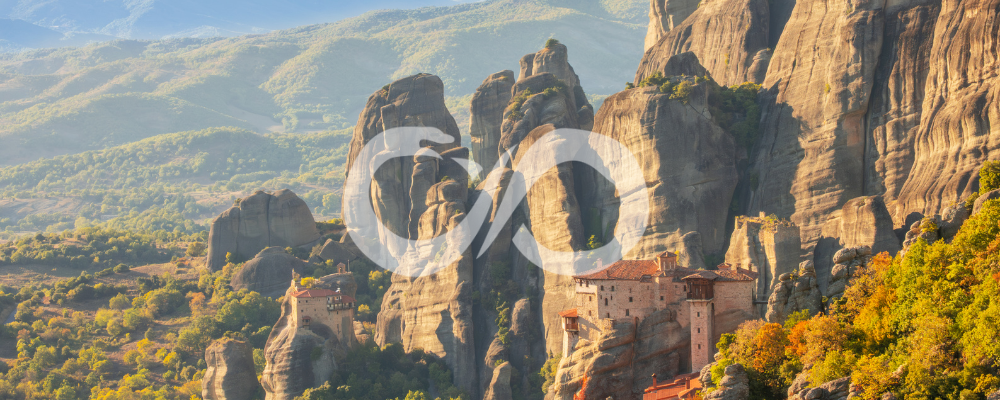
In northern Greece lies Thessaly, a vast plain surrounded by mountains, the birthplace of mythical heroes... and a major center of witchcraft in the ancient imagination. From the Classical period onward, the Greeks and then the Romans attributed a distinctive reputation to this fertile region: that of a land where formidable sorceresses operated, capable of extraordinary incantations. From the mythical Medea to the witches mentioned by Latin poets, Thessaly established itself as the land of enchantments and occult practices. Let us explore it.
The Birth of Thessaly’s Magical Reputation
Thessaly’s reputation as a land of magic appears as early as sources from the 5th century BC. Aristophanes, in his comedy The Clouds (423 BC), alludes to it humorously: a debt-ridden character suggests “buying a Thessalian sorceress” to bring the Moon down from the sky and keep it imprisoned, hoping thereby to stop the passage of time so he will no longer have to pay interest. The Thessalian appears here as a professional witch, familiar with lunar powers. A few decades later, around 380 BC, Plato likewise attests to this popular belief in a passage from the Gorgias. He compares the moral compromises of political life to the fearsome effects of Thessalian spells: “lest we should have to suffer […] the same thing as the Thessalians, when they are said to bring down the Moon.” The philosopher thus confirms that, in his view, ordinary people attributed to the women of Thessaly the supernatural power to act upon the nocturnal heavenly body.
This idea of lunar witchcraft rooted in Thessaly was probably not accidental. Ancient authors suggested that the region housed ancient cults connected with magic: the goddess Hecate, mistress of the Moon and nocturnal enchantments, was said to have been particularly honored there. Whatever the truth, from Classical Antiquity onward the Thessalian sorceress became a stock character. Her name itself became synonymous with the archetypal witch, to the point that a later Latin author could refer to “Thessalian marvels” to designate magical deeds. Writers regularly placed the most spectacular occult exploits in Thessaly. All it took was for a traveler or hero to pass through Thessaly for the dangerous and fascinating specialty that accounted for half its reputation to be praised there. In other words, in the minds of the Ancients, Thessaly had become the land of witches and magical rites.
Thessalian Witches and Sorceresses
Several mythological and legendary accounts helped shape this image of Thessaly as a “land of witchcraft.” One of the first great sorceresses in Greek mythology, Medea, acts precisely in Thessaly. Coming from the East with Jason and the Argonauts, Medea stays in Iolcos (in Thessaly), where her occult knowledge will overturn the fate of King Pelias. The witch of Colchis performs disturbing marvels there: she rejuvenates Jason’s father by boiling him in a cauldron with enchanted herbs, then deceives Pelias’s daughters into cutting their father into pieces in the hope of restoring his youth. This murder by magical trickery, committed on Thessalian soil, establishes in local mythology the idea of a terrifying occult power. Medea herself now embodies the figure of the witch capable of concocting potions and poisons, taming fabulous creatures, and manipulating life or death through her arts. Alongside her, other mythical female figures such as Circe (the sorceress who enchants Odysseus’s companions) are mentioned as a counterpoint - but Circe acts on her distant island, whereas Medea truly acts in Thessaly, giving this region a prominent place in the mythical geography of magic.
Beyond myth, Greek and then Latin literature widely disseminated the image of Thessalian witches, enriching their portrait with striking details. As early as Hellenistic poetry, these sorceresses were credited with fearsome rituals. A fragment attributed to the historian Aglaosthenes (or to a later author), for example, reported that the witches of Thessaly could bring down the Moon from the sky in exchange for an atrocious sacrifice - giving up what they held most dear, such as a child or even one of their eyes, in return for this power. The idea of paying a high price for magic reinforces these women’s sinister aura. In the same spirit, the legend of Aglaonice of Thessaly, a priestess and astronomer of the 3rd century BC, tells that she announced lunar eclipses and claimed, through her chants, to cause them. Her contemporaries said that Aglaonice “detached the Moon from the sky through her magical charms” and noted that each time she accomplished this feat, misfortune struck her family. Here reality (the scientific prediction of eclipses) mingles with belief: the scholar is perceived as a sorceress capable of subjugating the night star, in accordance with the Thessalian stereotype.
Latin authors of the late Republic and early Empire took up and amplified these motifs, making the Thessalian witch a recurring character in their works. Propertius, an elegiac poet of the 1st century BC, opens his Book I by evoking the bewitching power of love and alluding to Thessalian enchantments. Powerless before his passion, the fictional lover comes to wonder “what witch, what sorcerer could [deliver him] with Thessalian potions.” This passage attests that Thessalian potions - that is, the brews and spells originating in this country - were regarded as the most effective means of casting love spells. Likewise, in his Amores and Remedies for Love, Ovid multiplies his references to Thessalian witchcraft. At times the poet claims that a saga Thessala (a Thessalian witch) may have cast a spell responsible for his temporary impotence in love; at other times he advises his readers against resorting to harmful herbs and magical arts from Thessalian lands, practices he considers outdated. “This is the ancient way of practicing witchcraft,” Ovid writes of these occult remedies, before offering the reader more rational ways to heal a broken heart. Through these allusions, the Latin writer confirms that, in the minds of his audience, Thessaly rhymed with love magic, poisons, and enchantments.
It is, however, in Roman poetry and satire that the Thessalian witch reaches her full stature, often appearing as an old woman skilled in the black arts. Horace, in his Epodes (around 30 BC), stages the fearsome Canidia and her accomplices preparing macabre spells. Although these witches operate in Rome, Horace explicitly associates them with occult knowledge from Thessaly. Thus, in Epode 5, the witch Folia, Canidia’s accomplice, is presented as an intriguer capable of making the stars fall: “with a Thessalian word, [she would make] Moon and Sun fall from our sky.” The expression “Thessalian word” here designates a magical formula inherited from Thessaly, powerful enough to unhook the heavenly bodies from the firmament. Horace thus suggests that these Italian witches derive their knowledge from ancient Thessalian magical traditions. Elsewhere, speaking generally of superstitions, the same poet advises the wise man to laugh at everything that frightens the common people: dreams, magical terrors, nocturnal ghosts, and “Thessalian marvels.” Thessalian witchcraft had become, for Horace and his readers, a synonym for frightening spells.
Prose narratives of the Imperial period likewise exploited this vein. Around the 1st century AD, the poet Lucan places one of the most striking scenes of his Pharsalia (an epic of the civil war between Caesar and Pompey) in Thessaly. In Book VI, the young Sextus Pompey consults the witch Erichtho in the plains of Pharsalus on the eve of the great battle. Lucan gives a horrifying portrait of this Thessalian sorceress: she is a wild-eyed old woman who lives among tombs, feeds on dead flesh, and desecrates corpses for her rituals. Her incantations overturn the order of nature: “At a Thessalian woman’s voice, the laws of nature are interrupted: the earth is covered with floods, the sun grows dark, and the sky thunders without Jupiter’s knowledge.” Erichtho practices necromancy in particular: Lucan shows her collecting the still-warm blood of a dead soldier to anoint a corpse and bring it back to life - the specter torn from the Underworld then prophesies the battle’s disastrous outcome. This scene of macabre witchcraft, set on Thessalian soil itself, leaves a strong impression on Roman readers. After Lucan, no one would ever mention a Thessalian witch again without thinking of this repulsive figure, capable of making the dead speak and suspending the course of the stars.
Thessaly also provides the setting for the Latin novel The Metamorphoses (or The Golden Ass) by Apuleius (2nd century AD), which is largely built around the theme of magic. The hero, Lucius, is a young Greek fascinated by enchantments: “knowing that he was in the heart of Thessaly, the cradle of magical arts whose powerful spells are praised throughout the world,” he is eager to uncover their secrets. Very soon, he becomes entangled in the misdeeds of formidable Thessalian witches. Apuleius first introduces the witch Meroe, who attacks an unfortunate traveler: she drains his blood while he sleeps and leaves him dying, demonstrating a terrifyingly evil power. Further on, it is the sorceress Pamphile, with whom Lucius lodges, who reveals the full extent of local witchcraft. Every night, Pamphile transforms herself into an owl by rubbing herself with a magical ointment, so that she can go and meet her lover. Discovered by Lucius, she arouses a dangerous curiosity in him. The young man attempts a transformation himself, but a mistake turns him into a donkey - a picaresque misadventure that gives the novel much of its charm. Throughout the story, Apuleius accumulates episodes presenting Thessalian occult practices: summoning the spirits of the dead, love elixirs, transforming men into beasts or stone out of revenge, nocturnal flights through the air,... The author clearly emphasizes that Thessaly was regarded as “the cradle of magical arts,” the ideal place to satisfy [his hero’s] curiosity about witchcraft.
Notably, an earlier Greek version of the same novel, attributed to Lucian of Samosata (Lucios or The Ass, 2nd century), also takes place in Thessaly. This satirical tale, very close to Apuleius’s, features a hero transformed into a donkey after spying on the spells of a Thessalian woman. Whether it was truly written by Lucian or by another author, the choice of Thessaly as the setting was no accident: by the 3rd century AD, every reader knew that this region was “renowned throughout the world as the cradle of magical arts and enchantments.” In other works, Lucian also mocks credulity toward magic and “miracle workers.” His decision to set this tale of transformation in Thessaly confirms once more the unbreakable link between this land and witchcraft in the ancient imagination. From then on, the myth of the Thessalian witches was firmly established, with its prominent figures (from Medea to Erichtho) and recurring themes: lunar invocations, love potions, poisons, necromancy, transformations... Greco-Roman Antiquity thus bequeathed to posterity a rich tableau of magic in which Thessaly occupies a privileged place.
The Legacy of an Esoteric Image
The powerful image of the Thessalian witches did not disappear with the end of Antiquity: it survived through the centuries in Western scholarship and the esoteric imagination. During the Middle Ages, the ancient sorceress partly merged with the demonized figure of the medieval witch, but scholars did not forget the classical accounts. Translations and commentaries on ancient authors during the Renaissance rediscovered these Thessalian enchantresses. Sixteenth-century humanists and demonologists, while condemning the witchcraft practices of their own time, readily mentioned Greek and Roman examples: Medea, Circe, and the Thessalian women capable of bringing down the Moon were cited as mythical precedents for contemporary maleficia. Renaissance and Baroque artists and poets also drew from this reservoir of images: witches were depicted surrounding a magical cauldron beneath the full Moon, while love potions and poisons inherited from Thessaly were evoked. Montague Summers, an early 20th-century scholar, reports that in the eyes of the ancient Greeks “the Thessalian ladies were considered, more than any other people, experts in witchcraft and enchantments.” This remark, taken from a 1927 work, shows that the tradition was still very much alive in the imagination. Indeed, many esoteric authors of the 19th and 20th centuries perpetuated Thessaly’s mystical aura. The old expression “to reach for the Moon,” directly inherited from the Thessalian witches capable of drawing the nocturnal star toward themselves, entered common speech to denote an impossible quest - a sign of the enduring cultural memory of these myths. In addition, certain modern neo-pagan movements, such as Wicca, have symbolically reused the ritual of “bringing down the Moon” in their practices, in explicit reference to the enchantresses of Thessaly.
Ancient magical Thessaly has never entirely ceased to haunt the imagination. From authors of Antiquity to modern occultists, people have continued to celebrate - or fear - the extraordinary powers attributed to its witches. Land of wild horses and centaurs, the Thessalian plains were also, through the grace of literature, the domain of women with potions and incantations. This legendary construction, born of the fears and fantasies of Classical Greece, has endured through the ages. It reminds us how a region can, through the power of stories, become the favored stage of the invisible and the marvelous. Thessaly as a land of magic thus remains a fascinating legacy of ancient culture, having nourished centuries of poetry, myths, and esoteric beliefs.
Sources:
-
Aristophanes - The Clouds (423 BC), lines 749-755 (allusion to Thessalian sorceresses and the “descent” of the Moon).
-
Plato - Gorgias (around 380 BC), 513a (proverbial mention of Thessalian women bringing down the Moon).
-
Propertius - Elegies, I, 1 (evocation of Thessalian potions for healing the pains of love).
-
Horace - Epodes, V and XVII (the witches Canidia and Folia, uses of Thessalian enchantments).
-
Ovid - Amores and Remedia Amoris (references to the witches of Thessaly and criticism of ancient magical practices).
-
Lucan - Pharsalia, VI (portrait of Erichtho the Thessalian and necromancy before Pharsalus).
-
Apuleius - Metamorphoses or The Golden Ass (2nd century AD), Books I-III (Lucius’s adventures with Meroe and Pamphile in Thessaly, transformations, etc.).
-
(Pseudo-)Lucian of Samosata - Lucius or The Ass (2nd century AD), Greek novel attributed to Lucian (the same plot as Apuleius’s, highlighting the tradition of Thessalian witches).
-
Jacques Cazeaux - “The Thessaly of the Sorceresses,” in Thessaly (Proceedings of the Lyon Round Table, 1975), 1979. Historical study of the construction of the Thessalian witch myth.
-
Brian Clark - The Witches of Thessaly (Paper, 2000s). Analysis of Thessaly’s reputation as a center of witchcraft in Antiquity and beyond.
-
Montague Summers - The Geography of Witchcraft, Kegan Paul, 1927. A dated work discussing the tradition of Thessalian witches in Western culture.

Par Olivier of Aeternum
Passionate about esoteric traditions and the history of the occult from the earliest civilizations to the 18th century, I share some articles on these topics. I am also co-creator of the online esoteric shop Aeternum.













Bonjour Olivier,
Histoire très passionnante que je ne connaissais pas et même pas lu. Une chose je sais que la Grèce Antique est remplie d’histoires passionnantes et profondes.
J’ai une question par rapport au Thessalie.
N’y a-t-il pas une colération avec les Thessalonitiens écrit dans la Bible ? J’entends toujours parler des Thessalonites. 🤔😊🙏
Merci Olivier