






























































































Contents...
The Theban alphabet (or Witches' alphabet or Honorius's runes , or Theban in English) was a very important tool for preserving the secrets of magic practitioners. Developed in the 16th century, it found its place in particular in Books of Shadows and within covens, where it is still used today. Want to learn more? Follow the guide!
1. The birth of the Theban alphabet
1.1. An uncertain origin
The Theban alphabet is presumed to have originated in the work of Heinrich Cornelius Agrippa, an eminent figure of the Renaissance known for his substantial contributions to esotericism and magic. He is said to have first presented it in the book De Occulta Philosophia libri tres (Three Books of Occult Philosophy), published in 1533. However, the alphabet itself does not appear directly in the surviving editions of this work, raising questions about its direct attribution to Agrippa. According to other sources, this alphabet comes to us from Johannes Trithemius in 1516, who himself attributed it to the monk Honorius of Thebes. But these are only theories. Despite this, esoteric tradition closely associates it with Agrippa, attributing its creation to the scholar in an effort to codify a symbolic system intended for magical and esoteric practices.
The precise creation of the characters is difficult to determine, but overall, it seems to be linked to that of the alchemical alphabet.
1.2. From a secret alphabet to a magical alphabet
After its "supposed" introduction by Agrippa, the Theban alphabet slowly began to spread throughout Europe, first among occult circles and scholars, and then within popular magical practices. Its dissemination was facilitated by the circulation of esoteric manuscripts, grimoires, and Books of Shadows, which often incorporated the alphabet into their instructions for creating talismans, performing magical rituals, or writing invocations. Over the centuries, the Theban alphabet became a staple of magical traditions, with each new generation adapting it to its needs and beliefs. This continuity imbued the alphabet with an aura of mystery and power, strengthening its appeal among occult practitioners and seekers of hidden knowledge.
2. Structure and characteristics of the Theban alphabet
2.1. A sound-based alphabet
What makes this alphabet distinctive is that it is fundamentally a language based on sounds. Thus, each symbol represents a specific sound that is incomprehensible to the uninitiated.
2.2. Description of the symbols
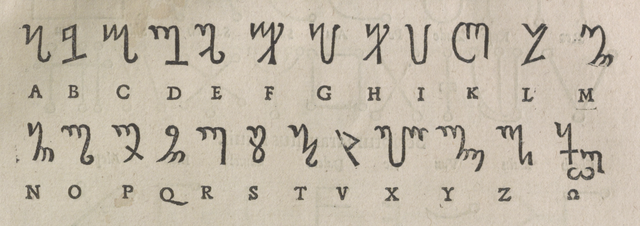
The Theban alphabet consists of specific symbols that have long been mistakenly confused with the Futhark (the runic alphabet). These characters are distinctly stylized, with lines and curves that differ significantly from the letter forms to which we are usually accustomed.
It has several specific features:
- It does not distinguish between the letters I/J and V/W
- It has no uppercase or lowercase letters
- It has no numbers or punctuation marks
3. The use of the Theban alphabet today
As you will have understood, this alphabet was used for a long time to encrypt and transmit messages securely. But as you have seen above, the correspondences are now available and widely circulated, which limits its secrecy.
Today, it has mainly a symbolic and decorative value rather than being truly functional.

Par Olivier of Aeternum
Passionate about esoteric traditions and the history of the occult from the earliest civilizations to the 18th century, I share some articles on these topics. I am also co-creator of the online esoteric shop Aeternum.