



















































































































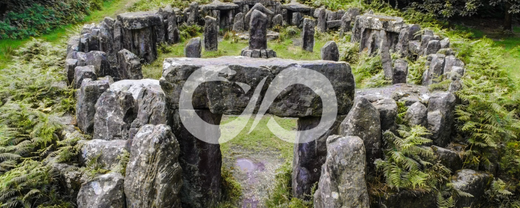
Contemporary Druidry draws its name and part of its imagery from the druids of antiquity. Yet it is not the institutional continuation of a priesthood that remained intact after the Roman conquest and Christianization. Between the druids described by Caesar and modern orders lies a history of ruptures, rediscoveries, literary creations, civic ceremonies, and new religions.
This history does not reduce modern Druidry to an imitation. It shows how each era gave the druid a new meaning: a Gallic philosopher for some ancient authors, a bloodthirsty priest in Roman propaganda, a patriotic sage for British antiquarians, a national bard in Wales, and later a religious figure connected with nature in some forms of contemporary paganism. Modern Druidry is the result of this long succession of interpretations.
Who were the druids of antiquity?
Druids belonged to certain Celtic societies of the Iron Age and the beginning of the Roman period. Greek and Latin authors attribute religious, judicial, political, and scholarly functions to them. Julius Caesar, in Book VI of The Gallic War, presents them as responsible for worship, sacrifices, education, and the arbitration of disputes. He states that they enjoyed exemptions, underwent a long oral apprenticeship, and gathered in Gaul at a consecrated site.
Other authors, including Strabo, Diodorus Siculus, and Pliny the Elder, mention druids alongside bards or seers. Tacitus describes the Roman attack on the island of Mona, present-day Anglesey, where religious figures take their place facing the soldiers. These texts indicate that specialists in ritual and knowledge existed in part of the Celtic world. However, they provide neither a complete liturgy nor a doctrine written by the druids themselves.
The word “Celts” encompasses populations spread across a vast area, connected by related languages and certain cultural traits. It does not designate a state, nation, or centralized religion. The roles attributed to druids in Gaul therefore cannot automatically be extended to every population speaking a Celtic language.
Ancient sources that are difficult to interpret
No religious treatise composed by an ancient druid has survived. This absence cannot be explained solely by Roman or Christian destruction. Caesar states that druidic teaching relied on memorization and that its members avoided committing their doctrine to writing, while using the Greek alphabet for other matters. His account may contain an element of observation, but it also serves his portrayal of the Gauls.
Greco-Roman authors wrote for their own audiences. They admired in foreign peoples a wisdom comparable to that of philosophers, or emphasized their violence in order to justify Rome’s domination. The learned druid and the barbarian druid are two ancient constructions that must be read with equal caution.
Archaeology provides sanctuaries, votive deposits, weapons, human and animal remains, but it rarely identifies the exact status of the person who carried out a rite. A rich grave does not become a “druid’s grave” merely because it contains medical instruments, a headdress, or unusual objects. The association remains a hypothesis unless an inscription confirms it.
Did the druids practice human sacrifice?
Caesar, Strabo, and Diodorus attribute human sacrifices overseen by druids to the Gauls. Caesar even describes large wooden structures filled with victims and then set alight, the origin of the famous image of the “wicker man.” Pliny and Tacitus likewise associate the druids with rites that Rome considered cruel.
These accounts can neither be accepted without examination nor rejected outright. Ritual killings existed in several Iron Age societies, and some archaeological discoveries support this interpretation. But no remains confirm the gigantic structures described by Caesar. Bodies found in bogs or sanctuaries may relate to an execution, a ritual, wartime violence, or a combination of these contexts.
The image of a druidic institution regularly sacrificing innocents throughout Gaul therefore goes beyond what the evidence allows. The subject belongs to the history of ancient religions; it obviously does not describe any practice of modern druidic orders.
What happened to the druids after the Roman conquest?
Roman authorities suppressed certain Druidic practices in the 1st century. Suetonius attributes their suppression in Gaul to Claudius, while Tacitus recounts the destruction of the sanctuaries of Mona in 60 or 61. The transformation of Gallic elites, integration into the Empire, and religious changes subsequently caused the Druid to disappear as an identifiable role on the continent.
In the British Isles, the situation followed a different course. Medieval Irish and Welsh texts preserve figures described as Druids, seers, or bards. They were written by Christian scholars several centuries after the pre-Christian period. They transmit narratives, vocabulary, and narrative structures deriving from an older memory, but they do not prove the intact survival of an ancient religious college.
The filid, learned poets of medieval Ireland, performed roles involving memory, praise, and counsel. Their existence sheds light on the enduring importance of learned speech. Identifying them without qualification with the ancient Druids, however, erases the transformations introduced by Christianization and medieval society.
The rediscovery of the Druids in the 16th and 17th centuries
During the Renaissance, the publication of ancient texts and the study of British antiquities repositioned the Druids within national history. Scholars sought to understand the megalithic monuments, whose builders remained unknown. In the 17th century, John Aubrey proposed a connection between the Druids, Stonehenge, and Avebury. William Stukeley developed it in the following century.
Archaeology has since established that Stonehenge, Avebury, and the great British dolmens predate the Celtic societies of the Iron Age by a considerable margin. No historical Druid built Stonehenge. The association nevertheless exerted considerable influence: it placed the Druid in a landscape of standing stones and made prehistoric monuments major sites of modern Druidism.
Christian antiquarians were not necessarily seeking to restore a pagan religion. Some saw the Druids as heirs to the patriarchal religion, precursors of Christianity, or philosophers who had preserved a primitive knowledge of God. Modern Druidism therefore first emerged in a Christian, scholarly, and patriotic milieu.
The first Druidic orders of the 18th century
The 18th century saw the emergence of societies that borrowed their name, trappings, and ideal of fraternity from the druids. The Ancient Order of Druids, founded in London in 1781 around Henry Hurle, belonged to the world of fraternal societies. Its meetings, degrees, and mutual aid were more reminiscent of the clubs and Freemasonry of the period than of a reconstructed Gaulish cult.
These orders played a major role in transmitting druidic vocabulary. They formed lodges, organized public ceremonies, and produced recognizable imagery: robes, harps, symbolic groves, and bardic titles. Several branches later split for political, social, or administrative reasons.
Speaking of a “revival” is appropriate if the word refers to the druid’s return to cultural life. It is misleading if it implies the reopening of an organization that had been closed since antiquity. The founders had classical texts and antiquarian speculations, not a chain of initiations reaching back to Gaul.
Iolo Morganwg and the Creation of the Gorsedd
Edward Williams, known by the bardic name Iolo Morganwg, holds a pivotal place. A Welsh poet, stonemason by trade, political radical, and Unitarian, he organized the first ceremony of the Gorsedd of the Bards of the Island of Britain on Primrose Hill in London in 1792. He claimed to be restoring an institution handed down from antiquity.
The National Library of Wales preserves his manuscripts and now acknowledges the extent of his fabrications. Iolo composed poems, triads, and bardic materials that he presented as ancient. The Gorsedd itself was his creation. His inventions were not fully identified until the 20th century.
This discovery did not eliminate its cultural influence. The Gorsedd was incorporated into the Welsh national festival of the Eisteddfod and contributed to the defense of the Welsh language, poetry, and identity. A ceremony can be modern and acquire genuine continuity over successive generations. The distinction concerns its date of creation, not its value to those who participate in it.
Romanticism, Celtic Nations, and Bardism
In the 19th century, the druid became a figure of Romanticism and Celtic cultural revivals. The poetry attributed to Ossian by James Macpherson, Welsh scholarship, and debates about national origins fueled a vast imaginary. The bard embodied the language of the people; the druid represented a wisdom tied to the land and predating Roman or English domination.
These movements do not all pursue a religious aim. The Welsh, Breton, and Cornish gorseddau may be literary festivals, expressions of linguistic identity, or civic ceremonies. The Gorsedd of Brittany, founded in 1900 following ties with Wales, belongs to this modern cultural history. It does not descend from an Armorican priestly college.
From then on, the word “Druidry” referred to several spheres: fraternal society, bardism, cultural nationalism, moral philosophy, and later, pagan religion. Confusing them leads to attributing one group’s principles to all the others.
When did contemporary religious Druidry emerge?
A more explicitly religious orientation developed in the 20th century within certain British orders. The Ancient Druid Order welcomed members interested in esotericism, meditation, and seasonal ceremonies. Ross Nichols, a poet and teacher, broke away from it in 1964 to form the Order of Bards, Ovates and Druids, known by the acronym OBOD.
Nichols maintained friendly ties with Gerald Gardner, a central figure in Wicca. Wiccan and Druidic circles then contributed to the formation of the eight-festival Wheel of the Year. The four solar festivals and the four festivals bearing Gaelic names form a modern synthesis, not the common calendar of the ancient Celts. The new article on Neopaganism places this creation in context.
From the 1970s and 1980s onward, religious Druidry gained visibility in the United Kingdom and North America. New organizations offered polytheistic, initiatory, ecological, or reconstructionist paths. Correspondence courses, followed by the Internet, made it easier to access groups previously limited by distance.
Are all modern Druids pagans?
No. Contemporary Druidry forms a family of movements rather than a unified denomination. Some members define themselves as polytheists and honor Celtic deities. Others adopt an animist, pantheist, Christian, universalist, or nontheistic approach. Bardic and fraternal societies do not require any religious affiliation.
This diversity explains why two groups bearing the name druids may follow very different ceremonies and theologies. One may favor medieval Irish sources and Celtic languages; another, meditation in nature; a third, poetry and community service.
The term “neo-Druidry” serves to emphasize the modernity of these movements. Several members prefer “Druidry” or the word Druidry, believing that every living tradition evolves. From a historical perspective, the qualifier “contemporary” remains useful to avoid confusing current orders with the religious specialists of the Iron Age.
Bards, Ovates, and Druids: an ancient hierarchy?
Strabo distinguishes three categories among the Gauls: bards, vates, and Druids. Bards are associated with song and poetry, vates with sacrifices and the study of nature, and Druids with moral philosophy and justice. The text does not present these functions as three successive grades through which every student had to pass.
The modern Bard, Ovate, Druid path was structured by revival orders. In the OBOD, it organizes a curriculum in which each stage is given symbolic and educational significance. Other groups use the same titles differently or do not use them at all.
It is therefore incorrect to present this curriculum as the exact training of an ancient Druid. It is a modern method inspired by categories transmitted by a Greek author. It can offer a coherent framework without claiming an origin that no document confirms.
What rites do contemporary Druids celebrate?
Ceremonies vary according to the orders. They may include an opening to the directions, a declaration of peace, prayers, offerings, poetry, music, meditation, and a meal. The “grove” designates either a local group or the space in which it meets. A clearing, garden, room, or home altar can host the rite.
The eight-festival Wheel of the Year holds an important place in several traditions: Samhain, Yule, Imbolc, Ostara, Beltane, Litha, Lughnasadh, and Mabon. The names Ostara and Mabon, as well as the general organization of the cycle, are modern constructs. Not all Druids celebrate all eight dates, and their interpretations vary. Our article on Yule shows how a modern festival can engage with historical evidence without being conflated with it.
Rites of passage, weddings, funerals, blessings of places, and community ceremonies complete this calendar in some groups. Divination, magic, or spiritual healing may appear in instruction, but they do not define Druidry as a whole.
Trees, groves, and mistletoe
The image of the Druid beneath an oak comes largely from Pliny the Elder. In his Natural History, he describes Gallic Druids cutting mistletoe from an oak with a golden sickle on the sixth day of the moon, before the sacrifice of two white bulls. The passage is famous, but no other ancient author confirms this exact ceremony.
Caesar writes that the Druids gathered at a consecrated place among the Carnutes, without mentioning a circle of oaks. Gallic sanctuaries known through archaeology include enclosures, buildings, deposits, and open-air spaces. The idea that the Celts had no temples and prayed exclusively in forests is outdated.
In modern Druidism, trees represent continuity, connection to place, and the interdependence of living things. Several orders develop a symbolism of species and an ecological commitment. This orientation responds both to ancient references, Romanticism, and contemporary environmental concerns.
Women Druids and the place of gender
Ancient sources provide little information about the presence of women among the Druids. Late Roman texts mention dryads or Gallic prophetesses, but their relationship to the institution described by Caesar is unclear. Medieval Irish literature uses the term bandrúi, “female druid,” for certain female characters. These accounts attest to a literary category, not necessarily to a documented office in the Iron Age.
Modern orders broadly welcome women and entrust them with religious or administrative responsibilities. This is a modern choice based on the group’s values. Claiming that all ancient Druids formed an egalitarian institution would be as tenuous as excluding women from it as a matter of principle.
This distinction respects both the limitations of the sources and contemporary reality. A community does not need to invent ancient evidence to defend the equality of its members today.
The main families of modern Druidism
OBOD offers progressive training as a bard, ovate, and druid, with a strong emphasis on creativity, nature, and personal quest. The Ancient Order of Druids preserves a heritage more directly rooted in fraternal societies. The British Druid Order develops a pagan religion centered on British traditions and the relationship with the land.
Ár nDraíocht Féin, founded in the United States by Isaac Bonewits in 1983, presents itself as an Indo-European polytheist organization. Its scope extends beyond Celtic cultures alone, and its public ritual follows its own method. The Druid Network, for its part, brings together members and resources around Druidry as a nature religion; its British charitable status, obtained in 2010, concerns that organization, not official recognition of all Druids or of a general doctrine.
This brief presentation does not constitute an authoritative ranking. Independent groups, local circles, and solitary paths also exist. To understand an organization, one must consult its history, charter, sources, governance rules, and the way it distinguishes historical facts from symbolic teaching.
Druidry, Ecology, and Public Engagement
The protection of living things holds an important place in some forms of modern Druidry. Tree planting, the defense of natural sites, public ceremonies, and participation in environmental movements express a religion lived within the land. This orientation is not proven survival of an ancient ecological program; it responds to the crises and values of our time.
Druids also appear in debates about access to monuments, the excavation of human remains, or the development of places regarded as sacred. Stonehenge accounts for part of this visibility, although the monument predates the historical Druids by several millennia. It became a Druidic site through the modern history of its reception.
Connection with nature is not enough to define all currents. Poetry, ancestral memory, Celtic languages, hospitality, study, and service to the community may occupy an equally important place.
How can Druidry be approached without historical confusion?
A serious approach separates three levels. The first concerns the ancient Druids, known through outside authors and an archaeology that provides no catechism. The second concerns the image of the Druid developed by antiquarians, poets, fraternal societies, and national movements. The third concerns the Druidic religions and philosophies developed in the 20th and 21st centuries.
These levels interact with one another without forming a linear transmission. A modern rite may use the name Belenos, a Welsh poem, and a ceremony created in 1964. Each of these elements has its own date and context. Identifying them strengthens understanding of the rite rather than impoverishing it.
It is also advisable to be wary of manuals that attribute to the “ancient Druids” a complete tree alphabet, a zodiac, divination cards, or a detailed liturgy without citing their sources. Ogham is an Irish writing system attested by inscriptions; its interpretation as a tree calendar owes much to modern authors. Documented history already offers abundant material without adding false relics.
A Modern Movement in Dialogue with Antiquity
Contemporary Druidism does not identically restore the religion of a unified Gaul that never existed in this form. It brings together paths created from fragmentary ancient sources, medieval literature, modern scholarship, bardism, Western esotericism, and ecological concerns.
Its modernity does not negate its coherence or religious significance. It merely requires its legacies to be named accurately. Ross Nichols, Iolo Morganwg, and the founders of fraternal orders belong to its history just as much as Caesar, Pliny, and the Irish tales do.
Understanding Druidism therefore means studying two related subjects: the religious specialists of ancient Celtic societies and the succession of movements that made the Druid a living figure in the modern world. The richness of the subject arises precisely from the gap, dialogue, and transformations between these two histories.
Sources and Further Reading
For information on ancient Druids and the limitations of the evidence, see Miranda Aldhouse-Green, Caesar’s Druids: Story of an Ancient Priesthood, Yale University Press, 2010, as well as Stuart Piggott, The Druids, Thames & Hudson, 1968.
For the historical construction of British Druidism, see Ronald Hutton, Blood and Mistletoe: The History of the Druids in Britain, Yale University Press, and his presentation, “Who Are Modern Druids?,” for Gresham College.
For information on Iolo Morganwg and the Gorsedd, consult the National Library of Wales archives, which document the 1792 ceremony and the literary fabrications discovered in his manuscripts.

Par Olivier of Aeternum
Passionate about esoteric traditions and the history of the occult from the earliest civilizations to the 18th century, I share some articles on these topics. I am also co-creator of the online esoteric shop Aeternum.













