



















































































































She is said to be rebellious, dangerous, and free. Yet Lilith barely appears in Scripture, though her very absence has fueled the imagination. Sometimes feared, sometimes admired, she emerges wherever rules falter, wherever order wavers in the face of what cannot be controlled. But who is she really? A demon cast out of paradise, a shadowy figure forgotten by history, or the first woman erased from official accounts? An exploration.
1. The Mesopotamian Origins of Lilith
1.1. The Demon of Wind and Storms
The earliest traces of Lilith appear in ancient Mesopotamia, long before her incorporation into Hebrew legends. Her name is said to derive from the Sumerian líl, meaning “wind” or “spirit,” which entered Akkadian in the form lilītu (the feminine form of lilû).
A brief clarification: Akkadian is an ancient language that was spoken more than 4,000 years ago. It is a Semitic language, like Arabic or Hebrew, but it was written using cuneiform characters, a system of small nail-shaped signs engraved on clay tablets. It was also the first known Semitic language to be put into writing.
In this context, Lilith is not a human woman but a female demon associated with storms and the violent winds of the desert. This creature is described as sterile and dangerous, unable to reproduce, seeking instead to torment humans. Akkadian texts do indeed mention demons named Lilû, Lilītu, and Ardat-Lilî, portrayed as harmful spirits wandering through arid places. The female Lilītu and the Ardat-Lilî (literally “ghostly young women”) are depicted as lustful entities that seduce men at night and threaten pregnant women and newborns. They roam at dusk, like nocturnal creatures, entering through open windows to steal the lives of infants from their cradles. It was even said that the milk from their breasts was poisonous rather than nourishing...
1.2. A Birth in a Legendary Tree?
But where does she come from? In Sumerian mythology, Lilith is said to appear in an ancient tale linked to the Epic of Gilgamesh. A Sumerian poem called Gilgamesh and the Huluppu Tree tells how a goddess plants a Huluppu tree (a legendary tree) on the banks of the Euphrates, in Inanna's sacred garden at Uruk. After years of growth, the tree is inhabited by three intruders: a monstrous serpent at its base, a storm bird (Zu) in its branches, and a female demon living in the middle of the trunk. This text uses a Sumerian term (transcribed ki-sikil-lil-la-ke) that some Assyriologists have translated as “Lilith.” The hero Gilgamesh then comes to Inanna's aid: he kills the serpent, drives away the bird, and the terrified demon destroys her own house before fleeing into the desert.
This would be the oldest literary mention of Lilith as a malevolent spirit of the wilderness. However, this identification is debated: other scholars point out that the word might simply refer to an owl or an anonymous spirit of the night rather than the later Lilith. In any case, the image of a winged demon driven toward desert regions clearly foreshadows Lilith's role as a nocturnal and, above all, untamed creature.
1.3. An Assimilation to Lamashtu
Beyond the texts, Mesopotamia bequeathed us images that have been linked to Lilith, at least symbolically. The famous Burney Relief, a Babylonian clay plaque dating from around 1800 BCE, depicts a nude woman with outstretched wings and clawed feet, flanked by two owls and perched on lions.

Mesopotamian relief known as the “Queen of the Night” (1800-1750 BCE, British Museum). Source: World History Encyclopedia
Discovered in the 1930s, this panel was initially interpreted as a representation of Lilith, because its nocturnal attributes (wings, owls) matched the demoness's description. However, the current consensus views it instead as a major goddess of the Mesopotamian pantheon - possibly Inanna (Ishtar) or her underworld counterpart Ereshkigal - because the figure wears the horned tiara of the deities and stands on lions, symbols of Ishtar. Although this relief is probably not Lilith herself, it illustrates the kind of iconography (a winged woman, a half-woman, half-bird creature) that was later associated with Lilith in the popular imagination. Furthermore, in late Mesopotamia, the figure of Lilith tended to merge with another demoness named Lamashtu. From the Middle Babylonian period (1600 to 1000 BCE), texts equated Lilith with Lamashtu, a fearsome ogress who killed babies and caused mothers to die in childbirth. To ward off these scourges, the Assyrians placed their trust in the protective demon Pazuzu (the “king of the wind demons”), whose name they invoked to drive Lamashtu/Lilith away from the home. Thus, as early as ancient Mesopotamia, we find the idea of an evil female spirit wandering in the deserts, an enemy of women and children, whom only rituals or talismans could keep at bay.
2. Lilith in the Hebrew Bible
After millennia of existence in Mesopotamian myths, the name Lilith makes a discreet appearance in the Hebrew Bible. In reality, Lilith appears only once in the Old Testament, in the form of a hapax (a word used only once). This mention occurs in the Book of Isaiah, chapter 34, verse 14, at the heart of a prophecy describing the desolation of the land of Edom after divine wrath. The Hebrew text of Isaiah lists the strange creatures that will inhabit these ruins: desert animals, satyrs, and Lilith herself, who will find a place of rest there. Here is how the Bible describes this scene:
« The animals of the desert will meet the hyenas there, and the wild goats will call to one another. Lilith too will rest there and find her dwelling. »
The word Lilith is translated here in various ways in ancient versions because its precise meaning was disputed. The earliest translations of the Bible into Ancient Greek interpreted Lilith according to their own cultural references. The Septuagint (the very first translation of the Hebrew Bible into Greek in the 3rd and 2nd centuries BC) presented Lilith as an onocentaur, a fantastic creature that was half human and half donkey. This curious translation may be explained by an association with Lamashtu, depicted riding a donkey in Akkadian iconography. Another Greek translator, Symmachus (2nd century), chose to replace Lilith with Lamia, the name of a child-eating demoness in Greek mythology. These equivalents show that ancient scholars understood Lilith as an evil demon, even though they named her differently.

Excerpt from the Septuagint. Source: Aleteia
Later translations still offer varied interpretations: some medieval Bibles translated Lilith as “witch,” “night specter,” or “owl,” influenced by a popular etymology linking Lilith to layl (“night” in Hebrew). It was only in modern times that translators generally retained the proper name Lilith as it was, recognizing that she is a unique mythological being.
Apart from this verse in Isaiah, the Bible does not develop a story about Lilith. The sacred text does not explicitly present her as a character, and no allusion is made to a wife of Adam before Eve in Genesis. Thus, Lilith does not literally appear in the Creation narrative, contrary to a widespread belief. It was later, through exegesis and legends, that Lilith came to be associated with the Book of Genesis - but the Bible itself in fact remains almost silent about her. The isolation of this name in Scripture likely encouraged the imagination of later commentators, who sought to fill the text's silence by incorporating Lilith into the biblical story of Creation.
Lilith in the later rabbinic tradition
3.1. Lilith, the winged creature
It was the sages of post-biblical Judaism who first mentioned Lilith in somewhat greater detail. In the Babylonian Talmud (written between the 3rd and 6th centuries AD), Lilith is mentioned precisely four times. Although brief, these Talmudic allusions already paint a portrait very close to the Lilith of later legends. The rabbis describe Lilith as a winged female demon with abundant hair - an appearance confirmed by two Talmudic passages. In particular, the tractate Eruvin 100b teaches that an aberration during childbirth may have “the appearance of a Lilith”, that is, a humanoid creature with wings. Similarly, the tractate Niddah 24b mentions that a woman who miscarries and expels a fetus resembling a Lilith (a child with wings) is nevertheless considered to have given birth to a normal child, confirming that Lilith is viewed as a being with a female form, but with wings. And you may think that this second interpretation is somewhat contradictory, but it becomes clearer when read in its cultural and legal context.
The tractate Niddah 24b explains that a woman who miscarries by expelling a fetus resembling a Lilith - that is, a female being with wings - is nevertheless considered to have given birth to a viable child, in the ritual sense.
This does not mean that the rabbis consider Lilith a “normal” human child in an emotional or biological sense. What the Talmud asserts here is a legal ruling. The question the sages ask is not “Is this a strange or demonic creature?” but rather: “Does this birth trigger the rules of ritual purity or impurity?”
In this specific case, the answer is yes: even if the fetus has an abnormal form - here, a female silhouette with wings, and therefore associated with Lilith - it legally counts as a birth. This is a very rabbinic way of reasoning: one can recognize that the appearance is strange, even disturbing, without excluding the event from the usual legal framework.
So: yes, Lilith is seen as a supernatural, disturbing, sometimes demonic creature in other passages of the Talmud. But here, in Niddah, the sages are not asking whether Lilith is a monster; they are asking whether a birth of this kind has the same legal consequences as other births. And the answer is: yes.
These details correspond to the depictions on magical bowls from the same period, in which female demons are drawn with long hair and wings to represent Lilith.
3.2. Lilith, the succubus
The Talmud also warns about the danger Lilith poses to men. The sage Hanina ben Dossa even taught that it is inadvisable to sleep alone in a house, for fear that Lilith might attack the sleeping man. This warning, reported in Shabbat 151b, reveals the succubus nature attributed to Lilith: she is feared because she might abuse an isolated man during his sleep. Indeed, in the rabbinic imagination, Lilith is the one who causes impure nocturnal embraces and erotic dreams, stealing men's semen in order to beget demonic sons. Furthermore, the Talmud preserves traces of Persian influence in Lilith's legendary genealogy: one passage (Bava Batra 73a) calls her the “daughter of Ahriman,” the prince of Evil in Zoroastrianism (the earliest known monotheistic religion). By symbolically linking her to the enemy of Ahura Mazda (the Wise Lord), the rabbis expressed the extent to which Lilith was perceived as an embodiment of absolute evil.
However, in these Talmudic sources, Lilith attacks everyone - men, women, and children - and not only infants, unlike certain later traditions that portray her primarily as a child killer.
3.3. Incantation bowls against Lilith
Alongside scholarly texts, late Jewish culture produced numerous magical artifacts intended to protect against Lilith. Among these, incantation bowls (or “magic bowls”) discovered in Mesopotamia and Iran offer direct evidence of popular fears and remedies associated with the demoness. These earthenware bowls, dating from the 4th to the 6th century AD, were buried beneath the thresholds of houses to trap or repel demons. Many bowls bear Aramaic formulas invoking the protection of God and angels against “male and female Liliths”. They even contain the earliest visual representations of Lilith: a small, rough drawing at the bottom of the bowl, depicting a female figure with raised arms, surrounded by the spiral text of the incantation. On one of these bowls, preserved at Harvard's Semitic Museum, a female-looking demon can be seen raising her arms menacingly, her body covered in spots resembling leopard skin - a detail that, according to experts, identifies Lilith by comparison with other similar bowls. The inscription encircling the figure declares the expulsion of evil spells from the house of a certain Quqai, son of Gushnai, and his wife Abi, driving out all the evil spirits tormenting them.

Although Lilith's name is not explicitly written on this bowl, tradition has identified it as referring to her, so well established was her reputation at the time. The texts on the bowls accuse “the sorceress” or “the Lilith” of roaming at night to torment sleepers and unlawfully unite with them. One of them mentions “Hoblas, the Lilith, granddaughter of Zarni, the Lilith” striking children, boys and girls, and cruelly devouring them. Faced with such threats, the incantations inscribed on the bowls take the form of magical “letters of divorce”: Lilith is sent away (or the lilith when she is considered a category of demons rather than a demoness herself), repudiated, and forbidden in writing from approaching the household or the child to be protected.
Thus, between the Talmud and magical practices, Lilith came to be established in late Jewish culture as a well-defined demon. She is a winged, lustful, and dangerous female demon, regarded as responsible for erotic nightmares, sudden infant deaths, and a host of unexplained ailments. The sages debate her existence (some, such as the later medieval scholar Maimonides, rejected Lilith as an unfounded superstition), but the people took precautions just in case. Lilith was by then sufficiently rooted in the imagination for amulets to be dedicated to her: for example, ancient medallions or scrolls bearing the inscription “Adam and Eve, Lilith out” have been found, accompanied by the names of the three angels Senoy, Sansenoy, and Semangelof - the only ones supposedly capable of keeping her at bay. These are precisely the three angels who will appear in the legend of Lilith as Adam’s first wife, a legend that took shape at the dawn of the Middle Ages.
4. Lilith, Adam’s first wife
Around the early Middle Ages, the figure of Lilith underwent a major transformation: she was incorporated into a quasi-midrashic story that presents her as Adam’s first wife, preceding Eve.
Before going any further, let us explain what a midrash is: when we speak of a quasi-midrashic story, we mean that the text fills in a silence in the Bible; it creates a story from an absence or tension in the text, but it is not officially part of the collections of midrashim recognized by rabbinic tradition. It may come from an anonymous author, a marginal text, a later collection, or a popular writing (some are highly serious and legalistic, while others are more narrative and imaginative, like this passage concerning Lilith). This clarification is important because although Christianity and Islam take up the story of Adam and Eve from Genesis, neither makes room for Lilith, because neither inherited the midrash. That is why she is mainly mentioned in Jewish traditions.
The oldest origin of this story is therefore found in an anonymous text compiled between the 8th and 10th centuries, known as the Alphabet of Ben Sira. This work (wrongly attributed to the sage Shimon Ben Sira) is actually a satirical collection of fables and edifying stories compiled in Babylonia or medieval Persia. It is there, in a chapter devoted to Adam’s descendants, that the complete story of Lilith the rebellious woman first appears.
According to the Alphabet of Ben Sira, after creating Adam from the dust of the ground, God fashioned Lilith from the same earth to give him a companion. Lilith therefore came from the same material and the same creative moment as Adam, which immediately made her equal to him in nature and status. Very soon, however, the couple quarreled: Adam wanted to impose his authority, while Lilith refused to submit. Their quarrel is illustrated through an evocative scene from married life: when they were about to have sexual relations, Adam demanded that Lilith lie under him, which she could not accept. Lilith demanded equality:
« We are equal to each other, since we were both created from the earth.
With neither willing to yield - Adam refusing to lie underneath, and Lilith refusing to lie beneath him - Lilith, furious, pronounces the ineffable Name of God (Yod, He, Vav, He, sacred and unpronounceable) and flies out of Eden. By using the divine Name, she gains magical power enabling her to leave the Garden of Eden through the air. She then flees toward the Red Sea, the territory of demons.
Adam, distraught at seeing his companion leave, begs the Creator to bring her back. God then sends three angels - named Senoï, Sansenoï, and Samangelof - in pursuit of Lilith to convince her to return to Adam. The three messengers catch up with Lilith on the shores of the Red Sea, where they find her surrounded by the demons with whom she has already united. Indeed, in the meantime Lilith is said to have taken the "Great Demon" named Samael as her lover (other versions speak of Asmodeus) and given birth to numerous demonic creatures in the waters of the Red Sea. The angels deliver the divine command: Lilith must return to Adam, or she will be put to death. Lilith stubbornly refuses. In retaliation, God's messengers threaten to drown her. Lilith then proposes a deal: she swears that she will no longer take the lives of human newborns as long as they bear a sign that repels her - namely, the names of the three angels themselves inscribed on an amulet. The angels accept this compromise: Lilith escapes divine punishment by promising to spare children protected by a talisman, but in return she permanently abandons Adam.
Thus, in this account, Lilith takes on the role of a wandering child-killing demon while retaining her aura as the first free woman. The Alphabet of Ben Sira explains that if Lilith was Adam's first companion, her departure serves to justify the presence of two accounts of the creation of woman in Genesis. The Book of Genesis indeed presents two versions: Genesis 1:27 states that God created Man "male and female at once" (which left many commentators perplexed), while Genesis 2:22 recounts the formation of Eve from Adam's rib. The legend of Lilith resolves this apparent inconsistency: in the first biblical account, the "woman" mentioned would be Lilith, created as Adam's equal, while the second account describes the creation of Eve, formed differently after Lilith's disappearance. Lilith thus becomes the first Eve, the one who was formed like Adam from dust, but who, refusing to be dominated, abandoned paradise and made way for another woman, Eve, fashioned from Adam and destined to be "bone of his bones".
This later myth of Lilith, although non-canonical, enjoyed immense success in the Jewish imagination and even beyond it. It spread through manuscript and oral versions, so that by the Middle Ages, Lilith the first woman was a widespread idea used to explain certain mysteries in sacred texts. From then on, interpretations were numerous and varied. For example, the 10th-century scholar Isaac Ben Jacob mentions in his writings that, according to some, "Adam had a first wife before Eve, but she was an evil spirit". Later commentaries on Genesis briefly evoke this "first rebellious woman", without always naming her Lilith, but it is clear that she is the one meant.
Furthermore, the agreement made between Lilith and the angels in the Alphabet of Ben Sira had a direct impact on popular customs. From the Middle Ages onward, it therefore became common to hang an amulet above newborns' cradles bearing the inscription "Senoy, Sansenoy, Semangelof, Adam ve-H’ava" ("Senoy, Sansenoy and Semangelof, Adam and Eve"), followed by the formula "Lilith out". This apotropaic text (intended to ward off evil) explicitly recalls Lilith's promise: upon seeing the names of the angels or those of Adam and Eve, the demoness is bound to leave the child in peace. This practice, attested by documents dating back to the 13th century, bears witness to the penetration of the Lilith legend into everyday life. Lilith, once a Mesopotamian desert wind, is now integrated into the story of Adam and Eve and feared in children's rooms. Her image as an unsubmissive demonic woman was firmly established by the end of the first millennium.
5. Lilith in Kabbalah
5.1. From Demoness to Queen
In the medieval period, Lilith's figure was enriched and transformed by Jewish mystical literature, particularly the emerging Kabbalah (from the 12th to the 15th century). The Kabbalists, seeking to unveil the secrets of creation and the nature of evil, incorporated Lilith into their dualistic vision of the whole. She was no longer merely a wandering demoness: she became a key figure in the spiritual architecture of evil, the feminine counterpart of the demonic forces opposed to the divine world.
One of the themes developed by the Kabbalah is the idea that Lilith was created not from holiness, but from the remnants of impurity left over during the creation of Adam. A medieval source (the Yalqut Reuveni, a 17th-century collection compiling older traditions) suggests that Lilith was fashioned from “impure earth,” unlike Adam, who was formed from pure clay, which would explain her demonic nature from the outset. Other Kabbalistic texts directly link Lilith's birth to that of a fallen archangel, Samael.
 Personification of Samael. Source: Wikipedia
Identified with Satan in Jewish mysticism, he is perceived as the “prince of evil.” According to a tradition reported by one of the first Kabbalists (Rabbi Isaac ben Jacob ha-Cohen, around 1260, in his treatise On the Emanation of the Left), Lilith and Samael appeared simultaneously, emanating from one another as an impure couple, an inverted mirror image of the sacred couple Adam and Eve. Lilith is then described as Samael's companion, forming with him the king and queen of the empire of evil. Together, they rule over the “left side” or Sitra Ahra (the “Other Side”), that is, the dark aspect of existence, opposed to the “right side” embodied by God.
This dualistic conception, clearly set out in ha-Cohen's writings and later incorporated into the Zohar (the major work of Jewish mysticism, compiled in the 13th century), thus makes Lilith the famous “Wife of Satan,” the queen of demons sharing Samael's infernal throne. From then on, the mission of the celestial forces at the end of time will be to destroy this demonic couple - a necessary condition for final redemption.
5.2. A Murderer... or a Vengeful Mother?
The Zohar is surprisingly full of passages about Lilith that refine her portrait. In particular, it distinguishes two Liliths: Great Lilith and Little Lilith. “Great” Lilith is Samael’s wife - the same as the demonic woman from the legend of Adam, now elevated to the rank of Queen of Demons. It is said that after she refused to return to Adam, God condemned her to watch one hundred of her demonic children die every day, driving her mad with grief. In despair, she allegedly tried to kill herself, but the angels saved her by offering her, in exchange, the power to kill human children herself (boys up to the eighth day, before circumcision, and girls up to the twentieth day). Thus her destiny as a murderer of innocents was sealed. Later, still according to these accounts, Lilith met Samael and united with him. Samael is also called Adam Belial when he forms a couple with Lilith, suggesting that he is the dark reflection of Adam joined to a wicked woman. Together, they beget countless demons who populate the lower world. Kabbalistic tradition even claims that Lilith took revenge on the original couple: she was the one who, disguised as a serpent, seduced Eve and brought about the Fall. The Zohar and other texts indeed present her as Eden’s tempting serpent, combining her powers with those of Samael (sometimes identified with the serpent itself) to cause Eve’s transgression and the loss of innocence. Moreover, Lilith is credited with inciting their son Cain to kill Abel, implying that she was responsible for the first human murder. After Abel’s death, legend says that Adam, overwhelmed with grief, separated from Eve for 130 years - a period during which Lilith returned to Adam in his sleep and “diverted his seed” to beget new demons by the legions. These dark children, born without physical bodies, form the army of evil spirits that has tormented humanity ever since.
 Adam and Eve facing temptation. Notre Dame de Paris.
“Little” Lilith, for her part, is sometimes distinguished as another female demon, subordinate to the Great One. She is associated with Asmodeus, a demon prince of lower rank, and counted among the four demon queens with whom Lilith shares infernal power (the other three being Igrat, Mahalath, and Naamah). This division into two figures allows Kabbalists to explain the multiple facets of Lilith described in the texts: sometimes Satan’s wife (Great Lilith), sometimes a succubus tempting men in their beds (Little Lilith). In any case, all these traditions agree in making Lilith a pillar of the Sittra Achra, the evil Other Side opposed to the forces of Good. Yes, Lilith has since been regarded as the source of all evils... if she is not evil itself.
Kabbalistic narratives incorporate Lilith even into unexpected biblical legends. For example, a 15th-century work, R. Joseph of Agrigento's Livnat Ha-Sappir, offers an esoteric reading of the story of King Solomon in which the Queen of Sheba is actually a manifestation of Lilith who came to test the wise king. Similarly, this text identifies Lilith with the prostitute who pleads before Solomon in the episode of the judgment of the disputed child, making her a hidden demon entangled in the affairs of the great king. These interpretations testify to Lilith's ubiquity in the symbolic imagination: for Kabbalists, she can hide behind many ambivalent female figures in Scripture.
Despite the importance these mystical currents attribute to her, not all medieval Jewish thinkers accepted these elaborations. Rationalist rabbinical authorities, such as Maimonides (12th century) and his successor Meiri (13th century), explicitly rejected the reality of demons and stories about Lilith, calling them unfounded superstitions. These sages denied that Lilith had a real existence or a role in Jewish theology. Nevertheless, Lilith's popular and esoteric influence was such that even these attempts at demystification failed to make her disappear. At the dawn of the Renaissance, Lilith was firmly established as the queen of impure spirits, the original temptress, and the mother of demons. Her legend, transmitted through the Kabbalah, would even travel beyond the Jewish world to inspire the art and literature of the following centuries.
6. From legend to modern culture: Lilith's legacy
A marginal figure in ancient texts who became a heroine of medieval myths, Lilith has endured into modern culture. Her image as a rebellious demonic woman has fascinated people far beyond religious circles. As early as the Christian Middle Ages, artists incorporated her into their works: for example, Lilith appears in certain interpretations of the temptation of Adam and Eve, where the serpent in the Garden of Eden is unsurprisingly depicted... with a woman's head or bust. This iconography, common in European art from the 12th century onward, draws directly on the tradition identifying Lilith with the tempting serpent. Michelangelo himself, in his monumental fresco on the ceiling of the Sistine Chapel (1508–1512), portrayed the serpent of the tree of knowledge with the torso of a graceful woman coiled around the trunk, suggesting to the initiated (like you now) Lilith's presence in the scene of the Fall.
 Lilith, Adam's first wife (painting in the Sistine Chapel). Source: Toysondor
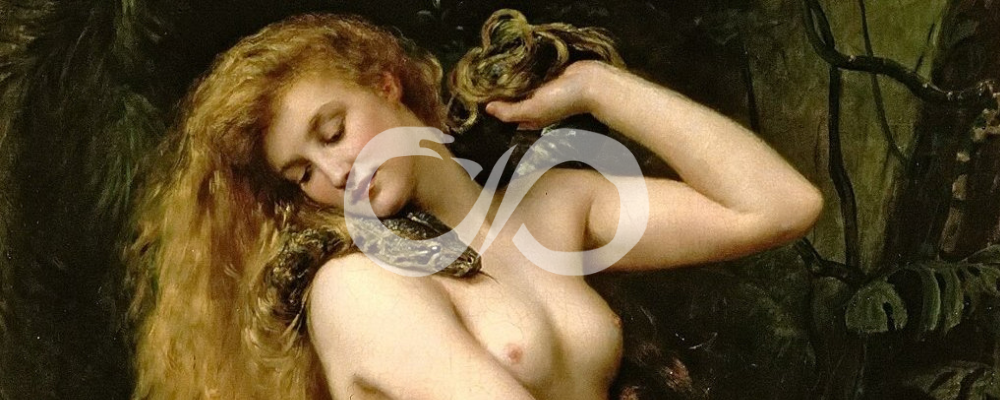
During the Romantic and Victorian eras, Lilith became a muse for many artists and poets. The poet Goethe mentions her in his Faust (1808) - "Lilith, Adam's first wife, beware of her beauty", Mephistopheles says - recalling her... fatal charm. Painters took up the theme: Dante Gabriel Rossetti painted "Lady Lilith" (1867), portraying her as an enchantress with long hair, a symbol of narcissistic seduction. His contemporary John Collier created a famous portrait of a nude Lilith winding around a tree in 1887, explicitly recalling her role as the temptress of Eden that clings to her. These works fixed the image of a sensual and dangerous Lilith in the collective imagination, the perfect embodiment of the femme fatale.
Lilith's name continued to appear in the 20th century in various contexts. In psychoanalysis and anthropology, authors such as Siegmund Hurwitz (in Lilith, the First Eve, 1980) and Raphael Patai (The Hebrew Goddess, 1967) explored Lilith as an archetype of the dark or repressed feminine. At the same time, the feminist movement of the 1970s rediscovered Lilith in a new light: no longer merely as a demon, but also as a symbol of the rebellious woman confronting patriarchy. The feminist Jewish magazine Lilith Magazine, founded in 1976, adopted its name in reference to this first woman who asserted her independence. Similarly, the music festival Lilith Fair (in the 1990s) celebrated female artists by invoking this figure of emancipation. Lilith thus went from being a monster to an icon for some activists, demonstrating the symbolic versatility of this character.
No, Lilith cannot be grasped at a single glance. She even eludes all definitions. She moves through eras, beliefs, and fears like a shadow that refuses to be silenced. People have tried to erase her, imprison her, and exorcise her. Yet she is still here. Intruder, demon, queen, killer, dominatrix. Or manipulated, hunted, wounded. And if her name endures, it may be because she has never stopped asking the same question: what becomes of a woman whom people refuse to hear?
Additional sources:

Par Olivier of Aeternum
Passionate about esoteric traditions and the history of the occult from the earliest civilizations to the 18th century, I share some articles on these topics. I am also co-creator of the online esoteric shop Aeternum.













