



















































































































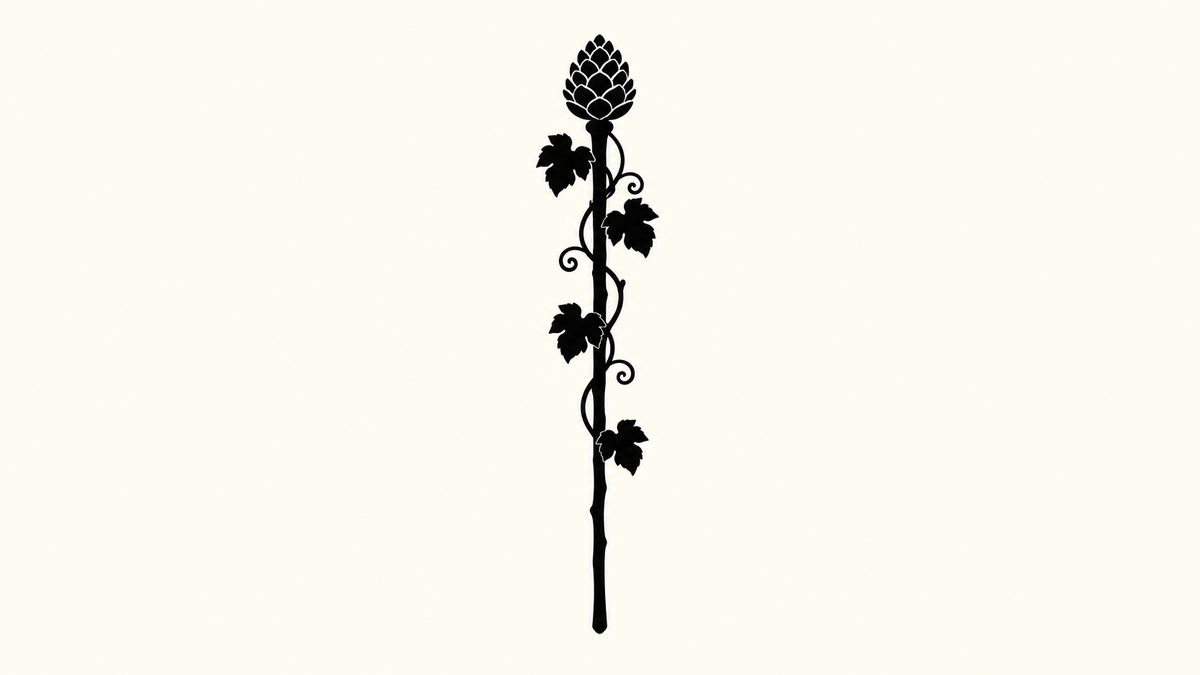
The thyrsus is the staff carried by Dionysus and the members of his procession. In Greek art, it takes the form of a long plant stalk, described as a fennel stalk, crowned with ivy, leaves, or a conical element resembling a pine cone. Maenads and satyrs carry it in scenes of dancing, celebration, and procession. The thyrsus is therefore enough to place an image in the Dionysian world.
| Form | Long plant stalk |
|---|---|
| Top | Ivy, leaves, berries, or a conical shape |
| Deity | Dionysus / Bacchus |
| Bearers | Dionysus, maenads, satyrs |
| Ideas | Dionysian procession, wine, vegetation, ritual ecstasy |
How can you recognize a thyrsus?
The Metropolitan Museum describes the thyrsus as a fennel stalk crowned with ivy.
In Roman and modern art, the top also takes the form of a pine cone surrounded by leaves.
The staff is recognizable by its length and vegetation, very different from a bare royal scepter.
Why does the god of wine carry a plant staff?
Dionysus belongs to the world of vines, wine, mountains, and flourishing vegetation.
A living staff covered in leaves suits a god whose procession bears ivy crowns and clusters of grapes.
The thyrsus therefore condenses several aspects of his power without being an agricultural tool.
What role does it play in his procession?
Maenads and satyrs carry the thyrsus while dancing and accompanying Dionysus.
A relief at the Met shows a moving maenad with a stalk covered in ivy and berries.
The attribute makes it possible to identify the figure even when the god does not appear directly.
What is its connection with ivy, grapes, and vegetation?
Ivy and vine structure the iconography of Dionysus. The thyrsus takes up this vegetation and concentrates it along a vertical axis.
The Met shows an 18th-century panel in which the thyrsus, vine, and grapes are brought together as direct references to Bacchus.
The plant is therefore not mere ornament: it defines the god's domain.
Why does the thyrsus become an emblem of the Dionysian?
By repeatedly appearing with Dionysus and his followers, the staff becomes a shorthand for his entire world.
It can evoke celebration, theater, wine, and religious ecstasy without depicting an entire narrative scene.
Like the caduceus for Hermes, the thyrsus is a divine attribute that became an autonomous symbol.
Sources and historical reference points
The Metropolitan Museum of Art depicts Dionysus carrying a thyrsus, a fennel stalk crowned with ivy. A relief of a maenad shows the same attribute in the Dionysian procession.










