



















































































































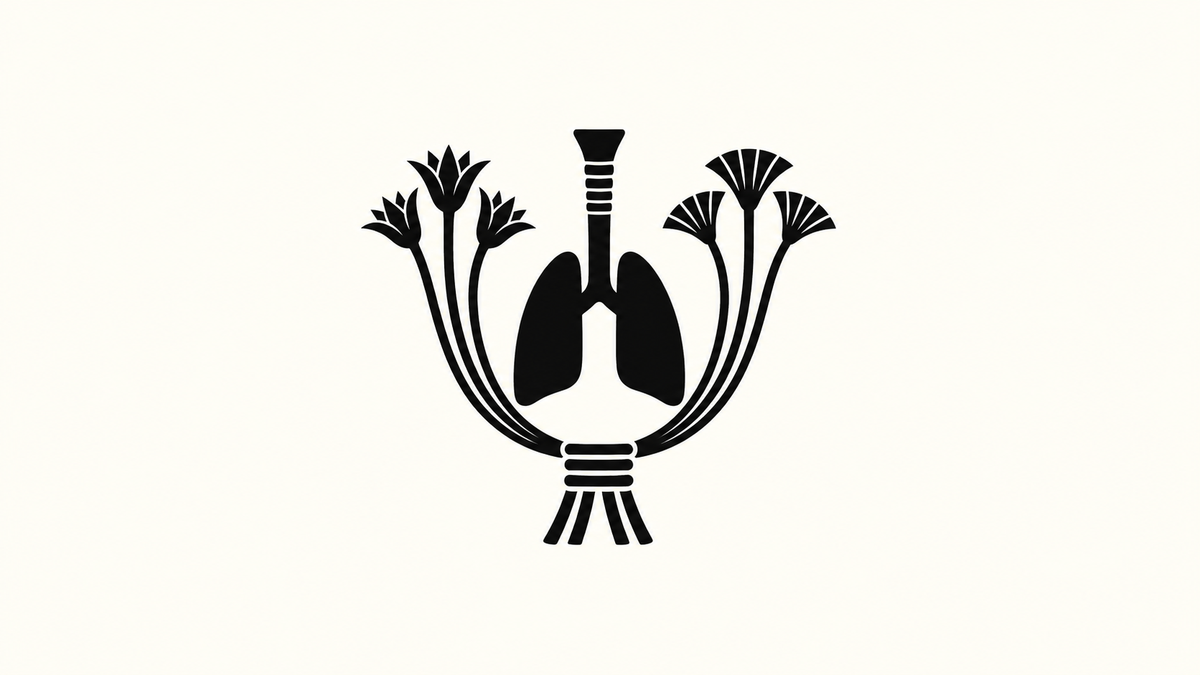
The Sema-Tawy is the emblem of the unification of Upper and Lower Egypt. The motif combines a central sign associated with union and two heraldic plants: the lotus for Upper Egypt and the papyrus for Lower Egypt. Divine figures may tie the plants around the sign, while the motif also appears in condensed form on scarabs and decorative objects.
| Name | Sema-Tawy, “union of the Two Lands” |
|---|---|
| Upper Egypt | Lotus |
| Lower Egypt | Papyrus |
| Function | Expressing the political and cosmic unity of the kingdom |
| Supports | Thrones, reliefs, scarabs, inlays |
What does Sema-Tawy mean?
The Metropolitan Museum translates the motif as “Unification of the Two Lands.”
It expresses the union of Upper and Lower Egypt in a single kingdom.
The symbol therefore belongs directly to the ideology of the pharaonic monarchy.
Why do the lotus and papyrus represent the Two Lands?
The lotus serves as the vegetal emblem of Upper Egypt and the papyrus of Lower Egypt.
The two plants are tied around the central sign, making the union visible in a single gesture.
The motif can be read as a sentence: the two distinct regions are linked and held together.
What is its connection to pharaonic sovereignty?
The pharaoh rules over the “Two Lands.” His power therefore depends on their unity.
The Sema-Tawy expresses this political function as much as a religious order of the country.
It complements the royal cobra, the crook and flail, and the crowns as emblems of sovereignty.
Why does the motif appear on royal seats?
Monumental statues show the Sema-Tawy on the sides of the throne.
The Met describes the motif carved on Amenhotep III’s seat, transforming royal furniture into a declaration of the kingdom’s unity.
The seated king is therefore literally supported by the image of a united Egypt.
How does the symbol span the centuries?
The Sema-Tawy appears as early as the ancient periods and continues in late Egyptian art.
The Met houses a glass inlay from the Ptolemaic or Roman period that still reproduces the same structure.
This exceptionally long continuity shows the strength of the idea of the Two Lands in Egyptian royal identity.
Sources and historical context
The Metropolitan Museum of Art describes the Sema-Tawy as a symbol of the unification of Egypt, with intertwined lotus and papyrus. A Middle Kingdom scarab shows the same emblem in a condensed form.










