
















































































































The Holy Crown of Hungary, frequently called the Crown of Saint Stephen, is much more than a coronation object. Composed of Byzantine and Western elements assembled in the Middle Ages, it became the essential insignia of the legitimacy of the king of Hungary. Over the centuries, a doctrine of the Holy Crown developed: the state and its rights were understood as attached to the Crown itself, above the individual sovereign.
| Name | Szent Korona / Holy Crown |
|---|---|
| Country | Hungary |
| Function | Coronation regalia and state symbol |
| Distinctive feature | Cross tilted at the top |
| Political history | Foundation of a constitutional doctrine unique to Hungary |
What does the Holy Crown look like?
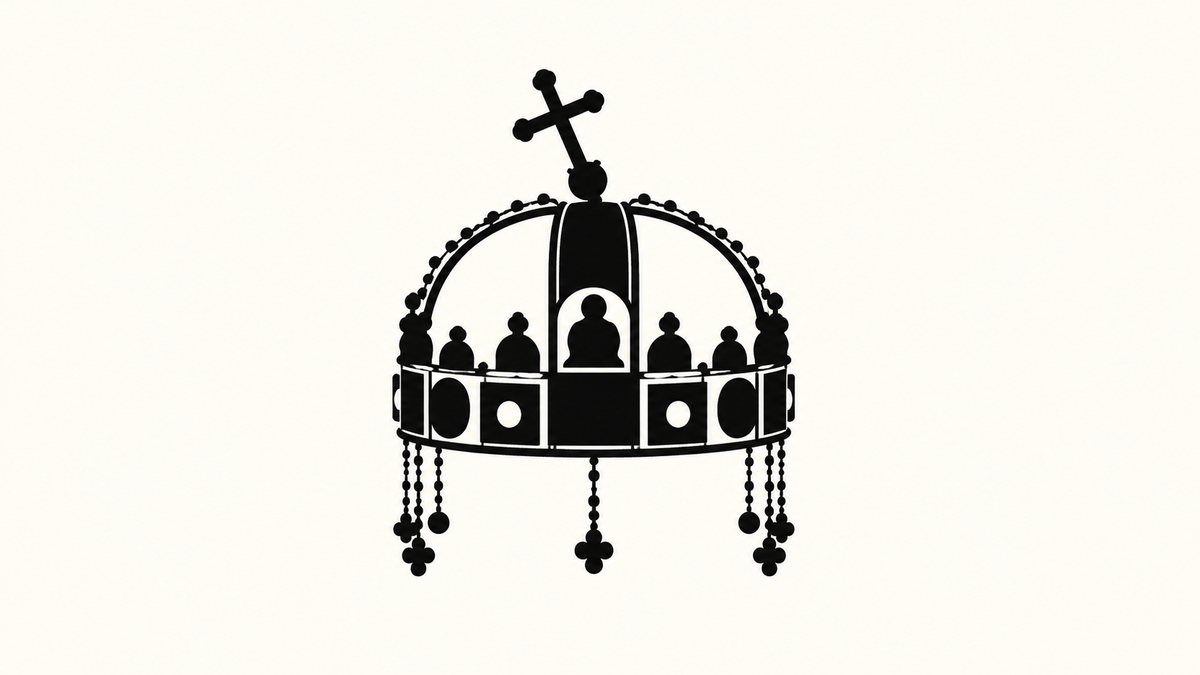
The crown has a band decorated with enamel, arches that cross at the top, and a small cross that is now tilted.
The images of Christ, saints, emperors, and kings place the object within a complex political and Christian program.
Did it really belong to the first king?
Tradition links it to Saint Stephen I, founder of the Christian Kingdom of Hungary.
Historical and technical studies nevertheless indicate that the current crown consists of elements dating from after his reign and assembled later.
The name “Crown of Saint Stephen” therefore expresses a political and sacred lineage more than a demonstrably proven material possession.
Why is the object indispensable to legitimacy?
In the Kingdom of Hungary, a ruler is fully legitimate only after a coronation performed with the Holy Crown according to the required forms.
This principle gave the object an authority that went beyond the person of the king.
The Hungarian National Museum shows how periods when the Crown was absent, hidden, or moved became major political crises.
What does the doctrine of the Holy Crown mean?
In the late Middle Ages and the modern era, Hungarian jurists developed the idea that the Crown embodied the political community and the continuity of the kingdom.
The National Museum recalls that in the 20th century it could even be conceived as a kind of symbolic head of a kingdom without a king.
Few European regalia acquired a comparable political personality.
Why was its return in 1978 a national event?
At the end of the Second World War, the Crown left Hungary and came under American custody.
It was returned to the country on January 6, 1978. The Hungarian National Museum presents this return as a major episode in the modern history of the symbol.
Now preserved in Budapest's Parliament, it remains a central symbol of Hungary's historical continuity.
Historical sources and key points
The Hungarian National Museum preserves historical depictions of the Holy Crown and documents its political role. Its article on its return to Hungary in 1978 explains its exceptional status in the country's constitutional tradition.










