


















































































































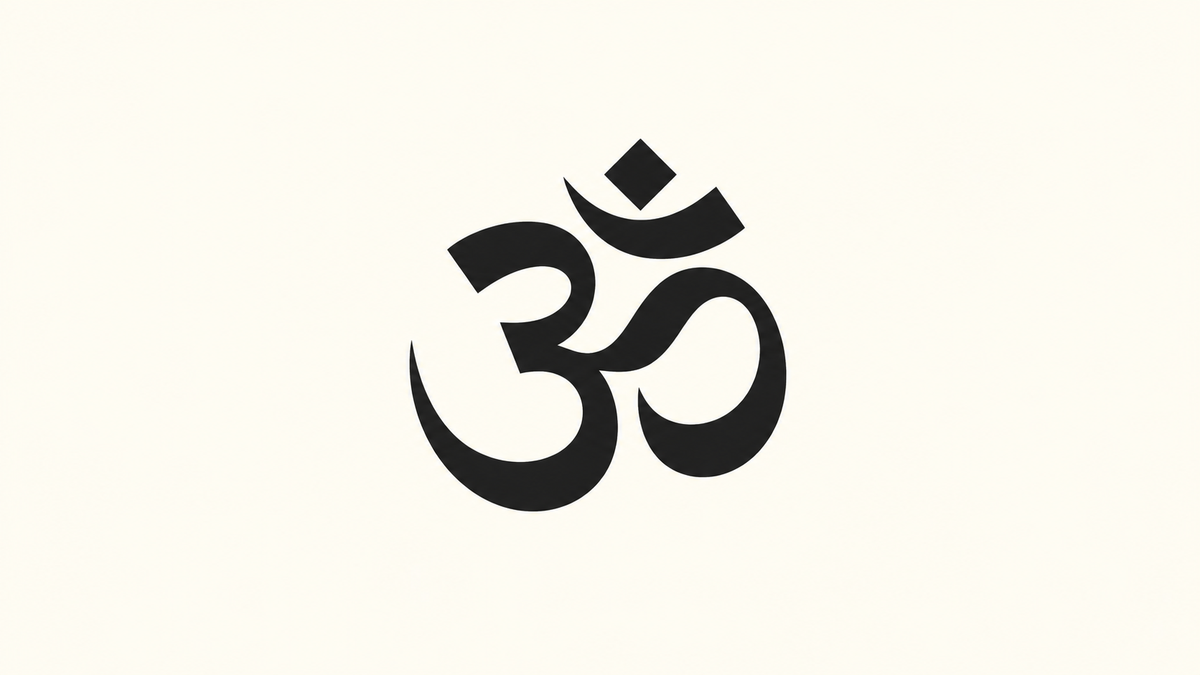
Om, also transcribed as Aum, is first and foremost a sacred syllable rather than a drawing. It holds a major place in Hinduism and also appears in Buddhist and Jain traditions. Indian texts associate it with totality, the ultimate principle, and the origin of manifestation. Pronounced at the beginning of prayers, recitations, and mantras, it also becomes an immediately recognizable written sign. Understanding Om therefore requires starting with the sound and its religious use before interpreting its calligraphy.
| Name | Om / Aum / Oṃ |
|---|---|
| Primordial nature | Sacred syllable and mantra |
| Traditions | Hinduism; also used in Buddhist and Jain traditions |
| Functions | Invocation, recitation, meditation, and designation of the ultimate principle according to the texts |
| Written sign | Writing forms vary according to Indian scripts |
Why is Om first and foremost a syllable?
The modern graphic symbol immediately catches the eye, but Om exists first as a ritual sound. It is pronounced, prolonged, and placed at the beginning or end of many recitations. The sonic dimension is therefore fundamental.
The Metropolitan Museum of Art describes Om as a sacred syllable and a primordial “seed,” a metaphor for the origin of all things. This wording summarizes an important part of its function in Hinduism.
The spelling “Aum” seeks to make several phonetic components of the sound visible. Depending on the analytical traditions, these elements may receive philosophical correspondences, but recitation is not reduced to spelling out three French letters.
What do the Upanishads say?
Several Upanishads give Om a central place. The Mandukya Upanishad builds a meditation on the syllable in relation to the states of consciousness and the Atman. Other texts use it as a support for contemplation of Brahman.
These sources explain why Om is regularly described as an expression of totality. This totality is not a modern slogan: it belongs to genuine Indian philosophical developments.
Nevertheless, all Hindu schools should not be reduced to a single system. The uses of Om vary according to the traditions, texts, and deities invoked.
How does sound become a written symbol?
Om can be written in several writing systems. The most internationally recognized form derives from the Devanagari script “ॐ”. Other Indian and Asian scripts have their own forms.
The visual sign has therefore not had a universal form since antiquity. It is the syllable that runs through the traditions; its representation depends on the language and script.
The Met preserves modern images of Krishna or Ganesha appearing within the Om sign. These works show how the written syllable can itself become an iconographic space in devotional art.
How is Om used in recitation?
Om opens prayers, accompanies mantras, and serves as a meditation aid. Its pronunciation marks an entry into ritual space and can frame a sacred text.
The sign therefore does not act only when it is looked at. Its role is inseparable from voice, breath, and repetition. A poster bearing ॐ does not serve the same function as a recitation integrated into a rite.
The Sri Yantra offers a useful parallel: one works primarily through sound and mantra, the other through diagram and visualization, although the two can meet in Tantric or devotional contexts.
What is lost when it is reduced to a spiritual logo?
Om has become a global motif associated with yoga, meditation, and well-being. This spread makes the form familiar, but it can obscure its religious and philosophical status.
The sign does not simply mean “peace” or “positive energy.” These contemporary translations capture a general impression without conveying the richness of the texts that associate it with the ultimate principle, totality, and consciousness.
A serious reading therefore respects two levels: the sacred syllable within Indian traditions and its international reuse as a symbol of spirituality. Both exist, but they are not identical.
Historical sources and reference points
The Metropolitan Museum of Art describes Om as a primordial sacred syllable and a metaphor for the origin of all things in a devotional image of Krishna. Another example, Sri Ganesh in Om, shows the integration of the sign into modern Hindu imagery. The Upanishads, particularly the Mandukya Upanishad, provide the fundamental textual source for philosophical interpretations of the syllable.










