



















































































































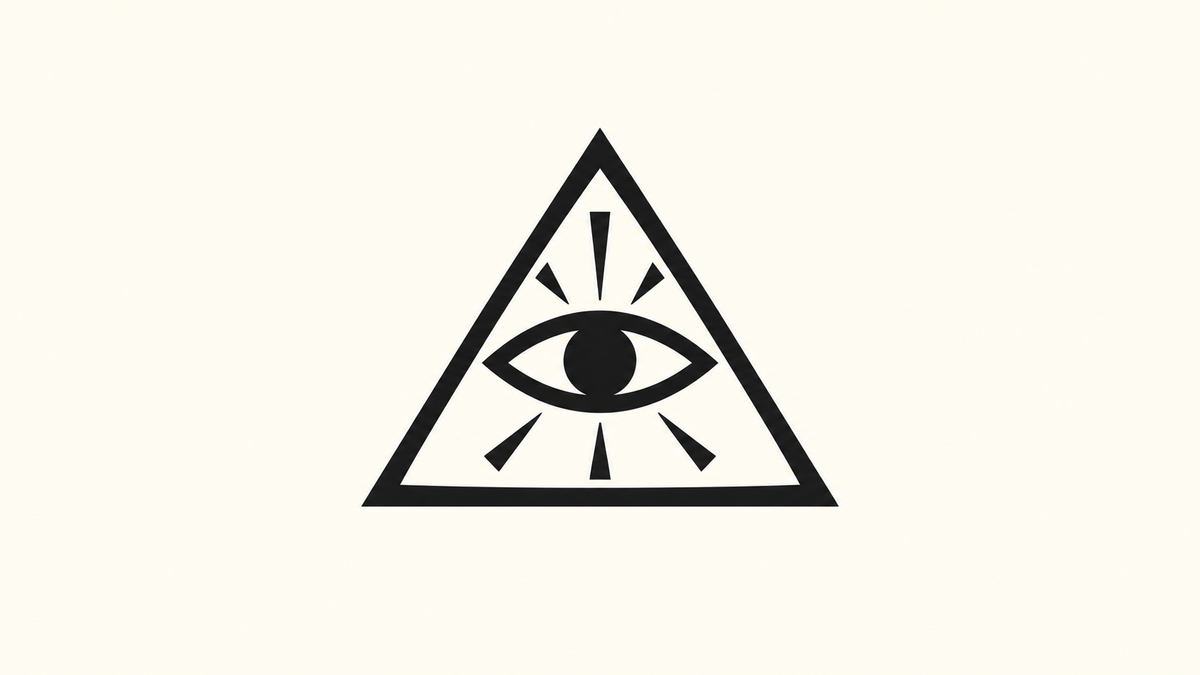
The Eye of Providence is an eye surrounded by rays or clouds, frequently inscribed in a triangle. Today it is associated with the United States, Freemasonry, or conspiracy narratives, but its visual history first runs through European Christian iconography. The triangle refers to the Trinity and the eye to the divine presence that sees and watches over all. The motif then enters political emblems, including the reverse of the Great Seal of the United States adopted in 1782. Linking it directly to the Eye of Horus erases two distinct histories.
| Form | Eye inscribed in a triangle, frequently surrounded by rays |
|---|---|
| Major context | Christian iconography of Providence and the Trinity |
| Political reference | Reverse of the Great Seal of the United States, adopted in 1782 |
| Meaning | Divine presence, vigilance, and providence |
| To distinguish | Eye of Horus / wedjat, Egyptian symbol of restoration and protection |
Why does the eye appear inside a triangle?
The triangle has a clear Trinitarian significance in Christian art. Three equal sides provide a geometric image of three persons united in a single divinity. The eye placed inside then becomes the eye of God within the sign of the Trinity.
The Metropolitan Museum of Art preserves an eighteenth-century crucifix drawing in which a triangle containing an “all-seeing eye” is explicitly identified as a symbol of the Holy Trinity. This work shows that the association was well established in European religious art before the modern dissemination of the American political motif.
The halo of light around the eye reinforces its divine dimension. It can evoke glory, heavenly light, and presence, without being a mandatory part of every version.
What does the divine gaze really mean?
The word “Providence” refers to divine action and care in governing the world. The eye expresses God's ability to see human actions and watch over creation.
This meaning should not be reduced to an unsettling idea of surveillance. In Christian iconography, the gaze can refer as much to protection, omniscience, and presence as to judgment.
The motif thus joins a long history of the eye as a sign of divine presence, but it belongs to a specific theological framework. A resemblance to other protective eyes is not enough to establish a direct lineage.
How does it enter the Great Seal?
The reverse of the Great Seal of the United States places an unfinished pyramid beneath an Eye of Providence. The U.S. National Archives indicate that the final design was adopted by the Continental Congress in 1782 after several successive proposals.
The eye is accompanied by the Latin motto Annuit Coeptis, interpreted in official explanations as the idea that God has favored the American enterprise. The motif therefore explicitly retains a language of Providence.
The pyramid and the eye became known worldwide because they appear on the one-dollar bill. This widespread circulation helped detach the symbol from its earlier Christian context and associate it with new narratives.
What does it have to do with Freemasonry and the Illuminati?
Freemasonry also used the radiant eye as a symbol of a higher presence and moral vigilance. This does not mean that every representation of the Eye of Providence is Masonic, nor that Freemasonry invented the motif.
The association with the “Illuminati” belongs primarily to modern popular culture. The historical Order of the Bavarian Illuminati did not create the triangular eye of the Great Seal of the United States, and the adoption of the seal reflects an institutional history preserved in the Congressional archives.
A symbol can be adopted by several groups. The mistake is to take a particular use as the origin of the entire figure.
Why isn’t it the Eye of Horus?
The Eye of Horus, or udjat, belongs to ancient Egypt and the story of an injured eye that was later restored. Its form combines a human eye with falcon markings, and its protective function is linked to Horus.
The Eye of Providence belongs to a much later European Christian iconography. Its triangle refers to the Trinity and its eye to divine Providence. The two motifs share neither the exact same form, nor the same context, nor the same origin story.
Their contemporary association stems from the fact that both represent an eye imbued with religious significance. This resemblance is enough to inspire comparisons, but not to establish historical continuity.
Sources and historical context
The Metropolitan Museum of Art holds an eighteenth-century design for a crucifix in which the triangle is identified with the Trinity and the eye with the divine gaze. For the 1782 Great Seal of the United States and its Eye of Providence, see the National Archives.










