



















































































































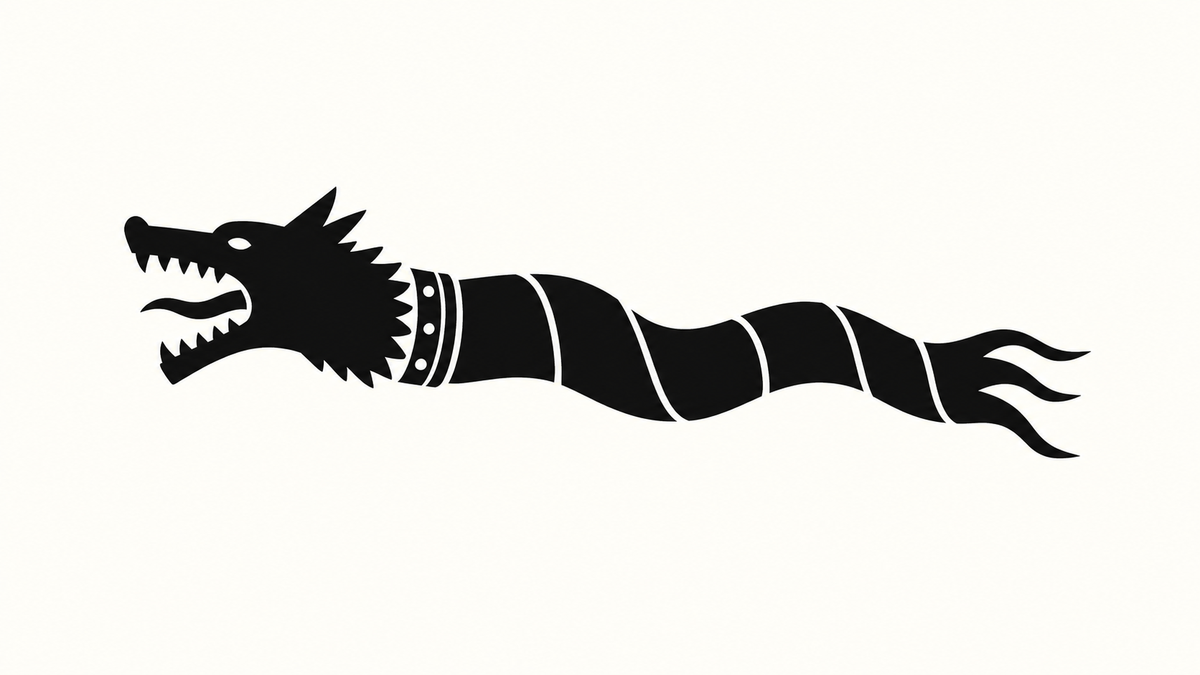
The Dacian Draco is a military standard featuring a creature’s head, frequently interpreted as a dragon or a wolf, extended by a flexible tubular body. The reliefs on Trajan’s Column show Dacians carrying this emblem during the wars against Rome. The motif survived the conquest: the Roman army in turn adopted draco-type standards, demonstrating the strength of this visual tradition.
| Type | Military standard |
|---|---|
| People | Dacians |
| Form | Animal head and tubular body |
| Visual source | Trajan’s Column |
| Legacy | Adoption in the late Roman army |
How can the Draco be recognized?
The emblem has a rigid head with an open mouth attached to the top of a pole. Behind it extends a fabric sleeve that billows in the wind.
The silhouette therefore combines sculpture and a mobile banner.
Where is it seen in the sources?
The National Museum of Romanian History points out that Trajan’s Column clearly depicts Dacian warriors carrying the Draco during the wars of the early 2nd century.
The Roman monument thus became a major source for understanding the standard’s appearance.
Dragon, wolf, or composite creature?
The head has been likened to a wolf, a dragon, a serpent, or a hybrid creature. Modern descriptions vary depending on the reconstructions.
The Romanian museum refers to a “winged dragon” in the decoration of certain Dacian objects, while also connecting this repertoire with the military draco.
Why did the Romans adopt it?
After the conquest of Dacia, draco-type standards entered the Roman army, particularly the cavalry. The motif then embarked on an imperial career beyond its Dacian context.
This transmission shows that the symbol did not disappear with Dacia’s political defeat.
Why does it become a heritage symbol?
In contemporary Romania, the Draco recalls Dacian heritage and appears in museums, reenactments, and heritage discourse.
It should nevertheless be placed in its ancient context rather than turned into an ageless national symbol.
Historical sources and reference points
The National Museum of Romanian History presents the Draco as the Dacians’ standard depicted on Trajan’s Column. A museum exhibition also connects the dragons on Dacian royal objects with the draco tradition.










