



















































































































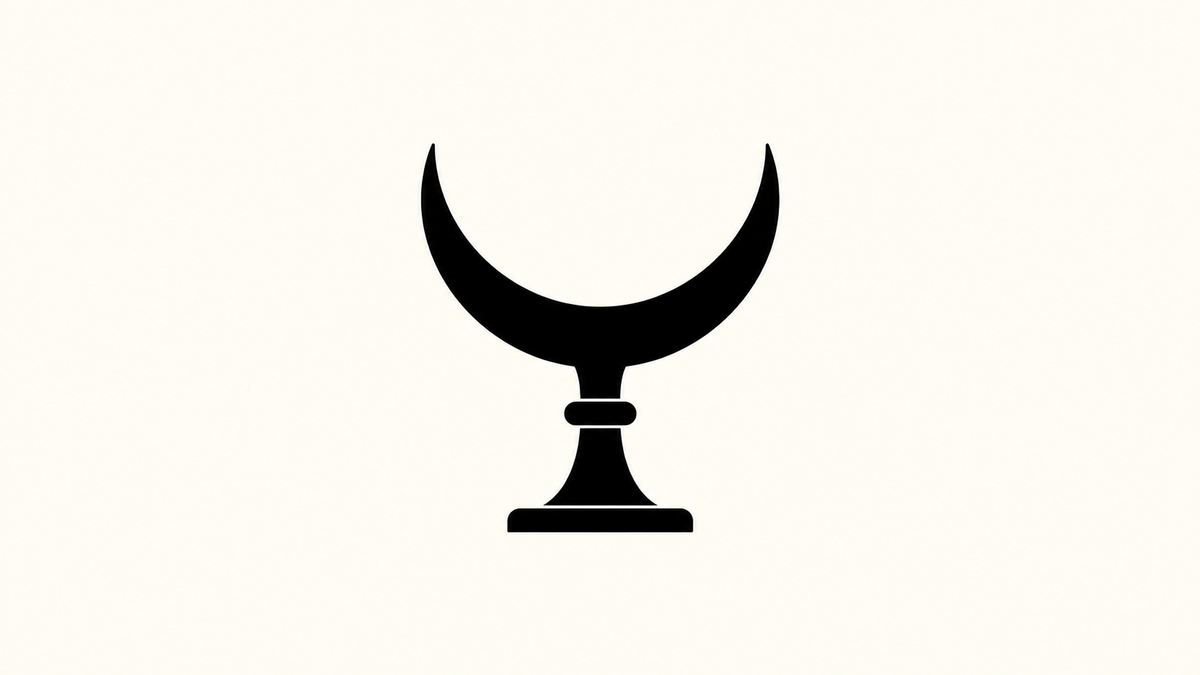
The crescent is the emblem of Sîn, the moon god of Mesopotamia. It appears on stelae, seals, and royal objects among the signs of the great deities. The form directly reflects the appearance of the lunar crescent visible in the sky. Sîn holds a major place in several cult centers, including Ur and Harran, and his emblem may be shown alongside Shamash's disk and Ishtar's star.
| Form | Lunar crescent |
|---|---|
| Deity | Sîn / Nanna |
| Cult centers | Ur and Harran |
| Functions | Moon, calendar, cycle, divination |
| Context | Royal stelae and divine emblems |
How can Sîn's crescent be recognized?
The symbol reproduces a phase of the Moon, sometimes inside a disk or placed on a support.
The British Museum explicitly identifies the crescent with the god Sîn on several Neo-Assyrian stelae.
Who is Sîn in the Mesopotamian pantheon?
Sîn, called Nanna in Sumerian traditions, is the Mesopotamian moon god.
The Metropolitan Museum highlights his place in the Babylonian divine hierarchy, where his sacred number is 30, a value linked to the lunar cycle.
His cult has major centers at Ur and then Harran.
Why does the Moon have such strong calendrical significance?
The lunar cycle structures the months and the measurement of time in Mesopotamian calendars.
The crescent therefore becomes more than a nocturnal image: it makes visible a celestial body used to organize ritual and administrative time.
How does the symbol function on royal monuments?
Stelae place Sîn's crescent above the king alongside the emblems of the other gods.
The sign acts as a condensed divine presence and recalls that royal power exists under the authority of the pantheon.
On a British Museum stele, the crescent even dominates the series of emblems in size.
How does it differ from the modern Islamic crescent?
The crescent and star associated today with several Muslim states have a much more recent political history.
Sîn's crescent belongs to the religion of ancient Mesopotamia.
The formal resemblance comes from observing the same celestial body, not from direct religious continuity.
Sources and historical reference points
The British Museum presents the crescent and disk as emblems of Sîn on the Kurkh Stele. Another Babylonian stele associates the crescent with Shamash and Ishtar.










