






























































































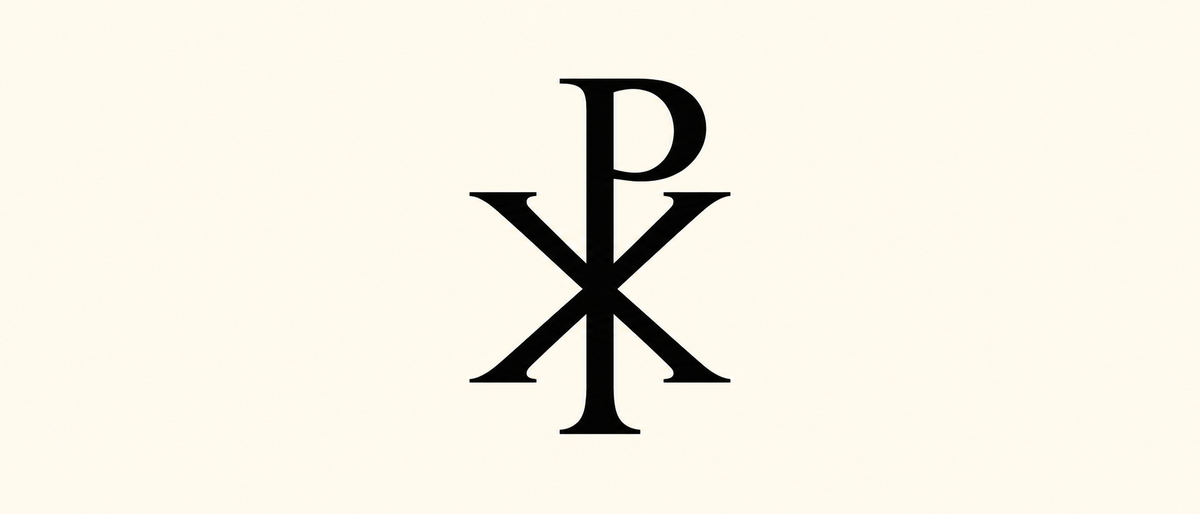
The Chi-Rho, also called a christogram, is a monogram formed by the Greek letters chi (Χ) and rho (Ρ), the first two letters of the word Christos. It became one of the most important signs of Late Antique Christianity, particularly after its adoption in 4th-century imperial iconography. The symbol may appear alone, inscribed within a wreath, placed on standards, coins, sarcophagi, or liturgical objects. It is frequently accompanied by Alpha and Omega.
| Name | Chi-Rho / christogram / Christogram |
|---|---|
| Construction | Superimposition of Χ (chi) and Ρ (rho) |
| Source word | Christos, “Christ” in Greek |
| Major spread | Christian Roman Empire from the 4th century onward |
| Associations | Crosses, Alpha and Omega, crowns, and standards |
How is the monogram constructed?
The christogram combines the Greek chi, which resembles an X, and rho, which resembles a Latin P. The vertical stroke of the rho overlaps the center of the chi, creating a compact sign.
This construction makes it possible to write Christ’s name in abbreviated form. Early Christians used several christograms, and the Chi-Rho is not the only possible monogram.
Its interpretation therefore requires recognizing the Greek letters rather than seeing it as a distorted cross. Some works deliberately play on the proximity between monogram and cross, reinforcing its visual power.
Why does it become an imperial symbol?
In the 4th century, the Chi-Rho became closely associated with Emperor Constantine and the gradual Christianization of the Roman Empire. Accounts concerning the imperial labarum and Constantine’s vision helped turn the sign into an emblem of Christian victory.
Imperial coins from the following decades show the monogram’s spread into political language. The Metropolitan Museum notably holds solidi of Valentinian I on which the Chi-Rho appears on the imperial standard.
The symbol thus connects two realms: the name of Christ and imperial power, which now presents itself as Christian. This dual function explains its extraordinary spread in Late Antiquity.
Where does it appear in early Christianity?
The Chi-Rho is found on sarcophagi, mosaics, fibulae, coins, architectural reliefs, and personal objects. It may serve as an autonomous emblem or be integrated into a larger composition.
The Metropolitan Museum preserves a fragment of a Byzantine lintel from the 5th-6th centuries where the monogram combines with a cross. The object shows that the boundaries between cross and Christogram can be deliberately blurred.
This presence on highly varied objects makes the Chi-Rho one of the most widespread signs of early Christianity, long before contemporary decorative uses.
Why do these letters accompany it?
The Alpha and Omega, the first and last letters of the Greek alphabet, frequently frame the Chi-Rho. They refer to the formula in Revelation where God presents himself as the beginning and the end.
The Met preserves a late Roman fibula where the Chi-Rho is associated with Alpha and Omega, showing the combination of these signs within the same Christian program.
The monogram identifies Christ; Alpha and Omega develop a theology of his totality and eternity. Their association is therefore as textual as it is graphic.
What does the chrism still mean today?
The Chi-Rho remains in use in churches, on liturgical ornaments, and in Christian art. It is particularly valued as a historical symbol of the first centuries of Christianity.
Its antiquity also gives it heritage value. A person may recognize the sign on a mosaic or sarcophagus without immediately knowing the two Greek letters that compose it.
A rigorous reading avoids attributing to it an esoteric origin independent of Christianity. The Chi-Rho is a Christogram: its history begins with the Greek abbreviation of Christ's name and its spread through the Christian culture of the Roman Empire.
Sources and historical landmarks
The Metropolitan Museum of Art describes the Chi-Rho as the first letters of Christ's name in Greek on a late Roman fibula. The museum also preserves a Byzantine lintel where the sign functions both as a cross and a Christogram.