



















































































































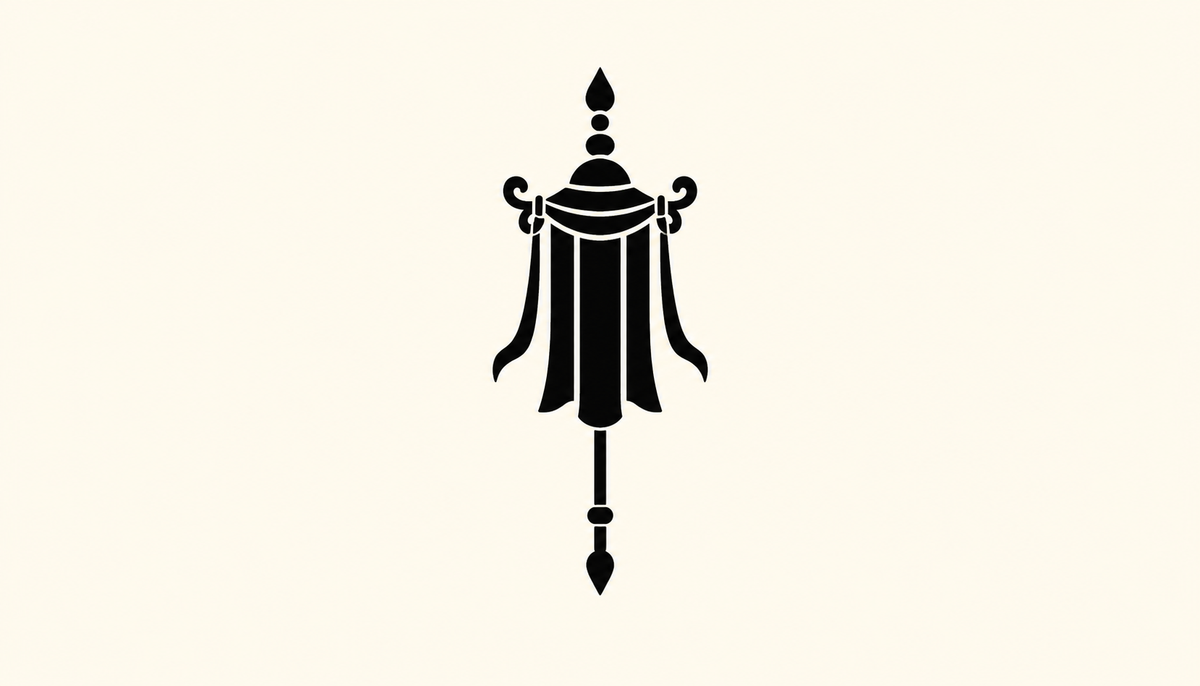
The victory banner is one of the eight auspicious symbols of Tibetan Buddhism. It draws on an ancient military emblem - the banner that announces a victory - and transforms this language into a spiritual image. The triumph is no longer that of one army over another, but that of the Dharma over ignorance, obstacles, and the forces that prevent awakening.
| Name | Victory banner / bannière de victoire |
|---|---|
| Set | Eight auspicious symbols |
| Symbolic origin | Emblem of victory transformed into a religious symbol |
| Concept | Triumph of the Dharma over obstacles |
| Materials | Textiles, metal, architecture, decorative objects |
Why does a military banner appear in Buddhism?
In ancient India, a banner could signal the victory of a sovereign or an army.
Buddhism adopts this vocabulary of triumph without retaining military combat as its purpose.
The symbol becomes an image of an inner and doctrinal victory.
What does the triumph really concern?
The banner expresses the victory of the teachings over ignorance, disturbances, and whatever leads one away from awakening.
The language of combat becomes a metaphor: to conquer means to overcome the obstacles that keep one in error.
This interpretation is related to the Vajra, which is also associated with a power capable of shattering ignorance, but through a different image.
How to recognize the emblem?
The banner may appear as a cylinder or a vertical standard adorned with fabrics and fringe.
In representations of the eight signs, it takes on a compact form suited to decorative series.
Its silhouette varies more than that of the wheel or lotus, making context particularly useful for identifying it.
What is its connection with the other signs?
The Met lists the banner alongside the knot, lotus, parasol, conch, wheel, vase, and fish.
Together, these emblems form a vocabulary of protection, teaching, good fortune, and accomplishment.
The banner conveys the dimension of triumph: the path has overcome what hindered it.
Why do we see banners on temples?
Temples and monasteries may use actual banners or architectural forms inspired by them.
The motif thus becomes visible in space, and not only in a painting.
This material presence recalls the emblem's origin: a banner is made to be seen from afar and publicly announce a victory.
Historical sources and reference points
The Metropolitan Museum of Art lists the victory banner among the eight auspicious symbols on a Tibetan or Mongolian quiver. Its study of sacred Tibetan decoration confirms the motif's place in this vocabulary.










