



















































































































The 72 spirits of the Ars Goetia do not form a perfectly fixed list. Names, spellings, certain ranks, and even some details of their functions vary from one manuscript to another. The list that has become most familiar today owes much to the manuscripts of the Lemegeton, followed by S. L. MacGregor Mathers’s edition, published by Aleister Crowley in 1904.
The catalogue below is based on the catalogue of the British Library manuscript Sloane MS 3825, transcribed and compared by Joseph H. Peterson. When Mathers-Crowley or other manuscripts offer a different spelling, we mention it only when it genuinely helps clarify modern variants.
The descriptions below are not recommendations for practice. They summarize the offices attributed to the spirits by the historical text: arts, sciences, treasures, war, love, diseases, invisibility, divination, travel, or relations with the dead. Above all, they show the astonishing variety of the catalogue.
Kings, dukes, presidents, and counts do not form a simple ranking of power
The Ars Goetia uses hierarchical vocabulary borrowed from the nobility and government: king, duke, prince, marquis, count, president, and knight. Yet it would be reductive to read these titles as levels in a game where “king” always means more powerful than “duke,” and so on.
Several spirits possess two titles at once. Botis is President and Count; Morax is Count and President; Ipos is Count and Prince; Gaap is President and Prince; Ronove is Marquis and Count; Vine is King and Count; Murmur is Duke and Count; Zagan is King and President. This fact alone is enough to show that the system is not a perfectly ordered pyramid.
The Mathers-Crowley edition classifies the spirits by rank and even associates each category with a planetary metal. This presentation has become famous, but it already represents editorial work on the manuscripts. Peterson’s transcription makes the divergences between Sloane 3825, Sloane 3648, Harley 6483, Weyer, Scot, and other witnesses clearer.
To understand the text’s general history before looking at the list, see How Goetia Became the Art of the 72 Spirits.
Why can the same spirit bear several names?
Manuscript magic is an excellent field for observing how names change. A copyist misreads a letter, a translator misunderstands a Latin word, an edition prints a variant, and that variant in turn becomes the familiar form.
The case of Morax / Marax is typical. Sloane 3825 gives Morax, while Mathers follows another witness with Marax. Gamigin frequently becomes Samigina. Eligor also circulates as Eligos. Vual became Uvall or Vual depending on the edition. Procel is better known today as Crocell. Cimeies appears as Cimeries, Kimaris, or closely related variants.
Joseph H. Peterson published a comparative table of spelling variants among Weyer, Scot, several manuscripts of the Lemegeton, Mathers-Crowley, and other editions. This document shows how misleading the search for an “authentic secret spelling” can be.
The 72 Spirits of the Ars Goetia
The table follows the order of the Sloane MS 3825. The attributes are deliberately summarized: the complete text gives each spirit an appearance, an office, a number of legions, and a seal, with many variations among the witnesses.
| No. | Seal | Spirit | Rank in Sloane 3825 | Summarized attributes |
| 1 |  |
Bael | King | Invisible in the text; 66 legions. |
| 2 |  |
Agares | Duke | Brings back fugitives, teaches languages, lowers dignities, and causes earthquakes. |
| 3 |  |
Vassago | Prince | Reveals the past and future and helps recover hidden or lost things. |
| 4 |  |
Gamigin (Samigina) | Marquis | Teaches the liberal sciences and answers questions about the souls of the dead. |
| 5 |  |
Marbas | President | Reveals hidden things, causes or cures diseases, and teaches the mechanical arts. |
| 6 |  |
Valefor | Duke | Presented as a good familiar, but he drives those who associate with him to theft. |
| 7 |  |
Amon | Marquis | Speaks of the past and future and reconciles friends and adversaries alike. |
| 8 |  |
Barbatos | Duke | Makes animal voices understandable, reveals treasures, and reconciles the powerful. |
| 9 |  |
Paimon | King | Teaches arts, sciences, and secrets, grants dignities, and provides familiars. |
| 10 |  |
Buer | President | Teaches philosophy, logic, and the virtues of plants; he is also associated with healing. |
| 11 |  |
Gusion | Duke | Answers questions about the past, present, and future, interprets questions, and reconciles relationships. |
| 12 |  |
Sitri | Prince | Stirs desire and attraction between men and women. |
| 13 |  |
Beleth | King | Associated with obtaining love and affection. |
| 14 |  |
Leraje | Marquis | Causes battles, quarrels, and wounds from projectile weapons. |
| 15 |  |
Eligos | Duke | Reveals hidden things, foretells wars, and obtains the favor of the great. |
| 16 |  |
Zepar | Duke | Brings men and women together in love and is also associated with infertility. |
| 17 |  |
Botis | President & Count | Speaks of the past and future and reconciles friends and enemies. |
| 18 |  |
Bathin | Duke | Knows the virtues of plants and stones and transports people quickly from one country to another. |
| 19 |  |
Sallos | Duke | Fosters mutual love between men and women. |
| 20 |  |
Purson | King | Reveals treasures and secrets, speaks of the past, present, and future, and provides familiars. |
| 21 |  |
Morax (Marax) | Count & President | Teaches astronomy and the liberal arts and knows the virtues of plants and stones. |
| 22 |  |
Ipos | Count & Prince | Knows the past and future and makes the mind lively, bold, and courageous. |
| 23 |  |
Aim | Duke | Symbolically sets strongholds on fire, gives wit, and answers questions about secret matters. |
| 24 |  |
Naberius | Marquis | Teaches arts and sciences, especially rhetoric, and restores honors and dignities. |
| 25 |  |
Glasya-Labolas | President | Teaches the arts, speaks of the past and future, grants invisibility, and is associated with violence. |
| 26 |  |
Bune | Duke | Moves the dead in the account, grants wealth, wisdom, eloquence, and answers to questions. |
| 27 |  |
Ronove | Marquis & Count | Teaches rhetoric and languages, provides good servants, and grants the favor of others. |
| 28 |  |
Berith | Duke | Answers questions about the past, present, and future, transmutes metals into gold, and grants dignities; the text calls him deceptive. |
| 29 |  |
Astaroth | Duke | Reveals secrets, the past, present, and future, teaches sciences, and recounts the fall of the spirits. |
| 30 |  |
Forneus | Marquis | Teaches rhetoric and languages and grants reputation, as well as the favor of friends and enemies. |
| 31 |  |
Foras | President | Teaches logic, ethics, and the virtues of plants and stones; finds treasures and lost things. |
| 32 |  |
Asmoday | King | Teaches arithmetic, geometry, astronomy, and crafts; reveals treasures and answers questions. |
| 33 |  |
Gaap | President & Prince | Teaches philosophy and sciences, causes love or hatred, and transports people or things quickly. |
| 34 |  |
Furfur | Count | Fosters love, causes thunder, lightning, and storms, and answers questions about secret matters. |
| 35 |  |
Marchosias | Marquis | Presented as a faithful fighter who gives truthful answers. |
| 36 |  |
Stolas | Prince | Teaches astronomy and the virtues of plants and stones. |
| 37 |  |
Phenex | Marquis | Teaches the sciences and poetry and appears in the form of a phoenix. |
| 38 |  |
Halphas | Count | Builds cities or fortifications, arms them, and sends men of war there. |
| 39 |  |
Malphas | President | Builds houses and towers, gathers craftsmen, thwarts opposing plans, and gives familiars. |
| 40 |  |
Raum | Count | Steals treasures, destroys cities and dignities, speaks of the past and future, and reconciles. |
| 41 |  |
Focalor | Duke | Associated with winds, the sea, shipwrecks, and drowning. |
| 42 |  |
Vepar | Duke | Governs waters and ships, raises the sea, and is associated with wounds that become infected. |
| 43 |  |
Sabnock | Marquis | Builds fortifications and cities, afflicts with plagues, and gives familiars. |
| 44 |  |
Shax | Marquis | Removes meaning and understanding from text, steals possessions, reveals certain hidden things, and gives familiars. |
| 45 |  |
Vine | King & Count | Discovers hidden things and witches, speaks of the past and future, and acts upon towers, walls, and storms. |
| 46 |  |
Bifrons | Count | Teaches astrology, geometry, and natural properties and appears in accounts concerning the dead and tombs. |
| 47 |  |
Vual (Uvall) | Duke | Procures love and friendship and speaks of the past, present, and future. |
| 48 |  |
Haagenti | President | Makes one wise, transmutes metals, and symbolically transforms wine and water. |
| 49 |  |
Crocell (Procel) | Duke | Teaches geometry and the liberal sciences and produces sound-related or water-related phenomena. |
| 50 |  |
Furcas | Knight | Teaches philosophy, astronomy, rhetoric, logic, palmistry, and pyromancy. |
| 51 |  |
Balam | King | Answers questions about the past, present, and future and makes one invisible and spiritual or subtle, according to the readings. |
| 52 |  |
Alloces | Duke | Teaches astronomy and the liberal sciences and gives good familiars. |
| 53 |  |
Caim | President | Makes the voices of animals and waters understandable and answers questions about the future. |
| 54 |  |
Murmur | Duke & Count | Teaches philosophy and compels the souls of the dead to answer questions. |
| 55 |  |
Orobas | Prince | Speaks of the past, present, and future, grants dignities and favors, and answers questions about divinity and creation. |
| 56 |  |
Gremory | Duke | Reveals the past, present, future, and hidden treasures, and procures the love of women. |
| 57 |  |
Ose | President | Teaches the sciences, answers questions about secret things, and describes transformations or illusions of form. |
| 58 |  |
Amy | President | Teaches astrology and the sciences, gives familiars, and reveals treasures guarded by spirits. |
| 59 |  |
Orias | Marquis | Teaches the virtues of the stars and planetary abodes and grants dignities and favors. |
| 60 |  |
Vapula | Duke | Teaches crafts, mechanics, philosophy, and sciences. |
| 61 |  |
Zagan | King & President | Makes people clever, symbolically transforms liquids and metals, and turns wise people into fools or vice versa, depending on the versions. |
| 62 |  |
Valac | President | Reveals hidden treasures and indicates where snakes are found. |
| 63 |  |
Andras | Marquis | Sows discord and is presented as particularly dangerous to the operator. |
| 64 |  |
Flauros | Duke | Speaks of the past, present, and future, discusses theology and the fall of the spirits, and acts against enemies. |
| 65 |  |
Andrealphus | Marquis | Teaches geometry, measurement, and astronomy, and describes a transformation into a bird. |
| 66 |  |
Cimeies (Cimeries) | Marquis | Teaches grammar, rhetoric, and logic, finds treasures and lost objects, and gives a warlike appearance. |
| 67 |  |
Amdusias | Duke | Produces invisible music, bends trees, and provides familiars. |
| 68 |  |
Belial | King | Grants offices and dignities, the favor of friends and enemies, and familiars; the text emphasizes his deceitfulness. |
| 69 |  |
Decarabia | Marquis | Reveals the virtues of plants and stones and produces the appearance of birds. |
| 70 |  |
Seere | Prince | Travels with extreme speed, transports things, and provides information about thefts and treasures. |
| 71 |  |
Dantalion | Duke | Teaches arts and sciences, reveals secret thoughts and counsels, influences love, and shows people in visions. |
| 72 |  |
Andromalius | Count | Finds thieves and stolen goods, reveals hidden affairs and treasures, and punishes people described as dishonest. |
Are the seals as old as the names?
No. This is one of the most interesting points in the history of the text. Johann Weyer’s catalogue, which provides most of the names and offices later adopted by the Ars Goetia, does not include the individual seals that have now become inseparable from the 72 spirits.
Joseph H. Peterson notes that he does not know these sigils from the older manuscripts of the Offices of Spirits that predate the Lemegeton. Their presence therefore belongs to a later stage in the transmission. The drawings themselves may vary from one manuscript to another.
The seals in the table above reproduce forms already used on Aeternum and similar to those popularized by modern editions. They should be regarded as witnesses to a graphic tradition, not as immutable signatures dating directly back to Solomon.
This distinction corresponds to the one we make in our article on sigil magic: a seal transmitted by a grimoire does not have the same history as a sigil created from an intention according to a contemporary method.
Most of the spirits were already present in Johann Weyer’s work
The catalog of the Ars Goetia did not suddenly appear with the Lemegeton. Many of the names and descriptions are found in Johann Weyer’s Pseudomonarchia Daemonum from the 16th century.
Weyer nevertheless provides a list of 69 spirits, even though his text refers to the number 72. Reginald Scot then translates a large part of this material into English in The Discoverie of Witchcraft in 1584. Linguistic comparison shows that the compiler of the Lemegeton depended heavily on this transmission.
Some translation errors even become visible. In the case of Focalor, for example, a Latin number meaning thirty was read as three in one branch of the tradition. For Stolas, a Latin expression referring to a nocturnal bird eventually produced divergent descriptions in later copies.
This kind of detail explains why we avoided adding the number of legions as though it were perfectly stable data for all 72 entries. The variants are precisely one of the most interesting aspects of the material.
Vassago, Seere, Dantalion, and Andromalius do not all come from the same source
The Lemegeton list does not merely reproduce Weyer. Vassago does not appear in the Pseudomonarchia. Peterson also notes that Seere, Dantalion, and Andromalius are found neither in Weyer nor in Scot in this form in their catalog.
For Seere, Dantalion, and Andromalius, related descriptions appear in a “proto-Lemegeton,” Sloane MS 3824. Andromalius also has an independent history in several magical manuscripts, where his name appears in numerous variants and where he is involved in operations concerning thieves and treasures.
The number 72 therefore seems to have contributed to the final shaping of the series. Peterson points out that expanding the catalog to 72 may reflect the numerological value of this number and, in later interpretations, encourage an association with the 72 names or angels of the Shem ha-Mephorash.
This latter connection has become extremely popular in modern occultism. However, one should not regard every “72 angels versus 72 demons” table as an original feature of all goetic manuscripts.
Offices that are sometimes scholarly, sometimes violent
Reading the table immediately shows that the image of a list composed solely of destructive entities is too simple. A considerable part of the catalogue is devoted to teaching: astronomy, philosophy, rhetoric, logic, languages, the liberal arts, geometry, plants, and stones.
Other offices correspond to classic concerns of grimoire magic: discovering a treasure, recovering a stolen object, learning the past or the future, gaining a person’s favor, acquiring a rank, understanding animals, or receiving a familiar spirit.
Alongside these, several entries are explicitly violent: fire, war, discord, disease, drowning, injuries, or death. The Ars Goetia therefore does not seek to construct a morally homogeneous demonology. It brings together a series of powers to which the texts attribute extremely different functions.
The familiar itself deserves to be placed in its historical context: see What did a witch’s familiar really look like?.
Rank does not explain appearance
The appearances described do not follow a simple logic either. The kings do not all resemble sovereigns. Bael may appear as a cat, a toad, or a man; Paimon as a crowned man on a dromedary; Asmoday as a three-headed creature; Balam likewise with several heads; Belial as a handsome angel in a chariot of fire.
Birds, lions, horses, serpents, dragons, wolves, bulls, and hybrid forms run throughout the catalogue. These images belong to a culture of wonder, demonology, and magic books in which a creature can change shape when the operator orders it to adopt a human appearance.
It is therefore important to resist the temptation to turn every appearance into a universal “psychological symbol.” The text first provides narrative and ritual descriptions. Later symbolic interpretations constitute another layer.
Why did this list become so famous?
The publication by Mathers and Crowley in 1904 played an immense role. The manuscript went from being an object reserved for libraries and occult circles to a printed, illustrated book that was much easier to distribute.
The 72 names and seals also possess exceptional visual power. They have provided popular culture with a readily usable catalog: each spirit has a number, a name, a rank, an appearance, a domain, and a distinctive drawing.
Video games, manga, series, films, role-playing games, and music subsequently reused these names with complete freedom. Paimon, Stolas, Buer, Astaroth, and Andras are now known to people who have never opened the Lemegeton.
The result is paradoxical: Goetia has become more visible than ever, but its modern characters may have almost nothing left in common with the manuscript descriptions. Returning to the historical catalog makes it possible to identify precisely what actually comes from the text.
Reading the Ars Goetia in Context
To continue with the texts, explore Demonology Books, Grimoires & Parchments, and Sigil Magic resources. These sections make it possible to distinguish the books, seals, and objects without conflating them.
Sources and references
Main source for the order, ranks, variants, and offices: Joseph H. Peterson, Lemegeton, Part 1: Of the Arte Goetia, transcription of British Library Sloane MS 3825 with variants from several manuscripts, updated 2026.
To compare the spellings of the names: Joseph H. Peterson, Goetia spirit variant spellings, comparative table of Weyer, Scot, Sloane 3825, Sloane 3648, Harley 6483, Mathers-Crowley, and other witnesses.
For the classification published at the beginning of the 20th century: S. L. MacGregor Mathers and Aleister Crowley, Classified List of the 72 Chief Spirits, in The Goetia, 1904.
For the relationship between Weyer and the goetic catalog: Johann Weyer, Pseudomonarchia Daemonum, comparative edition by Joseph H. Peterson.
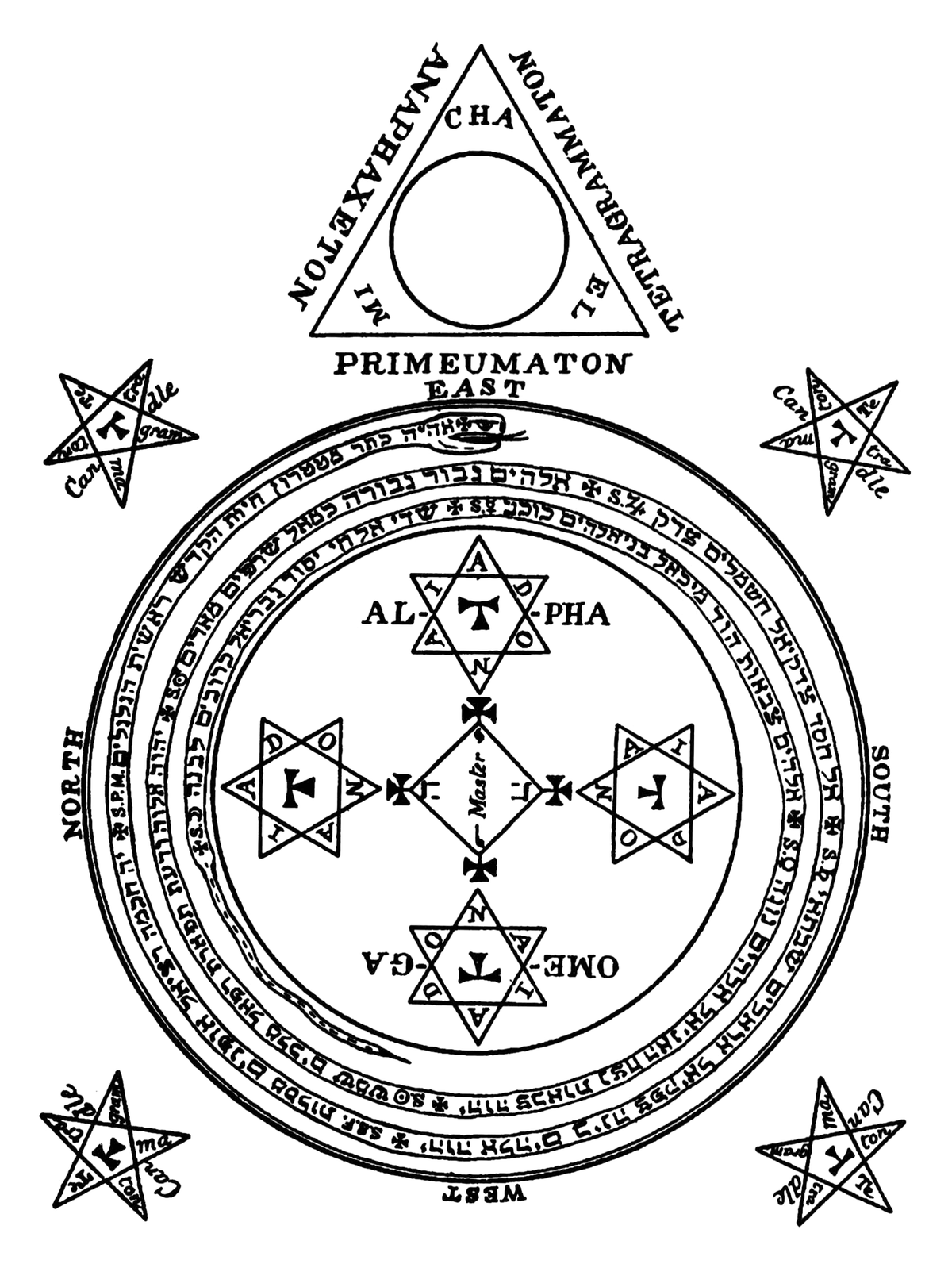
Cover image: Solomon’s circle and triangle reproduced in the Mathers-Crowley edition of The Goetia, 1904, public domain, Wikimedia Commons.

Par Olivier of Aeternum
Passionate about esoteric traditions and the history of the occult from the earliest civilizations to the 18th century, I share some articles on these topics. I am also co-creator of the online esoteric shop Aeternum.













Bonjour, merci pour cet article.
Je souhaiterais savoir si l’image représentant Les démons de l’Ars Goetia, que je trouve superbe, si on pouvait se la procurer quelque part ?
Cordialement
Merci pour ces infos…
Pouvez vous me donner le nom des œuvres picturales ainsi que les artistes qui les ont peint…
Merci d’avance.
D.W.