



















































































































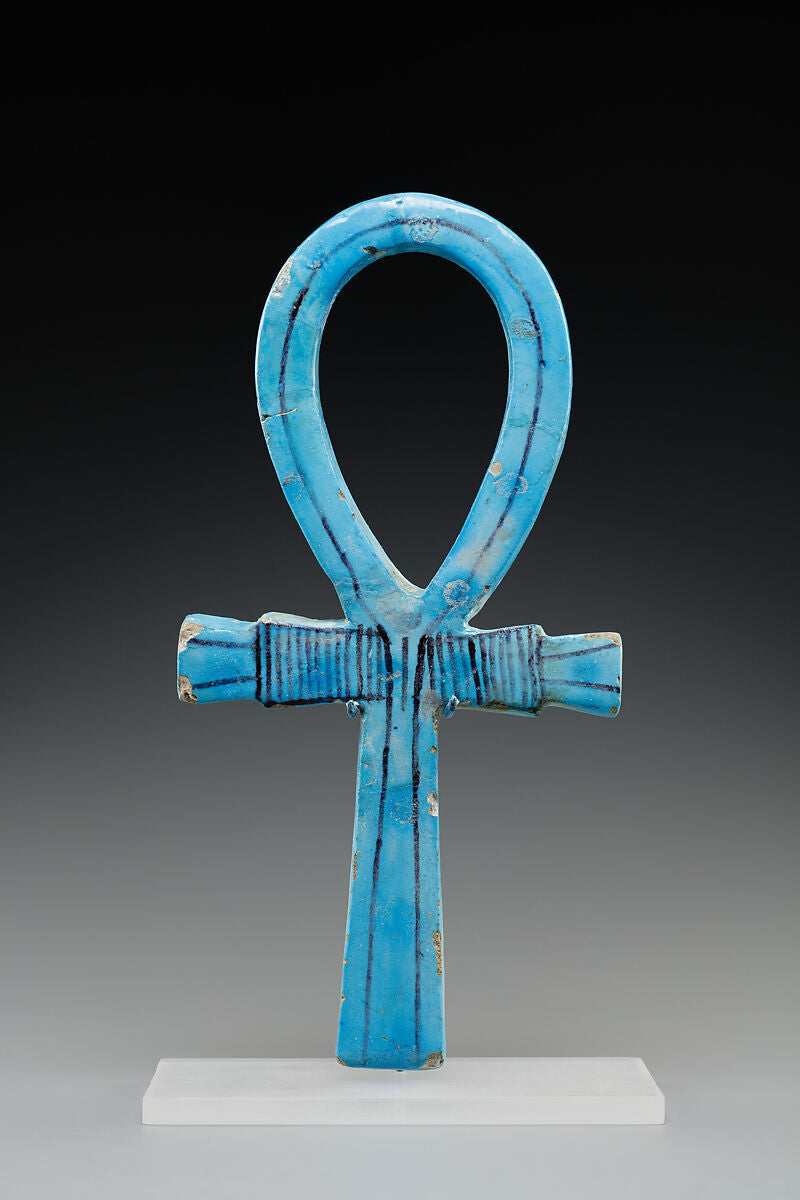
The ankh is above all a written word. Before becoming one of the most famous emblems of ancient Egypt, the sign ☥ was used in hieroglyphic writing to record the Egyptian word ꜥnḫ, “life,” as well as the verb “to live.” Its symbolic power comes precisely from this function: when a god holds an ankh, the image does not show a “secret key” in the modern sense, but makes life itself tangible.
This distinction makes it possible to understand the sign without piling on later interpretations. The ankh was indeed worn as an amulet, symbolically offered to kings, incorporated into ritual objects, and reused centuries later by Egypt’s Christians. However, interpretations that make it the union of male and female, an interdimensional portal, or an extraterrestrial artifact do not come from Egyptology.
What does the word ankh mean?
The sign is generally transliterated as ꜥnḫ. It is used to write the ideas of life, to live, living and, by extension, becomes a visual symbol of life.
The Metropolitan Museum of Art puts it very simply: the ankh is used as a hieroglyph to write “live,” “alive,” or “life,” and then becomes a popular symbol of life in general. This function is attested both in writing and in religious iconography. The Met notably houses a large ceremonial faience ankh from the 18th Dynasty, originating from the tomb of Thutmose IV.
We must therefore begin with the lexical meaning before looking for hidden symbolism. The ankh means life because that is also how the sign functions in the Egyptian language.
Is the ankh really very ancient?
Yes.
The Met houses a remarkable libation dish from the 1st Dynasty, dating to around 3100–2900 BC. Its form combines two hieroglyphic arms expressing the ka and an ankh sign, “life” or “to live.” The museum suggests understanding the whole as a formula such as “life to your ka,” or possibly as a proper name.
This piece shows that the sign was already integrated into the language and ritual thought at the very beginning of Egypt’s dynastic history. The Met’s description specifies that the vessel was intended for pouring a purifying liquid, probably water, to which the hieroglyphic form gave an additional ritual dimension.
In the Old Kingdom, the ankh already appears clearly in royal iconography. A statue of King Sahure, dating to around 2458–2446 BC, shows a local deity offering the ruler an ankh: the museum explicitly identifies it as the hieroglyph meaning “life.”
Why do the gods hold the ankh?
Because they are depicted as the holders and dispensers of life.
In Egyptian art, a deity may hold the ankh in their hand, extend it toward the king, or bring it close to his face. The gesture indicates that the ruler’s life depends on the divine powers and that they grant it to him.
This image is already visible in the Old Kingdom. The statue group of Sahure held at the Met depicts a provincial god offering the ankh to the king.
During the reign of Akhenaten, the rays of the solar disk Aten ended in small hands. In some scenes, one of these hands holds an ankh near the king’s nose. The Met then describes the ankh as the “symbol of life.” The image thus associates sunlight with life received from the god, without needing to imagine actual technology or a real breathing instrument.
Does the ankh mean “breath of life”?
The connection is understandable when the sign is shown in front of the king’s nose or mouth, but precision is important.
The hieroglyph’s primary meaning remains “life.” In some scenes, the fact that the ankh is presented to the face can naturally evoke the vital breath. This does not mean that the word itself would mean only “breath.”
In Egyptian religion, image and writing are closely connected. A hieroglyph can become almost an object within the scene: what writes “life” can be held, offered, and visually transmitted.
This way of integrating the sign and the image is typical of pharaonic art. University College London notes that hieroglyphic writing and monumental imagery belong to the same visual language, in which signs participate directly in the action depicted.
Does the ankh represent earthly life or life after death?
Both contexts exist.
The ankh is not exclusively funerary. It is associated with the living king, the gods, and blessings bestowed in temples. But the continuity of life after death is also a central theme of Egyptian religion, which explains its presence in tombs, funerary objects, and amulets.
It is better to speak of life and vital continuity than to automatically translate every ankh as “immortality.”
Depending on the context, the sign can express life given to the king, a formula of wishing, the duration of existence, or a promise of renewed life in the afterlife.
Did Egyptians really wear ankh-shaped amulets?
Yes.
The ankh also became an amuletic motif. University College London reports ankh amulets dating from the end of the Old Kingdom and the First Intermediate Period, with particular popularity during the 18th Dynasty.
Digital Egypt for Universities clearly classifies it among the “symbols of power” and translates ꜥnḫ as “life.”
This use as an amulet is therefore historical. However, claiming that an ankh amulet necessarily served to “repel negative energies,” “purify the aura,” or “heal the chakras” projects contemporary vocabulary onto ancient objects.
To understand the difference between an amulet and a talisman, see What is the difference between an amulet and a talisman?.
Did the ankh protect against illness?
Its connection with life can naturally give the sign a favorable, protective, or regenerative value. But the sources do not allow us to attribute a universal medical function to it.
Ancient Egypt had medicine, therapeutic rituals, and many types of amulets. Certain signs may appear in contexts involving health or protection.
However, it is too categorical to describe the ankh as a “healing instrument” that doctors would have used to channel healing energies.
In the surviving objects, what we can demonstrate is its connection with life, its amuletic use, and its association with the gods and royalty.
Where does the ankh's shape come from?
This is where the uncertainty truly begins.
We know the sign's meaning very well. We are much less certain about the object or form that served as the model for its design.
Egyptologist Alan Gardiner proposed identifying it as a sandal strap. This hypothesis is based on the sign's shape and on linguistic comparisons, but it has not been definitively proven.
Other hypotheses have been proposed. The British Museum notes in particular that some researchers have compared the ankh to a T-handled mirror, while the traditional interpretation sees it instead as a sandal strap. The resemblance to Egyptian mirrors is real, but none of these explanations can be considered definitively proven. The British Museum's entry for mirror EA22830 explicitly presents this debate.
The important point is therefore paradoxically very simple: we know the meaning of the ankh better than the exact origin of its shape.
Does the ankh represent the union of the masculine and feminine?
This interpretation is widespread in modern esotericism, but it is not the usual translation of the sign in Egyptian sources.
The explanation then holds that the loop represents the feminine and the vertical part the masculine, their union giving birth to life. The reasoning is appealing because it corresponds to the symbol’s general meaning.
But a coherent symbolic interpretation is not automatically an ancient Egyptian interpretation.
Egyptologists do not read the ankh as an explicit anatomical diagram of sexual union. It is better to present this interpretation as a modern esoteric meditation, not as the lost decoding of the Egyptian priests.
Is the ankh a “key”?
Not originally.
The expressions “key of life”, “key to life”, or “key to the Nile” became popular because the shape of the ankh vaguely resembles that of a ring-handled key.
But the sign does not derive its Egyptian name from a word meaning “key.”
The modern expression “key of life” should therefore be understood as an evocative nickname: the sign is primarily the hieroglyph for life, not the documented representation of an Egyptian key.
“Key of life” can be used as a modern nickname, provided it is not treated as an ancient etymology.
Did the Egyptians speak of a “key to the mysteries”?
Nothing allows it to be treated as a traditional formula of pharaonic Egypt.
The expression belongs mainly to modern esoteric reinterpretations, which transform the ankh into an instrument for accessing secrets, invisible planes, or initiation.
These interpretations may have symbolic value within a recent occultist system. They do not replace the documented meaning of the sign.
Ancient Egypt had its temples, priestly knowledge, rites, and initiation texts in the broad sense; this does not mean that every Egyptian symbol constituted a “key” in the occultist sense of the 19th or 20th century.
Was the ankh associated with water?
Yes, in certain ritual and iconographic contexts, but not because it was the “key to the Nile.”
The libation vessel from the 1st Dynasty preserved at the Met associated the sign with a purifying liquid, probably water.
In some temple scenes, streams of ritual water may also be stylized as small ankh signs and other hieroglyphs of blessing. The image then expresses life-giving water.
The relationship between water and life is therefore entirely consistent with Egyptian thought. However, there is no need to invent an origin for the sign in the shape of the Nile or in a hydraulic device.
Why is the ankh found with the djed and the was scepter?
Because these three signs can form a set of royal and divine wishes.
The djed expresses stability. The was expresses dominion or power. The ankh expresses life.
The Metropolitan Museum preserves an object in which the ankh, djed, and was are brought together. Its description explains that the combination forms a powerful set of wishes that could be offered by the king to a god or by a god to the king. This piece is dated between the Late Period and the Ptolemaic period.
The triad is therefore not an invention of modern esoteric shops: its association does indeed have an Egyptian history.
Does Ptah really hold the ankh, the djed, and the was together?
Representations of Ptah regularly show a composite scepter combining several signs, notably the djed and the was, with the ankh in some depictions.
This iconography associates the deity with life, stability, and power.
Nevertheless, these elements should not be treated as three independent “energies” in the modern sense. They are signs whose linguistic, religious, and royal meaning is closely tied to the image in which they appear.
Is the ankh connected to Isis and Horus?
Like many major Egyptian deities, Isis and Horus can be associated with the ankh in religious art.
But the ankh is not their exclusive symbol.
The sign is held by a multitude of gods and goddesses because it represents precisely what a deity can bestow: life.
Presenting the ankh as a particular attribute of Isis, Ra, or Horus would therefore reduce a much broader iconography.
For another Egyptian symbol frequently misinterpreted today, see What the Eye of Horus really represented in ancient Egypt.
What does the ankh mean in scenes of Akhenaten?
Under Akhenaten, the solar disk Aten is depicted with rays ending in hands. Several of these hands extend ankhs toward the royal family.
The Met explains that a hand may hold the ankh hieroglyph, “symbol of life,” near the king’s nose.
This image accords with Amarna theology: the light of Aten is presented as the source of life.
There is no need to interpret the object as a respiratory apparatus, an antenna, or a lost technology. Hieroglyphic writing already provides the key to understanding it: the god’s hand gives life.
Are Egyptian mirrors related to the ankh?
The visual resemblance between certain mirrors and the ankh has greatly fueled hypotheses about the sign’s origin.
Egyptian mirrors do indeed have a disk set on a handle and can produce a vaguely comparable silhouette.
But resemblance alone is not enough to claim that the ankh “represents a mirror.” Egyptian words and object forms must be studied in their context.
The question of its original form remains open, and it is better to accept this uncertainty than to choose the most appealing explanation.
Was the ankh a real object or merely a hieroglyph?
Both.
The sign exists in writing and imagery, but three-dimensional objects shaped like ankh symbols were also made.
The cover of this article shows precisely a faience ceremonial instrument found in the tomb of Thutmose IV in the Valley of the Kings. Dating to around 1396–1386 BC, it bears a royal cartouche at its center.
The Metropolitan Museum of Art classifies it as a ceremonial object and notes that the written sign means “to live,” “living,” or “life.”
Another Middle Kingdom wooden ankh model, dating to around 1981–1802 BC, is also preserved at the Met.
What were ankh-shaped objects used for?
Their function depends on the archaeological context.
Some are amulets, others are models or funerary objects, and still others are ceremonial instruments.
There is therefore no single “ankh object” with identical properties throughout Egyptian history.
This diversity is typical of ancient Egypt: a sign can simultaneously be a word, image, object, wish, offering, and element of protection.
Did the ankh guarantee eternal life?
In images, it can express life given by the gods and the continuity of existence. In amulets and funerary furnishings, its presence forms part of a set of favorable signs intended for the deceased.
But it would be reductive to imagine that wearing an ankh alone constituted a mechanical “guarantee” of immortality.
Egyptian funerary beliefs rested on a much broader set of elements: embalming rites, preservation of the body, offerings, funerary texts, relationships with Osiris and the other gods, judgment, remembrance of the name, and continuation of worship.
The ankh powerfully expresses life; it does not by itself summarize the whole of Egyptian funerary religion.
Did Coptic Christians adopt the ankh?
Yes, but even here the process deserves to be formulated precisely.
In Christian Egypt, the shape of the ankh was reused in the looped cross, or crux ansata. The resemblance between the ancient sign for “life” and the Christian cross naturally lent itself to a new interpretation centered on eternal life and resurrection.
The British Museum, for example, preserves a 7th-century Coptic stela featuring looped crosses. The museum’s notice explicitly states that these cruces ansatae derive from the Egyptian hieroglyph ânkh, meaning “life.” The Stela of Abraham thus shows the Christian reinterpretation of a much older form.
This formal continuity does not mean that Coptic Christianity simply preserved the ancient pharaonic religion intact. The sign is reinterpreted within a new religious framework.
Did the ankh become the Christian cross?
This overly simple formulation should be avoided.
The Christian cross has its own history, linked to the crucifixion of Jesus, and developed in the Roman Empire independently of the Egyptian context alone.
In Egypt, however, the shape of the ankh did encourage a particular type of looped Christian cross.
It is therefore a case of reuse and local transformation, not the universal origin of all Christian crosses.
Why did the ankh become so important in modern esotericism?
From the 19th century onward, European Egyptomania and the rise of occultism gave pharaonic symbols a new lease on life.
Archaeological discoveries, museums, translations of texts, and major occultist syntheses transformed Egypt into a major reference for modern Western magic.
The ankh then became a convenient emblem of life, initiation, Egyptian wisdom, and spiritual continuity.
Occultists in the 19th and 20th centuries incorporated it into new iconographies. These reuses belong to the history of modern occultism and should not be confused with the original pharaonic meaning.
To place this period in context, see What is High Magic really?.
Can the ankh be used in a modern esoteric practice?
Yes, provided you know how you are using the symbol.
If you use it as a reminder of life, vitality, or continuity, you remain close to its documented Egyptian meaning.
If you assign it the role of a gateway, masculine-feminine balance, auric protection, or energy activation, you are adopting a modern interpretation.
These two levels can coexist, but they must not be presented as identical.
A contemporary practice becomes more interesting when its additions are acknowledged rather than artificially attributed to the priests of ancient Egypt.
Is the ankh a protection symbol?
It can be used in a protective context, particularly when worn as an amulet or combined with other auspicious signs.
But its primary meaning remains life.
Defining it exclusively as a “protection symbol” would be comparable to defining the djed solely as an anti-bad-luck talisman: it reduces a much richer religious and linguistic sign.
To understand how the Egyptians actually used protective symbols, see Apotropaic Magic: History, Symbols, and Protections.
Was the ankh associated with fertility?
Life and fertility are naturally closely related, but the direct equation “loop = uterus, shaft = male sex organ” belongs mainly to modern interpretations.
In Egyptian sources, the sign expresses life in a much more general way.
It can therefore be incorporated today into symbolic work on birth or fertility, but this contemporary application should not be turned into an archaeological explanation of its form.
Is there an extraterrestrial theory of the ankh?
Yes, in modern pseudoarchaeological literature.
Some authors present the ankh as a technological device, a portal key, an electrical device, or an object transmitted by extraterrestrial visitors.
No archaeological data supports these hypotheses.
We possess thousands of contexts in which the ankh functions perfectly as the hieroglyph for “life,” a religious symbol, an amulet, or a ceremonial object. There is no need to assume lost technology to explain its presence.
The appeal of these theories comes mainly from the contrast between a very ancient sign and a form that appears immediately modern to the contemporary eye.
What do we really know, and what belongs to modern interpretation?
| Element | Status |
| ꜥnḫ means “life,” “to live,” “living” | Attested in Egyptian writing |
| The gods hold or offer the ankh to the king | Very extensively attested |
| Ankh-shaped objects and amulets exist | Archaeologically attested |
| The ankh can appear in funerary contexts | Attested |
| The shape derives from a sandal strap | Scholarly hypothesis, not definitively proven |
| Female loop + male axis | Modern esoteric interpretation |
| Key to a portal to other dimensions | Modern interpretation without an Egyptological basis |
| Extraterrestrial technology | Modern pseudoarchaeology |
Why does the ankh remain such a powerful symbol?
Because its ancient meaning is already extraordinarily powerful.
It does not need an additional secret code to fascinate. A sign more than five thousand years old was used to write life, offered to the king by the gods, worn as an amulet, incorporated into ritual objects and then reinterpreted in Christian Egypt.
Its history therefore spans several millennia without remaining fixed.
This continuity largely explains its current presence in esotericism, the arts, tattoos and contemporary spiritualities.
To continue exploring ancient Egypt, also see What the Eye of Horus Really Represented in Ancient Egypt and The Legacy of Egyptian Magic.
Sources and references
For the meaning of the sign and a ceremonial implement in the shape of an ankh: Metropolitan Museum of Art, Ceremonial Implement in the Shape of an Ankh, 18th Dynasty, reign of Thutmose IV.
For evidence dating back to the 1st Dynasty: Metropolitan Museum of Art, Libation Dish Depicting Ka-Arms Presenting an Ankh-Sign, circa 3100–2900 BC.
For the ankh offered to the king: Metropolitan Museum of Art, King Sahure Accompanied by a Divine Figure, circa 2458–2446 BC.
For ankh amulets and their chronology: UCL Digital Egypt, “Amulets: symbols of power”.
For the association of the ankh, djed and was: Metropolitan Museum of Art, Ankh, djed, was on neb basket.
For the Christian reuse of the looped cross: British Museum, Stela of Abraham, EA1257, Egypt, 7th century.
For theories about the sign’s original form, particularly the comparison with a T-handle mirror: British Museum, mirror EA22830.
Cover image: ceremonial implement in the shape of an ankh, faience, reign of Thutmose IV, circa 1396–1386 BC, discovered in tomb KV43 in the Valley of the Kings, Metropolitan Museum of Art, public domain.

Par Olivier of Aeternum
Passionate about esoteric traditions and the history of the occult from the earliest civilizations to the 18th century, I share some articles on these topics. I am also co-creator of the online esoteric shop Aeternum.













