



















































































































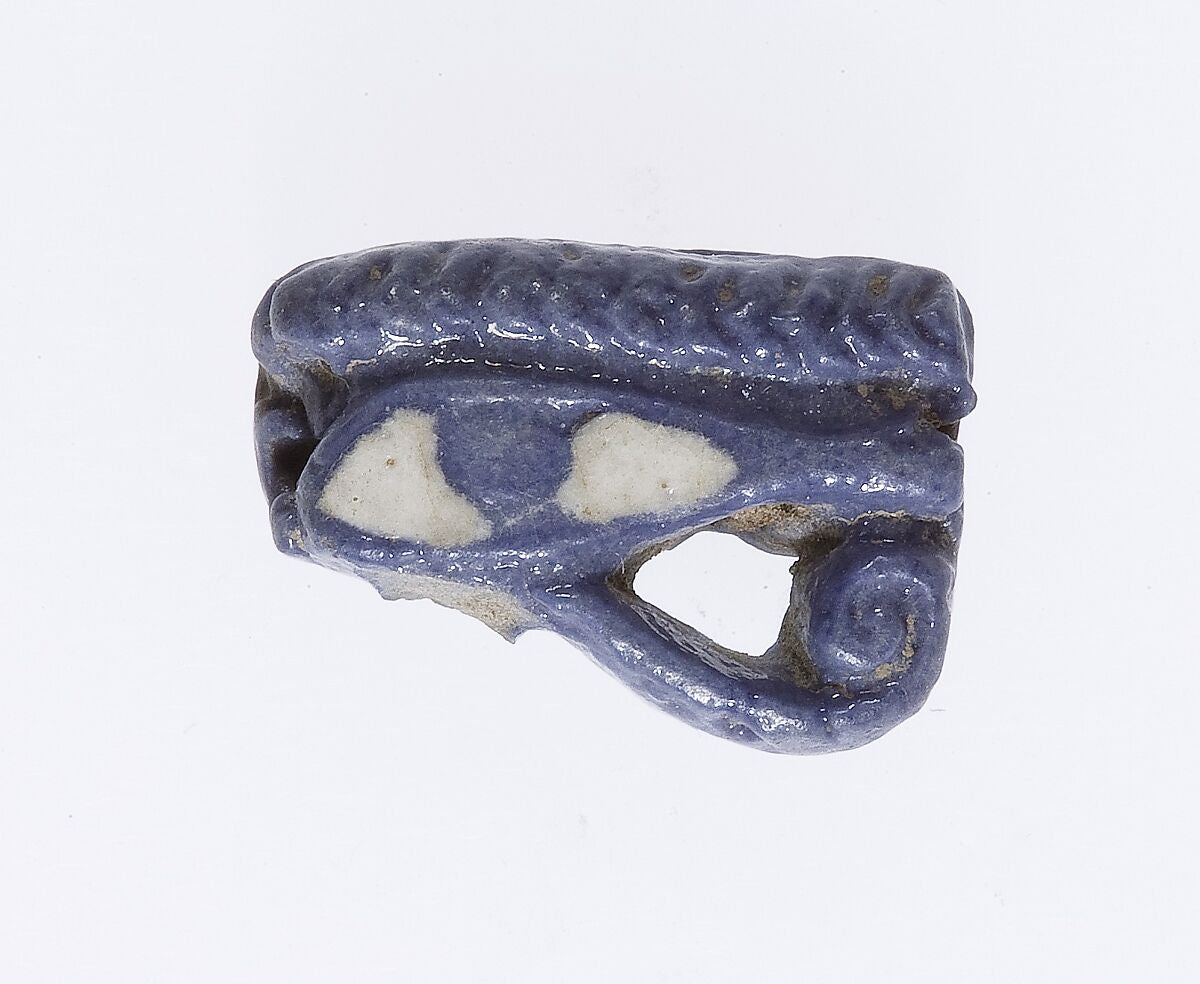
The Eye of Horus is neither a simple symbol of “clairvoyance” nor a design secretly encoding the five senses. In ancient Egypt, the udjat eye primarily refers to the eye that was injured and then made whole. Its name refers precisely to this idea: what has been restored, healed, and repaired. This healing explains its protective power, its connection with regeneration, and its immense success as an amulet.
Several traditions are frequently mixed together: the struggle between Horus and Seth, the judgment of the deceased before Osiris, the Eye of Ra, medicine, mathematical fractions, and modern interpretations of the symbol’s parts. Most of these elements did indeed exist in ancient Egypt, but they do not all tell the same story.
What does the word Oudjat really mean?
The Egyptian term generally transcribed as wḏꜣt, rendered in French as oudjat or wedjat, means “that which is intact,” “healthy,” or “made whole.” The Metropolitan Museum of Art describes the amulet as the healed eye of Horus and notes that this restoration explains its associations with healing, rebirth, and protection.
This clarification is important: the Eye of Horus is not protective solely because “an eye sees danger.” Its symbolic power comes from the fact that a destroyed or damaged organ has regained its integrity. The symbol therefore conveys an idea of restoration.
Nor should udjat be confused with the goddess Wadjet, the protective cobra goddess of Lower Egypt. The two names resemble each other in some modern transcriptions, but they do not refer to the same thing.
What happened between Horus and Seth?
Egyptian traditions recount in several forms the conflict between Horus and Seth over the succession of Osiris. During their confrontation, one of Horus’s eyes is injured, torn out, or lost, depending on the texts.
The version that became the best known attributes its restoration to Thoth. The Metropolitan Museum summarizes the myth by stating that Seth injures or steals the eye, and that Thoth then restores it. Other traditions have Hathor or other deities involved in this restoration.
It is therefore best to avoid an overly fixed narrative in which Horus loses exactly his left eye, which is cut into six pieces scattered throughout the world before being reconstructed according to a single procedure. Egyptian myths do not function like a modern canonical story: several versions coexist.
The theme nevertheless remains constant: the eye is damaged and then made whole. It is this structure that gives the udjat its healing and regenerative value.
Is the Eye of Horus the Moon’s left eye?
The answer requires nuance. In several traditions, the two eyes of the sky god are associated with the two great luminaries: the Sun and the Moon. The wounded and then restored Eye of Horus is thus linked to the Moon, whose phases give the impression of a loss followed by a gradual return to fullness.
This association is real, but the images do not always follow a simple graphic rule such as “left eye = Horus = Moon” and “right eye = Rê = Sun.” The Global Egyptian Museum emphasizes that the traditions overlap and that both celestial bodies may have been described as the eyes of Horus, while the Sun may also be the Eye of Rê.
Even more revealingly, many wedjat amulets depict a right eye, whereas the lunar explanation frequently emphasizes the left eye of Horus. This alone shows that the protective function of the wedjat goes beyond an absolutely fixed left/right code.
What does a wedjat eye really look like?
The Metropolitan Museum describes the symbol as a combination of a human eye and the facial markings of a falcon, an animal with which Horus is closely associated. The horizontal line recalls the makeup or outline of a human eye, while the extensions beneath the eye evoke the falcon’s markings.
These lines were therefore not originally a “tear,” a map of the five senses, or an anatomical diagram. Modern interpretations that assign a specific psychological function to each line - taste, smell, touch, thought, intuition - do not correspond to the usual Egyptological explanation of the motif.
The design also varies according to the period. For example, Met curators show that the position of the spiral motif and the lower extensions changes between the New Kingdom and later periods.
Was the Eye of Horus a protective amulet?
Yes, and this is one of the best-documented points. The wedjat was among the most widespread amulets in ancient Egypt. It was made of faience, glass, carnelian, gold, stone, and other materials.
The collections of the Metropolitan Museum and the British Museum contain numerous examples worn by the living or placed with the dead. The Met explains that the amulet’s form was intended to transmit to its wearer the power of recovery, regeneration, and protection associated with the healed eye.
This function fully falls within what is now called an apotropaic practice: the symbol serves to ward off danger, preserve the integrity of the body, or accompany the deceased.
The Amulets & Talismans collection also helps place this type of object within the much broader history of protections worn on the body.
Why was a wedjat sometimes placed over the embalming incision?
The Eye of Horus was indeed used in the context of mummification, but this use must be described precisely.
A remarkable example preserved at the Metropolitan Museum is an incision plate in the shape of a wedjat dating to approximately 1000–945 BC. It was found over the abdominal opening made to remove Gautsoshen’s internal organs before they were put back during mummification.
The museum explains that the healed eye of Horus here specifically embodies the ideas of healing, protection, and regeneration. The logic is particularly clear: an incision disrupted the body’s integrity; the symbol of the repaired eye ritually ensures its restoration.
Mummy bandages also bear wedjat symbols drawn in ink. The funerary use of the symbol is therefore not a modern extrapolation: it is abundantly attested.
Did the Eye of Horus determine access to the realm of the dead?
No. These are two different traditions.
In scenes of the judgment of the deceased, the heart is weighed against Ma’at or her feather. Anubis takes part at the balance, while Thoth records the result. Osiris sits as judge of the world of the dead. If the judgment is favorable, Horus may then lead the deceased to Osiris in some representations.
The famous Papyrus of Hunefer, preserved at the British Museum, clearly shows this sequence: Anubis leads Hunefer and watches over the balance, Thoth records the result, then Horus presents the deceased to Osiris.
The monster that threatens the heart is named Ammit, not “Hammit.” It combines features of a crocodile, lion, and hippopotamus.
The Eye of Horus plays a major role in funerary protection, but it should therefore not be turned into an emblem of the judgment scale.
Why is the Eye of Horus associated with offerings?
A much less familiar dimension of the symbol concerns offerings. In several Egyptian traditions, Horus brings the restored eye to Osiris, helping to restore his strength and life.
The Global Egyptian Museum explains that the restored eye thus becomes a model for the offering itself. In cultic texts, an offering may be called the “Eye of Horus”: what the god gives restores the integrity of the one who receives it.
This idea sheds new light on the symbol. The wedjat is not merely a shield against an external attack; it is also the image of what restores a complete state.
What do the famous fractions of the Eye of Horus represent?
This is probably the part most distorted by modern diagrams.
There is indeed an Egyptian tradition linking several signs used to write certain fractions to parts of the eye motif. The fractions generally cited are 1/2, 1/4, 1/8, 1/16, 1/32 and 1/64. Their sum is 63/64.
The British Museum mentions this association and reports the tradition that Thoth provided the final sixty-fourth needed for completeness. The Metropolitan Museum also notes in its educational resources that the parts of the sign could represent fractions.
But it is important not to reverse the history. A publication from the Oriental Institute of the University of Chicago specifies that the fractional signs were probably not created from the myth of the dismembered eye. The signs existed as mathematical notation; their arrangement may later have been associated with the sacred form of the wedjat.
In other words, the modern diagram "Seth cuts the eye into six pieces, and each piece becomes a fraction" turns a symbolic association into a mathematical origin story. The latter is not supported by the history of fraction notation.
Do the six parts of the eye represent the six senses?
No, not in the known Egyptian sources. Contemporary infographics frequently assign each segment of the symbol a meaning: sight, hearing, smell, taste, touch, and thought.
This system is appealing because it gives the design the appearance of a complete anatomical map. But it does not correspond to museum descriptions of the wedjat or to authoritative Egyptological sources. The marks beneath the eye are explained as falcon markings; the fractional signs belong to a different story; the six senses are a modern reconstruction.
This framework should therefore be set aside when presenting the symbol in its actual Egyptian context.
The Eye of Horus and the Eye of Ra are not simply two symmetrical eyes
The Eye of Ra is not merely the "other side" of the wedjat design. In Egyptian theology, it can be a personified, feminine solar power sent by the solar god to act in the world.
Several goddesses can fulfill this role: Hathor, Sekhmet, Wadjet, Bastet, Tefnut, and others depending on the texts and periods. The Metropolitan Museum, for example, describes Wadjet in her leonine form as a goddess of the Eye of Ra, a female relative of the solar god and an agent of his power.
Ra thus possesses an eye that protects but can also become destructive. The British Museum notes that Sekhmet can embody the solar god's blazing eye sent against his enemies.
The Eye of Ra therefore belongs to a theology of active and personified solar power. Horus’s wedjat places greater emphasis on wounding, restoration, completeness and regeneration. The traditions may overlap, but they cannot be reduced to two mirror logos.
Why is the Eye of Ra frequently a goddess?
Egyptian language and mythology allow the eye of the sun god to act as a distinct entity. This power becomes his daughter, emissary or vengeful arm.
A lioness goddess such as Sekhmet can then represent the Sun’s burning violence; Wadjet, in the form of a cobra, protects the sovereign and symbolically spits fire at his enemies. The royal uraeus placed on the king’s forehead follows this same protective logic.
This personification explains why the Eye of Ra cannot be understood solely through the geometry of an eye drawn on the right or left.
Was the Eye of Horus painted on boats to keep them on course?
Eyes appear on boats in several Mediterranean and Near Eastern cultures, and Egypt also has depictions of boats associated with sight and protection. But turning this into a precise rule according to which the Egyptians painted the Eye of Horus on their boats “so they would not get lost” requires much stronger sources than those currently available.
The wedjat’s general protective role is widely attested. However, it is best to avoid attributing a specific technical nautical function to every decorative use without precise documentation.
What remains of the symbol in modern esotericism?
The Eye of Horus left its original funerary and cultic context long ago. Today it appears on pendants, tattoos, protective objects and esoteric compositions.
A contemporary use can perfectly well retain the ideas historically linked to the symbol: protection, healing, restoration, integrity and regeneration. These meanings are much closer to the ancient wedjat than modern associations with “clairvoyance,” the third eye or the opening of psychic abilities.
If one wishes to use the wedjat as a talisman, it is therefore possible to do so knowingly: not as an omniscient eye, but as the image of what was wounded and then made whole.
This function connects more broadly to the traditions explored in our article Apotropaic magic, history, symbols and protections as well as our feature on the evil eye.
What the Eye of Horus really means
Reducing the wedjat to “seeing the invisible” strips away precisely what makes it remarkable. Its story is one of injury and repair.
Horus's eye is torn out or damaged in the conflict with Seth. It is restored. It becomes an offering. It conveys the power of recovery. It protects the living and the dead. It may be placed on a mummy, worn as an amulet, or incorporated into a stela.
The symbol therefore speaks less of clairvoyance than of restored completeness. It is this idea, contained in its own name, that gives the wedjat its coherence throughout the centuries of Egyptian history.
Sources and references
For the meaning of the wedjat, its iconography, and its use as an amulet: Metropolitan Museum of Art, Wedjat Eye Amulet, New Kingdom, reign of Amenhotep III, circa 1386–1347 BC.
For funerary use and the amulet as a symbol of regeneration: Metropolitan Museum of Art, Wedjat Eye Amulet, 21st Dynasty, circa 1000–945 BC.
For the plaque placed over the embalming incision: Metropolitan Museum of Art, Wedjat Eye Incision Plaque, circa 1000–945 BC.
For the fractions and the warning about their origin: Oriental Institute / University of Chicago, Visible Language: Inventions of Writing in the Ancient Middle East and Beyond. The study specifies that fractional notation was not created from the myth of the dismembered eye.
For the association between the wedjat and fractions, as well as the 63/64 tradition: British Museum, object EA23426.
For the scene of the judgment of the deceased: British Museum, Papyrus of Hunefer, in which Anubis oversees the weighing, Thoth records the result, and Horus then leads the deceased before Osiris.
For the Eye of Re and the goddesses who embody it: Metropolitan Museum of Art, lion-headed statue of Wadjet, and British Museum, statue of Sekhmet EA79.
Cover image: faience wedjat amulet from the reign of Amenhotep III, circa 1386–1347 BC, Metropolitan Museum of Art, object 11.215.128. Open Access public domain image.

Par Olivier of Aeternum
Passionate about esoteric traditions and the history of the occult from the earliest civilizations to the 18th century, I share some articles on these topics. I am also co-creator of the online esoteric shop Aeternum.













