



















































































































|
CONTENTS...
1. What is a cowrie shell? |
Cowrie shells are well known, particularly in esotericism. Also known as money cowries or lucky cowries, their natural aesthetics and distinctive shape make them highly valued objects. Cowrie shells were used as currency and ornaments before becoming divination tools. An overview.
1. What is a cowrie shell?
The term "cowrie" primarily refers to the animal's shell, but it is often used to refer to both the shell and the animal that produces it.
The animal that produces the cowrie shell belongs to the Cypraeidae family, in the Cypraea genus. This gastropod mollusk is a marine organism with a soft body protected by a hard, smooth shell. Like all gastropods, it has a muscular foot that it uses to move and a head with tentacles.

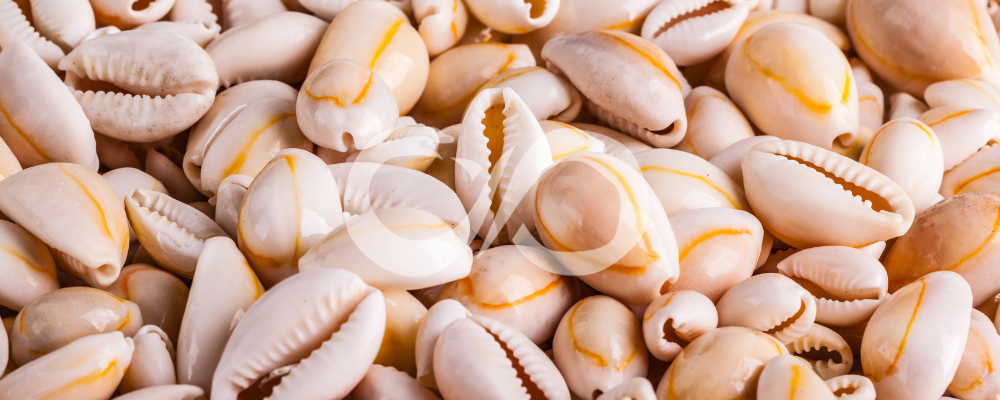
The cowrie shell, often simply called a "cowrie." It is recognizable by its oval shape, smooth, glossy surface, and serrated opening, which protects the animal from predators.
2. A brief history of cowrie shells
2.1. A shell from the Maldives
Cowrie shells, particularly those of the species Cypraea Moneta, originate from the warm waters of the Indian Ocean, especially around the Maldives. Recognizable by their smooth, rounded shape and serrated opening, these shells have fascinated humans for thousands of years.
The Maldives were the main source of cowrie shells for centuries. Maldivian merchants collected these shells in large quantities and exported them to India, Africa, and beyond. The cowrie trade route crossed the Indian Ocean, reaching markets in East Africa, from where the shells were then transported across the African continent.
Over time, cowrie shells were also found and used in other regions, particularly Southeast Asia, Oceania, and parts of the Americas. Their geographical distribution was largely facilitated by trade networks and cultural exchanges between different civilizations.
2.2. Then a currency in Africa...
West Africa was undoubtedly the region where cowrie shells had the greatest impact as currency. From the 11th century onward, cowrie shells were introduced into West Africa via trans-Saharan trade routes. They were exchanged for gold, ivory, and other valuable goods because of their great durability (calcium carbonate layers) and precious appearance.

Cowrie shells quickly became the main medium of exchange in this region, facilitating local and international trade. Powerful kingdoms such as Ghana, Mali, and Songhai adopted cowrie shells as official currency. West African markets were often flooded with cowrie shells, which were used to purchase goods, pay taxes and fines, and settle debts.
2.3. ...And in Asia
In China, cowrie shells were used as currency long before the introduction of metal coins. Their use dates back to the Neolithic period (around 3000 BC), when they served for commercial exchanges. Cowrie shells were valued for their uniformity and durability, and their small size made them easy to transport and store.
Over time, cowrie shells were imitated in metal to create coins, the cowrie-shaped bi, which were used until the Zhou period (1046-256 BC). These coins marked an important transition toward more advanced monetary systems, but shell cowries continued to circulate in some rural regions.
The use of cowrie shells as currency began to decline with the arrival of European colonists in Africa and Asia. Europeans introduced metal currencies, which gradually replaced cowrie shells because of their greater durability and ease of use. However, cowrie shells continued to be used in some remote regions and for local transactions until the beginning of the 20th century.
3. Cowrie shells as a divination tool
The use of cowrie shells in divination is believed to have originated in African traditions, although similar practices exist in other cultures. The peoples of West Africa, in particular, developed complex divination systems using cowrie shells, often as part of their traditional religions, including Vodou, Ifá, and Santeria (which originated from African traditions in Cuba).

The shape of cowrie shells resembles that of an eye or a vulva, giving the shells connotations of spiritual vision and fertility. The eye is often perceived as a symbol of clairvoyance and protection, while the vulva is associated with creation and life. The cowrie is also considered a good-luck charm for women.
Cowrie shells are relatively easy to obtain and handle, making them accessible divination tools. Their use does not require complex preparation, allowing a wide range of people to practice divination.
4. Where to buy divination cowrie shells?
One place only: our online esoteric shop! We offer sets of 4 cowrie shells to enable an immediate and simple reading. We also explain on the product page how to read and interpret them. You can therefore order them from our website and enjoy fast, discreet delivery!

Par Olivier of Aeternum
Passionate about esoteric traditions and the history of the occult from the earliest civilizations to the 18th century, I share some articles on these topics. I am also co-creator of the online esoteric shop Aeternum.













