


































































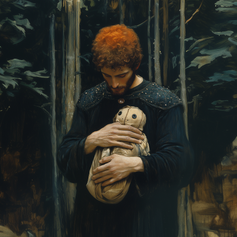




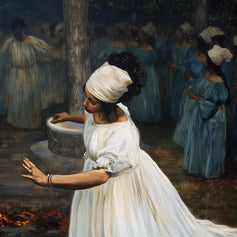
















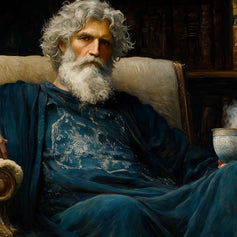


























The twentieth rune of the Elder Futhark, Mannaz bears the name of the human being. The rune poems do not describe an individual separated from the world. They show a person loved by their own, the joy they bring to others, their place in society, and the body’s final return to the earth.
In a contemporary reading, Mannaz speaks of the person amid their relationships: family, team, community, reputation, and mutual obligations. It may refer to the querent, a group on which they depend, or the human perspective that shapes a decision. Its message is not the exaltation of a superior self; it concerns identity lived alongside other fallible beings.
The Old English stanza adds a severe limitation: everyone eventually fails their fellow human, and then the flesh returns to the earth. Mannaz therefore brings together mutual aid and fragility, dignity and finitude. It invites us to recognize what connects us without idealizing loyalty, authority, or the place held within the group.
Mannaz in the Elder Futhark
Mannaz, written ᛗ, occupies the twentieth position in the Elder Futhark. Its phonetic value is m. The reconstructed name *mannaz refers to man or, more broadly, the human being. It continues in Old English mann and Old Norse maðr.
The Anglo-Frisian futhorc preserves the rune and its meaning. The Younger Futhark also has a rune maðr, but its shape differs across the Scandinavian series. Continuity lies in the name and sound value, not in an unchanging form. Michael P. Barnes presents these alphabetic developments in Runes: A Handbook.
The human being among their own
Mannaz does not reduce the human being to a solitary consciousness. The stanzas speak of parents, companions, decorated ships, and the earth that receives the body. A person exists through their name, alliances, rank, work, and the memory others retain of them.
This social dimension gives the rune a practical significance. Mannaz can represent collective intelligence, advice from someone close, the role held within a team, or a reputation earned through one’s actions. It also reminds us that the group does not erase personal responsibility. A community can support, judge, exclude, or impose its habits.
Mortality occupies a central place in the English and Scandinavian poems. Human beings increase the dust or earth because their bodies return there. This image does not devalue life; it measures the time available and brings pride back to its proper proportion.
\The heart of Mannaz:\ no one builds themselves alone, but no belonging exempts anyone from acting with discernment. The rune asks what place you occupy, what you owe others, and what your bonds demand of you.
The Three Rune Poems
The Norwegian poem states that man increases the dust, then evokes the great hall of the hawk. The Icelandic poem develops three images: man is man’s joy, the increase of the earth, and the adornment of ships. The first motif celebrates companionship; the second recalls death; the third connects humanity to its works and material world.
The Old English stanza says that a joyful man is dear to his relatives. It adds that everyone must one day fail their fellow, because the Lord will return the flesh to the earth. The verb translated as “be missed” or “fail” can suggest failure as much as betrayal. The text rejects a flawless image of human fraternity.
Bruce Dickins brings together the three stanzas and their translations in Runic and Heroic Poems of the Old Teutonic Peoples. They agree on a shared condition: man brings joy to man, lives among his own kind, and returns to the earth. The notions of a “higher self,” cosmic consciousness, or telepathy do not belong to these texts.
Meaning of Mannaz in a reading
Mannaz refers to a person, a human group, or the way the querent positions themselves among others. It fosters cooperation, advice, self-awareness, and recognition of everyone’s skills. It may also ask you to view a situation from a human perspective, with its limitations and obligations.
\For work and money,\ Mannaz represents a team, clientele, supervisor, business partner, or professional reputation. The solution comes through the right person or a better distribution of roles. A purely individual decision risks overlooking the collective consequences.
For relationships, the rune speaks of attachment, kinship, trust, and reciprocity. It may show a strong bond, but it asks you not to idealize your partner. Everyone remains capable of making mistakes, becoming tired, or falling short.
As advice, Mannaz invites you to ask for an opinion, listen to the group, and examine your own conduct. You must acknowledge shared needs without abandoning your judgment. The right question is not only “what do I want?” but also “what kind of person am I in this situation?”.
Mannaz reversed or challenged
The rune poems give no reversed meaning. Moreover, the form ᛗ has a symmetry that makes its reversal unstable depending on the design and medium. A reading method therefore benefits from interpreting Mannaz through its context and neighboring runes rather than through a forced orientation.
In a reversed reading, Mannaz may indicate isolation, pride, an identity shaped by the group’s gaze, or trust placed in the wrong person. It may also show a divided team, an unreliable close associate, or a reputation that conceals the reality of one’s actions.
The reversed rune calls for distinguishing chosen solitude from exclusion, autonomy from refusal of help, and loyalty from self-effacement. The remedy does not always consist of joining the group. It may require a clear boundary, a change of role, or the search for more reliable allies.
Mannaz with other runes
These associations belong to contemporary divination. They bring the images of the poems closer together and do not constitute ancient formulas.
Gebo and Mannaz unite exchange with community. An agreement, act of help, or sharing strengthens the bond between people. Reciprocity must remain visible to avoid hidden debt and dependence.
Ansuz and Mannaz place speech at the heart of human relationships. A conversation, piece of advice, or public decision shapes one’s reputation. Words bind the person who speaks them.
Wunjo and Mannaz show the joy of belonging to a group. Together, they favor friendship, family, or a harmonious team. It is important to check that this harmony allows for sincere disagreements.
Naudiz and Mannaz indicate a human constraint or a need that calls for help. The community can become a source of support, but it can also impose a heavy obligation. The reading must identify who helps whom, and at what cost.
Tiwaz and Mannaz link the person to public duty. This combination speaks of integrity, responsibility and decisions subject to a common rule. It also exposes anyone who claims authority without accepting its consequences.
Working with Mannaz in magic
No ancient source presents Mannaz in isolation as a means of awakening a higher self, accessing a universal memory or controlling another person’s mind. Runic inscriptions with a magical function derive their meaning from their complete text, their object and their context. Mindy MacLeod and Bernard Mees examine these uses in Runic Amulets and Magic Objects.
In a modern practice, Mannaz may accompany a reconciliation, teamwork, an examination of conduct or a request for help. The intention must name the people concerned, each person’s responsibility and the boundary that protects everyone’s dignity.
The rune may be drawn beside a list of names, a commitment or a question addressed to the group. A concrete action must follow: speak frankly, ask for advice, acknowledge a fault, assign a task or leave a relationship that distorts your identity. Mannaz makes the human dimension visible; it replaces neither speech nor responsibility.
Mannaz correspondences and guides
| Guide | Correspondence |
|---|---|
| Sign | ᛗ |
| Alphabet | Elder Futhark; name and value retained in the Anglo-Frisian and Scandinavian series under distinct graphic forms |
| Position | Twentieth rune; third ætt |
| Phonetic value | m |
| Reconstructed name | Common Germanic *mannaz |
| Attested forms | Old English mann; Old Norse maðr |
| Primary meaning | Man, person, human being |
| Images from the poems | The joy of loved ones, human company, failure, a body returned to the earth, ornamented ships |
| Favorable reading | Cooperation, counsel, belonging, self-knowledge, reputation, shared responsibility |
| Challenging reading | Isolation, pride, conformity, betrayed trust, distorted role, divided group |
| Question asked | What place do you occupy among others, and what conduct does that place require? |
| Rejected attributions | Heimdall, Aquarius, air, amethyst, crown chakra and the Magician of the tarot: the rune poems do not establish these equivalences. |
Reading guide: Mannaz celebrates neither individualism nor submission to the group. It shows a person shaped by relationships, responsible for their actions and aware of human time.










)