
















































































































The sixth rune of the Elder Futhark, Kaunan stands between two difficult-to-reconcile images. The English poem speaks of a torch with a pale, bright flame, known to all who live; the Scandinavian poems, by contrast, name the ulcer, the painful sore that afflicts the body. Yet light and injury belong to the same act of reading: something becomes visible and can no longer be ignored.
In a contemporary reading, Kaunan illuminates a situation, reveals a flaw, activates a skill, or shows the point requiring precise work. It may signal understanding, learning, and controlled creation. It may also indicate discomfort, weakness, or a problem that worsens as long as it remains hidden.
This dual nature protects the rune from overly flattering interpretations. Kaunan is not merely the “creative fire”: it is the flame that lets us see what we are making, but also the painful mark that forces us to look at what is wrong.
Kaunan in the Elder Futhark
Kaunan, written ᚲ, occupies the sixth position in the Elder Futhark and represents the sound k. Its original name remains debated. The form Kaunan, used in this guide, corresponds to Old Norse kaun, “ulcer” or “sore.” The name Kenaz, widespread in current works, is based on Old English cēn, “torch” or resinous wood used for lighting.
These two names belong to later linguistic branches. It would therefore be imprudent to claim that the rune certainly meant “torch” or “ulcer” throughout the ancient Germanic world. The sign and the sound are well attested; the name of the Elder Futhark must be reconstructed from sources that diverge. Michael P. Barnes describes this methodological problem in Runes: A Handbook.
Kenaz’s association with knowledge does not come directly from its etymology. It stems from an interpretation of the torch: light makes things visible, enables recognition, and accompanies work. This reading is coherent, provided it is presented as a symbolic development.
The torch and the sore
The torch produces light held in the hand. It is not the sun, which illuminates everything effortlessly: it requires fuel, supervision, and direction. It reveals a limited space, just large enough to work, read a sign, or avoid an obstacle. Kaunan can therefore represent practical knowledge acquired through contact with matter.
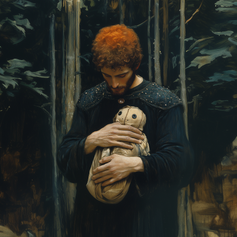
The wound shows what burns, causes discomfort, and demands attention. It no longer allows you to continue as though everything were fine. In a reading, this image may concern an error, a technical weakness, a disagreement, or a sensitive point that must be addressed. It is not intended to establish a medical diagnosis.
The two images come together in revelation. Light exposes what was hidden; pain draws attention to what was neglected. Kaunan asks you to look at the precise point, then apply the appropriate knowledge.
The heart of Kaunan: what becomes visible can finally be understood, worked on, or repaired. The rune illuminates a capability as much as a defect.
What the Rune Poems Say
The Old English poem describes cēn as a torch recognizable by its pale, bright flame, burning inside the place where princes rest. Here, the light belongs to an inhabited space: it makes the hall visible, extends activity, and marks the seat of power.
The Norwegian poem states that the ulcer is fatal to children and that death makes the body pale. The Icelandic text calls it a childhood disease, a painful spot, and the dwelling place of mortification. These images are severe and cannot be replaced by a simple idea of creativity.
The stanzas and commentaries are brought together in Bruce Dickins’s edition, Runic and Heroic Poems of the Old Teutonic Peoples. Their divergence gives Kaunan a demanding scope: the rune sheds light, but what it reveals may require immediate action.
Meaning of Kaunan in a reading
Kaunan announces that something is becoming understandable. A skill develops, an explanation arrives, a detail reveals the whole, or a task regains its direction. The rune favors learning, craftsmanship, analysis, and any activity that transforms a material through technique.
For work, it may refer to mastering a tool, resolving an error, training, or uncovering a defect. It advises focusing the light on a specific task instead of scattering the effort. A clear improvement is better than general agitation.
For relationships, Kaunan reveals a sensitive point. A truth becomes visible, a desire is expressed, or a difficulty is no longer denied. The rune can rekindle the warmth of the bond, but it requires that this fire be tended and that no wound be concealed beneath the enthusiasm.
For health, it draws attention to a concern or to the need to understand what is happening. It does not support any medical conclusion. Its practical advice is to observe, record the facts, and consult a qualified professional when the situation requires it.
As advice, Kaunan asks you to shed light on one point only. You must look for the cause, learn the technique, or clearly show what no longer works. Knowledge becomes useful when it leads to a precise action.
Reversed or ill-aspected Kaunan
The ancient poems provide no reversed interpretation. In current practices that observe orientation, reversed Kaunan shows a weak light, incomplete understanding, or a problem one refuses to see. It may indicate a technical error, a loss of skill, a creation that is fading, or an unresolved concern.
It can also describe an improperly contained fire: an escalating conflict, obsession, excessive exposure, or a revelation made without caution. Not everything needs to be shown to everyone. The ill-aspected rune calls for controlling the source, reach, and timing of the light.
Without a specified orientation, the context indicates whether Kaunan illuminates or burns. A favorable rune beside it supports understanding; a sign of constraint shows the difficulty of applying knowledge; a sign of rupture may reveal a failure that requires stopping.
Kaunan with other runes
These combinations develop a contemporary reading syntax. They draw on preserved images without claiming to reproduce an ancient divinatory catalog.
Ansuz and Kaunan bring speech and light together. An explanation makes the situation understandable, a lesson bears fruit, or someone finally finds the right wording.
Raido and Kaunan illuminate the path. Information, a tool, or a skill makes it possible to correct the route. This combination favors progress guided by experience.
Kaunan and Gebo combine knowledge with giving. They can describe passing on a technique, a creative collaboration, advice offered, or an exchange whose value lies in shared expertise.
Kaunan and Naudiz show a painful point under pressure. A flaw must be repaired, a difficult truth acknowledged, or a technique learned for lack of an alternative. Necessity forces concentration.
Kaunan and Isa reduce the flame. They can signal a breakdown, blocked understanding, suspended creation, or the need to let a situation cool down before continuing.
Working with Kaunan in magic
No ancient text provides a universal formula in which Kaunan, drawn alone, would ensure knowledge, healing, or creativity. The magical uses of runes are based on words, formulas, and tools connected to a situation. Mindy MacLeod and Bernard Mees examine these objects in Runic Amulets and Magic Objects.
Working with Kaunan today can serve to reveal and understand. Choose a specific problem, then write down what is known, what remains unclear, and the next possible check. The rune can be drawn in the center of the page or near the tool used to solve the difficulty.
To support learning, it can accompany a study program, a rehearsal, or a practical task. To uncover a flaw, the ritual should lead to an inspection, a request for advice, or a correction. Kaunan's light serves the work; it does not replace technical knowledge, care, or caution around real fire.
Kaunan's correspondences and guides
| Guide | Correspondence |
|---|---|
| Sign | ᚲ |
| Alphabet | Elder Futhark |
| Position | Sixth rune; first ætt |
| Phonetic value | k |
| Names used | Kaunan, from Old Norse kaun; Kenaz, from Old English cēn |
| Meanings retained | Ulcer or wound in Scandinavia; torch or resinous wood in England |
| Poem images | Pale, bright flame; illness, painful spot, and mortification |
| Favorable reading | Understanding, competence, learning, revelation, mastered work |
| Challenging reading | Hidden error, insufficient light, loss of control, neglected problem, excessive fire |
| Question asked | What point needs to be illuminated, understood, or repaired? |
| Excluded attributions | Venus, the Fire element as an ancient correspondence, crystal, chakra, tarot, and fixed day: the poems do not provide this system. |
Reading guide: Kaunan illuminates what demands precise attention. Its light reveals an ability to develop or a flaw that can no longer remain hidden.





)