















































































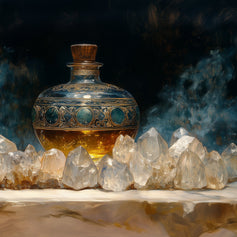















Beneath the appealing name Chrysoprase Emerald lies a green to bluish-green Chalcedony, luminous and dense, whose color evokes young leaves after the rain. It does not seek to imitate the power of Emerald: it expresses another green, softer and linked to microcrystalline quartz.
Its commercial name brings together two prestigious references, but its material belongs to the Chrysoprase family. This distinction precisely opens its esoteric language: recognizing the true nature of something, then giving it its own value. Venus gives it attraction and growth; Mercury, the right name and fair exchange.
To place this stone among related minerals, compare it with Chrysoprase, Green Agate, and Emerald.
A green Chalcedony
Chrysoprase is a variety of Chalcedony, that is, microcrystalline quartz, colored green by nickel compounds. Its texture does not show the large crystals of Emerald, which belongs to the Beryl family; it offers a waxy luster and color distributed throughout a compact mass.
The Gemmological Association of Great Britain places Chrysoprase among the main varieties of Chalcedony. Bluish-green shades can be highly attractive, and each piece has its own balance of hue and translucency.
What the name means
“Chrysoprase Emerald” functions as an evocative commercial name. It describes an emerald-like green within Chrysoprase-type material; it does not transform Chalcedony into Beryl.
The CIBJO Blue Books provide the international rules used to name and present gemstones. Knowing what you are holding makes it possible to appreciate the stone for its true family rather than for a comparison.
The heritage of Chrysoprase
The name Chrysoprase comes from Greek and combines gold with a green plant, the leek. Ancient sources used color categories that do not always correspond to modern identifications; the specific esoteric reputation of the name Chrysoprase Emerald is therefore recent.
Research by the Gemological Institute of America on naturally colored bluish-green Chalcedony demonstrates the true richness of this family, without needing to equate it with Emerald.
The trade name may be retained as an image of color, provided that the mineral family remains clear. On a magical level, this transparency becomes a virtue: prospering without borrowing another’s value.
Venus, Mercury, Earth, and Air
Venus corresponds to green, attraction, agreement, and fertility. Mercury governs commerce, contracts, and precision of language. Earth nourishes growth; Air circulates offers and ideas.
Friday suits resources and connections, while Wednesday suits sales and negotiations. A copper coin, a green leaf, and drawn scales can accompany the stone.
Value, growth, and fair commerce
This stone accompanies setting a fair price, presenting work honestly, seeking agreement, and growing an activity. It reminds us that value is built through quality, clarity, and relationships, not constant comparison.
Near an account book or a project, it supports clear prosperity: what comes in, what goes out, what sustains and what needs to be named differently.
The Rite of Name and Nature
Write the public name of a project, then beneath it its concrete nature in one simple sentence. Add three verifiable qualities that underpin its value. Place the stone between the name and the description.
Say: “I name with clarity, I present with integrity, I receive the fruit of my work.” Then revise a sales sentence, offer, or price so that it better reflects this value.
Correspondences and references
| Reference | Correspondence |
|---|---|
| Nature | Green to blue-green chalcedony |
| Celestial bodies | Venus and Mercury |
| Elements | Earth and Air |
| Days | Friday and Wednesday |
| Ritual colors | Green, copper, white |
| Areas | Value, growth, agreement, commerce |
| Associated objects | Coin, leaf, scales |
| Gesture | Linking a name to three verifiable qualities |