



















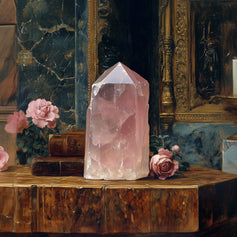































































































Red Aventurine combines the stability of Quartz with ferruginous sparkles that light up as the stone turns in the light. Its color speaks of momentum, but its sparkle adds a nuance: an opportunity becomes fruitful only when a gesture comes to meet it.
This variety has no ancient magical lineage under its current name. However, it inherits the modern legacy of Aventurine, associated with luck and openings, and then that of red, associated with action, courage, and desire. Mars, the Sun, Fire, and Earth thus form a coherent system, presented as a contemporary interpretation.
To place this stone among related minerals, compare it with Quartz, Aventurine, and Blue Aventurine.
A Red, Sparkling Quartz
Aventurine is a Quartz or quartzite crossed by bright inclusions. The Mindat mineralogical database cites micas and Hematite among the materials capable of producing this appearance. The adjective red describes the dominant color, not a distinct species.
Each stone may show brick red, warm orange, or coppery brown. Quartz’s hardness gives it good durability, while the inclusions and internal fractures call for protection against impacts.
Hematite and aventurescence
The shifting reflection is called aventurescence. The Gemological Institute of America explains that this effect comes from light reflected by small plate-like inclusions. In red materials, iron-rich phases provide color and sparkle.
A natural stone has irregular sparkles embedded in the texture of Quartz. This appearance distinguishes it from Goldstone glass, whose copper forms a more regular sprinkling. Both materials have their beauty, but their histories are not the same.
From adventure to opportunity
The name Aventurine was first associated with Venetian glass, then applied to natural stones showing a similar effect. The gemological dossier from Epigem distinguishes Aventurines according to their inclusions and host material.
The connection with the Italian a ventura, “into adventure” or “by chance,” has nurtured the modern association with fortunate opportunities. Red transforms this contemplated luck into luck set in motion.
Red Aventurine combines two modern images. The sparkle represents the opportunity revealing itself; the red, the decision to respond. It does not promise a guaranteed gain: it supports the action that allows a possibility to become real.
Mars, Sun, Fire, and Earth
Mars governs initiative, courage, and the conquest of space. The Sun corresponds to confidence, visible success, and radiance. Fire sets things in motion; Earth gives the result a lasting form.
Tuesday suits undertakings and challenges, while Sunday suits presenting a project. A copper coin, a red candle, and a seed can accompany the stone.
Active Luck, Boldness, and Commerce
Red Aventurine accompanies a launch, an application, a sale, public speaking, or a return to an abandoned task. It replaces neither preparation nor skill; it recalls the moment when you must stop waiting.
Near an order book or a project, it supports prosperity built through initiative. Its red color keeps ambition alive, while Quartz gives it a stable direction.
The Rite of Seizing an Opportunity
Write down a current possibility that you have not yet pursued. Beneath this sentence, note the shortest action that could open it: call, send, propose, publish, or ask. Place the stone on the verb.
Say: “I recognize the opening, I take action, and I give shape to my luck.” Complete the action before sunset, then record the response you receive.
Correspondences and References
| Reference | Correspondence |
|---|---|
| Nature | Red quartz or quartzite with inclusions |
| Celestial Bodies | Mars and the Sun |
| Elements | Fire and Earth |
| Days | Tuesday and Sunday |
| Ritual Colors | Red, copper, gold |
| Areas | Initiative, luck, commerce, courage |
| Associated Objects | Copper coin, seed, red candle |
| Action | Responding to an Opportunity Before Sunset |










