





























































































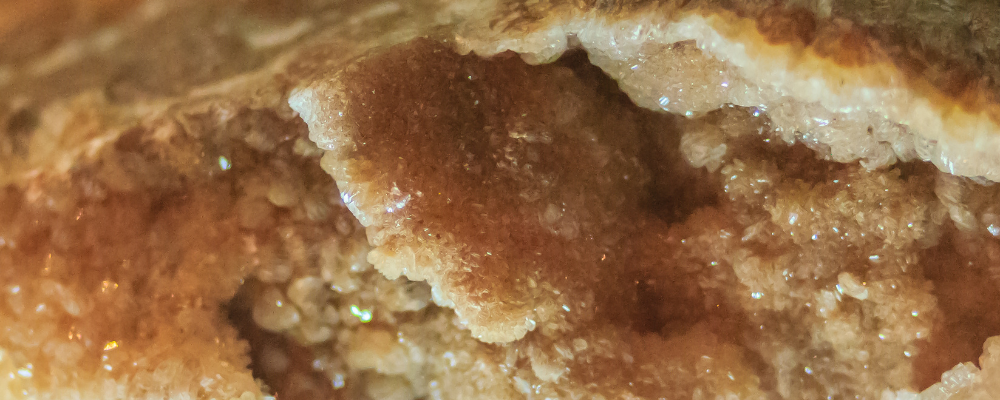
Calamine is not a single stone, but an old mining term that grouped several secondary zinc ores. Smithsonite, Hemimorphite, Hydrozincite, and other materials could be concealed under this name. Its history belongs to the separation of categories that were too broad.
Calamine nevertheless has a genuine material history: it was used to introduce zinc into copper during the traditional manufacture of brass. Mercury governs the collective name and analysis here, Venus receives the copper and alloy, Earth bears the ore, and Fire accomplishes the transformation.
To place this stone among related minerals, compare it with Zincite, Sphalerite, and Sphalerite.
An Old Collective Name
The word Calamine was applied to several secondary zinc ores. The Mindat entry mainly cites Smithsonite and Hemimorphite, but also Hydrozincite, Willemite, and Sauconite.
A “Calamine” label therefore cannot identify a species without examination. The name retains historical and commercial meaning, provided its breadth is recognized.
Smithsonite and Hemimorphite
Smithsonite is a zinc carbonate ZnCO3, whereas Hemimorphite is a hydrated zinc silicate. Their compositions and structures differ, even when their colors or massive forms look similar.
The notices for Smithsonite in the Handbook and Hemimorphite in the Handbook describe these characteristics. Commercial calamine may also contain several phases in the same piece.
James Smithson and Brass
In 1803, James Smithson published an analysis of several calamines and showed that this name covered chemically distinct materials. The Smithsonian archives present this work and the text of his findings.
Before the industrial isolation of zinc, heating calamine with copper and charcoal made it possible to produce brass by cementation. The collective name thus came before a precise understanding of its components.
Separating the materials does not destroy the shared work. Analysis shows what each part contributes; the alliance can then be chosen instead of endured.
Mercury, Venus, Earth, and Fire
Mercury governs classification, analysis, and commerce. Venus receives copper, brass, and the accord of materials. Earth carries zinc ores; Fire transforms their meeting with copper.
Wednesday is suitable for sorting and naming, while Friday is suitable for recomposing an accord. Two small bowls, a label, and a small brass object serve as supports.
Sorting, Naming, and Recomposing
Calamine accompanies situations grouped under a word that is too broad: expenses, tensions, merchandise, tasks, or needs. It invites you to separate the components before seeking an overall solution.
It then supports recomposition. Once the materials have been identified, you can choose which to reunite, in what proportion, and for what function.
The Rite of Separated Materials
Place two small bowls in front of you. Write the collective name on a sheet of paper, then cut it into as many strips as the components you identify. Place in the first bowl what must be treated separately and in the second what can be recomposed.
Say: “I separate to understand, I name to act, and I reunite what can form a fair accord.” Begin with the most concrete band.
Correspondences and reference points
| Reference point | Correspondence |
|---|---|
| Nature | Former collective name for secondary zinc ores |
| Celestial bodies | Mercury and Venus |
| Elements | Earth and Fire |
| Days | Wednesday and Friday |
| Ritual colors | Blue-green, brass yellow, white |
| Domains | Sorting, analysis, composition, accord |
| Associated objects | Two small bowls, label, brass |
| Gesture | Separate the components before bringing them together |