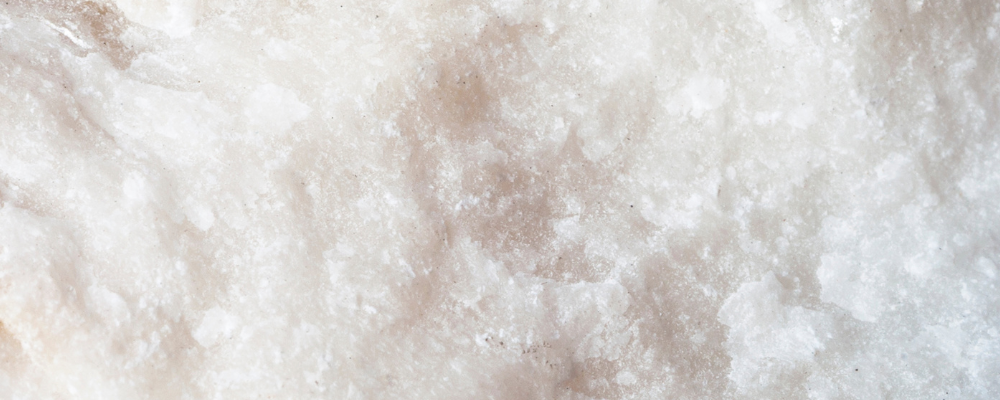
Anhydrite bears a name built on the absence of water. White, gray, blue, or violet, it can form compact masses and crystals with sharply defined planes, like architecture left behind after the retreat of an ancient flow.
This nature gives it a clear place in symbolic work: drying out what overflows, redefining boundaries, and returning each thing to its own space. Its blue variety, known as Angelite, belongs to the same mineral species.
To place this stone among related minerals, compare it with Gypsum, Selenite, and Alabaster.
A Water-Free Calcium Sulfate
Anhydrite is a calcium sulfate, CaSO4. Gypsum has a similar composition, but contains water in its structure. In the presence of moisture and depending on conditions, Anhydrite can hydrate and develop into Gypsum.
The Mindat entry describes the species and its forms. The Encyclopaedia Britannica places it in evaporite deposits where it occurs alongside salt and Gypsum.
The Name Given by Werner
Abraham Gottlob Werner named Anhydrite in 1804 from the Greek anhydros, “without water.” The name directly reflects its difference from hydrated Gypsum.
The equilibria between Anhydrite, Gypsum, and saline solutions are studied in geochemical models, as shown by the USGS PHREEQC documentation. For the reader, the key idea remains simple: the presence or absence of water transforms the structure.
Angelite and Recent Accounts
Angelite is the commercial name given to a pale blue Anhydrite, widely marketed from the late 20th century onward. Its association with angels comes from the name and color; it does not constitute an ancient tradition attached to the mineral.
Anhydrite possesses a more distinctive symbol than this single celestial image. It represents what appears when excess recedes: a clear boundary, available space, and a structure capable of standing without remaining saturated.
Saturn, Mercury, Earth, and Air
Saturn governs boundaries, drying, and consolidation. Mercury helps name categories and reorganize space. Earth provides structure; Air symbolically replaces the removed moisture and restores circulation.
Saturday suits closure and tidying; Wednesday suits reorganization. A chalk line, an empty box, or a gray candle can surround the stone.
Drying, delimiting, completing
Anhydrite supports situations that feel saturated: an overfilled schedule, an emotion taking up all the space, an endless file, or a cluttered place. It invites you to remove excess before seeking to add a new method.
It is also suited to boundary and closure work. Placed near an archive box or an interior door, it reminds us that finishing is not abandoning: it is returning space to what comes next.
The Rite of Returned Space
On a Saturday, draw a rectangle on a sheet of paper. Write inside what should remain in your space; outside, what should leave it. Place Anhydrite on the line.
Say: “I return everything to its proper place and close what is complete.” Then remove an object, task, or commitment that has become unnecessary. Leave the stone on the sheet until the next day.
Correspondences and references
| Reference | Correspondence |
|---|---|
| Nature | Calcium sulfate without structural water |
| Name | From the Greek anhydros, “without water,” 1804 |
| Celestial bodies | Saturn and Mercury |
| Elements | Earth and Air |
| Days | Saturday and Wednesday |
| Ritual colors | White, gray, pale blue |
| Areas | Boundaries, sorting, closure, decluttering |
| Ritual gesture | Separating what remains from what leaves |