





























































































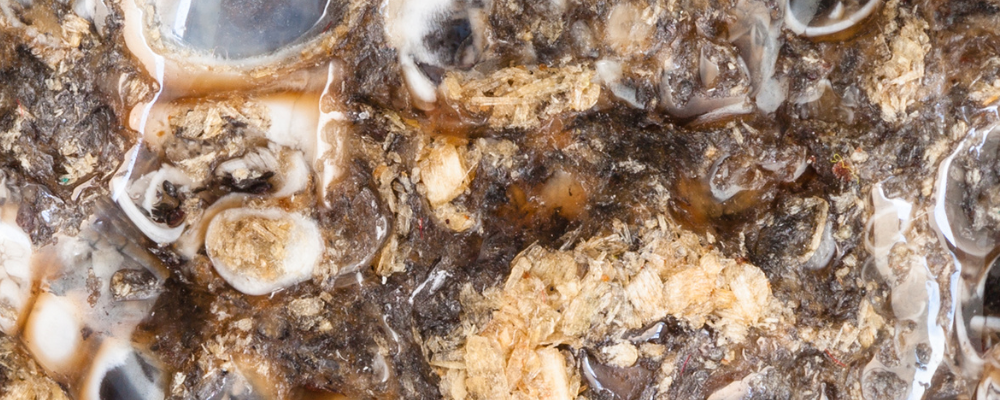
Turritella Agate appears to contain a multitude of tiny coiled lives. In its brown or black Chalcedony, the shells crowd together, intersect, and create a visible memory of ancient lakes.
Its name has remained famous in the lapidary world, even though the fossils are not marine Turritella. This correction does not diminish the stone; it reveals a more accurate story—that of freshwater gastropods preserved for nearly 50 million years.
To place this stone among related minerals, compare it with Agate, Blue Agate, and Dendritic Agate.
Shells in Chalcedony
The stone contains fossil shells embedded in silicified rock. The densest specimens consist of Chalcedony, but they do not necessarily display the bands that define Agate in the strict sense. Nevertheless, the commercial name remains well established.
A study by the Paleontological Research Institution places these deposits in the Green River Formation, in Wyoming, Utah, and Colorado. They formed in Eocene lakes approximately 51 to 49 million years ago.
An Inaccurate Name That Became Famous
The shells belonged to freshwater gastropods generally called Elimia tenera or Goniobasis tenera, not to the marine genus Turritella. The PRI overview explains the history of this confusion and the persistence of the lapidary name.
Using “Turritella Agate” remains understandable for identifying the stone, provided that its actual contents are explained. The value of the piece comes from its fossils, its silicification, and the vanished landscape it preserves.
The Memory of an Ancient Lake
A presentation by the Geological Society of America links these shell accumulations to the lake environments of the Green River Formation. The stone therefore does not preserve a distant ocean, but generations of small lake dwellers.
Its truest symbol is collective continuity. Each shell is small, but their multitude builds the rock. In a contemporary magical practice, Turitella Agate represents lineages, shared works, and modest actions whose accumulation carries them through time.
Saturn, Moon, Earth, and Water
Saturn governs time, fossilization, and inheritance. The Moon accompanies life cycles and the memory of the group. Earth corresponds to the rock that has become an archive; Water recalls the lake where the gastropods lived.
Saturday is suitable for work with ancestors and archives, while Monday suits family continuity. An empty shell, a photograph, or a notebook of names can surround the stone.
Lineage, community, and continuity
Turitella Agate supports genealogical research, collective projects, the transmission of a craft, and commitments intended to endure. It reminds us that a solid work arises less from a dazzling gesture than from a series of connected actions.
It can also support mourning or a period of family change. It does not require repeating the past: it helps recognize what shaped the present, then choose what deserves to continue its journey.
The Rite of the Transmitted Chain
On a Saturday, write three names on a sheet of paper: the name of someone who passed something on to you, your own name, and the name of a person or project that will receive your work. Connect them with one continuous line.
Place the stone at the center and say: “I recognize what I have received, I transform it and pass it on with justice.” Then carry out a concrete act of transmission within seven days.
Correspondences and references
| Reference | Correspondence |
|---|---|
| Nature | Silicified fossil-bearing rock, rich in Chalcedony |
| Fossils | Elimia or Goniobasis tenera |
| Celestial bodies | Saturn and Moon |
| Elements | Earth and Water |
| Days | Saturday and Monday |
| Ritual colors | Brown, black, white |
| Areas | Lineage, memory, community, transmission |
| Ritual act | Connecting three names with a line |