
















































































































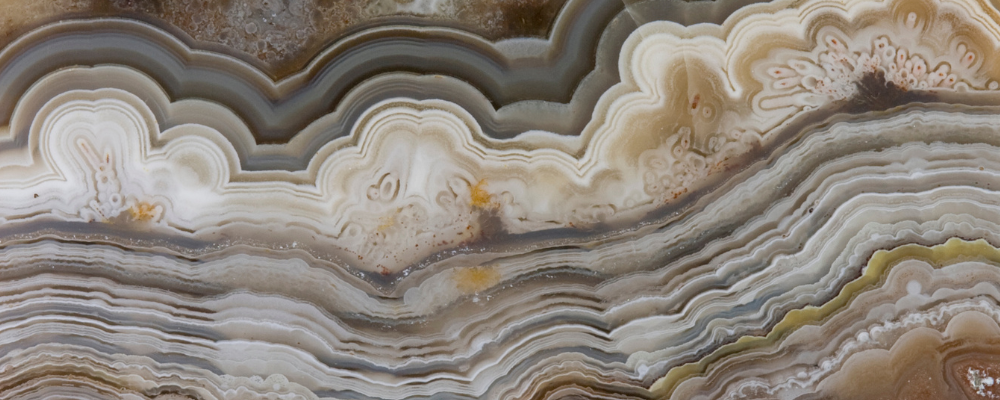
Crazy Lace Agate seems to reject the straight line. Its ribbons twist, cross, start out again, and open unexpected paths in shades of cream, red, ochre, and gray.
Its modern name, which could be translated as “crazy lace,” aptly describes this material in motion. The stone speaks less of disorder than of an intelligence capable of moving through complexity.
To place this stone among related minerals, compare it with Agate, Blue Agate, and Dendritic Agate.
A lace of Chalcedony
Crazy Lace Agate is a banded Chalcedony formed from successive silica deposits. Its scalloped lines can surround cores, fold over themselves, or form small labyrinths. Iron oxides contribute to the yellows, reds, and browns that animate many specimens.
The Mindat mineralogical entry places Agate within the microcrystalline quartz family. A research review published in Minerals shows how its formation can involve several episodes of growth and transformation.
A modern Mexican name
Crazy Lace is a commercial name given to Mexican Agates whose ribbons evoke exuberant lace. It is not an independent mineral species, but a visual type prized for the liveliness of its patterns.
In recent texts, it is nicknamed the “stone of laughter.” This phrase is appealing, but it does not come from a recognized ancient source. It is better to base its magical interpretation on what the stone actually reveals: movement, detour, play, and the ability to connect paths.
What the Agate family conveys
The name Agate is ancient. Theophrastus associated it with the Achates River in Sicily in the 4th century BCE. Lapidary texts later attributed functions of protection, favor, and eloquence to the Agate family.
Crazy Lace has no ancient tradition of its own. It inherits Agate’s general protective heritage, while its particular correspondences stem from a modern reading of its patterns. This distinction allows for a rich practice without inventing a past for it.
Mercury, Jupiter, Air and Earth
Mercury governs skillful detours, exchanges, and agile thought. Jupiter provides breadth and transforms hesitation into momentum. Air supports invention; Earth maintains structure amid the movements of the line.
Wednesday is suited to conversations and clever solutions, while Thursday is suited to collective projects. Knotted threads, a feather, a sheet covered with curves, or a yellow candle can be placed beside the stone on the altar.
Moving Through Complexity
This Agate supports projects with several possible paths, periods of change, and exchanges that require flexibility. It does not promise to make every situation easy: it reminds you that a detour can be a strategy and that a living path is not always straight.
It is suited to writing, creative work, meetings, and journeys involving several stages. Placed near a work surface, it invites you to rediscover flexibility where rigidity was blocking action.
The Rite of the Three Detours
On a Wednesday, draw the problem in the center of a sheet of paper. Draw three curved paths around it. On the first, write the most direct answer; on the second, a possible alliance; on the third, a solution you would not have considered the day before.
Gently roll the stone between the three paths, then choose the one that opens onto a concrete action. Say: “I remain flexible without losing my direction.” Keep the sheet until the first step has been taken.
Correspondences and References
| Reference | Correspondence |
|---|---|
| Nature | Mexican Agate with Scalloped Bands |
| Name | Modern Descriptive Name |
| Celestial Bodies | Mercury and Jupiter |
| Elements | Air and Earth |
| Days | Wednesday and Thursday |
| Ritual Colors | Yellow, Red, Cream |
| Areas | Adaptation, Exchange, Creativity, Solutions |
| Ritual Gesture | Draw Three Paths, Then Choose One |










