


















































































































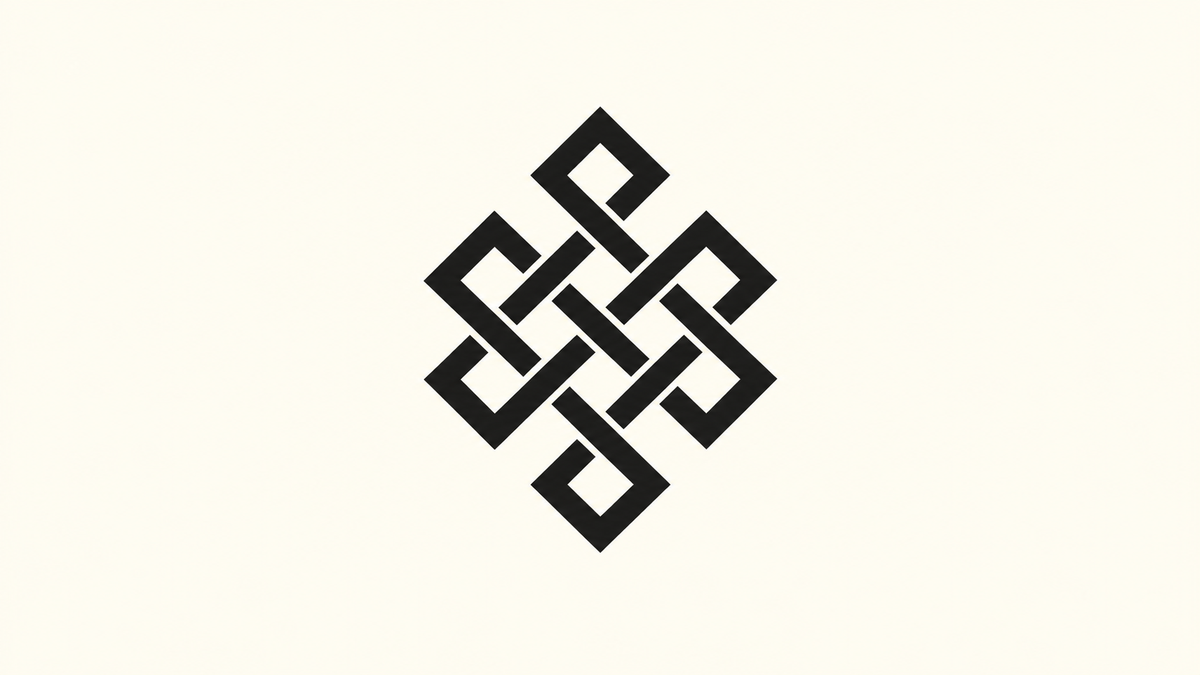
The endless knot is a geometric interlace formed by a line that crosses itself without revealing a beginning or an end. It belongs to the eight auspicious symbols of Buddhism in several Tibetan and Himalayan traditions. Its form naturally invites reflection on continuity, interdependence, and relationships: each segment exists because it passes over or under another. The modern version sometimes makes it a universal symbol of infinity, but its Buddhist context gives it a more precise depth.
| Form | Interlaced line forming a closed network with no visible end |
|---|---|
| Tradition | Tibetan and Himalayan Buddhism |
| Set | One of the eight auspicious symbols |
| Common ideas | Continuity, interdependence, union of causes and consequences |
| To distinguish | Triquetra and other European knots |
How can you recognize the endless knot?
The motif is constructed like a ribbon that crosses itself at regular angles and forms a complex rectangle or square. No end is visible. The eye can follow the line without encountering a visible beginning.
This continuity distinguishes it from the triquetra and Celtic knots. The interlaced similarities are real, but the traditions and historical contexts are not the same.
Tibetan objects may stylize the design extensively, but the principle of a continuous, closed path remains the essential criterion.
Why is it one of the eight auspicious symbols?
In Tibetan Buddhist traditions, the endless knot is part of the ashtamangala, a set of eight auspicious symbols used on textiles, ritual objects, paintings, and architecture.
The Metropolitan Museum houses a Tibetan lute from the late 19th century whose sound hole takes the form of an endless knot, explicitly identified as one of the eight Buddhist emblems.
The Wheel of Dharma and the lotus belong to the same set, which explains their common presence on many ceremonial objects.
What does the interlace without beginning or end mean?
The continuous line lends itself to an interpretation of interdependence. No segment is completely autonomous: each part participates in a network of intersections.
This structure corresponds well to Buddhist themes such as the interdependence of phenomena and the relationship between causes and consequences. It can also be interpreted as continuity of the teachings or the union of wisdom and method.
However, one should avoid reducing all Buddhist schools to a single definition of the motif. Interpretations vary, and the knot also functions as an auspicious sign without a philosophical explanation necessarily being made explicit on every object.
Where is it found in Tibetan art?
The endless knot appears on textiles, ceremonial weapons, furniture, musical instruments, jewelry, and paintings. It may stand alone or be incorporated into the complete series of the eight emblems.
The Metropolitan Museum notably preserves a Tibetan dagger decorated with several auspicious signs, including the knot and the Wheel of the Law. These objects show that the symbol fully belongs to material culture, not just to abstract diagrams.
Its structure is particularly well suited to engraving, textiles, and metalwork, because the interlacing can fill a surface without losing its legibility.
Why does it become a symbol of infinity?
A ribbon with no beginning or end easily evokes infinity. This contemporary interpretation is therefore visually logical and extends the motif’s continuity.
The risk arises when its Buddhist context is forgotten and it is presented as a “universal symbol” independent of any history. Its visual power is general, but its place among the eight auspicious signs is historically situated.
The comparison with the ouroboros is interesting: one creates continuity through a circular serpent, the other through an interlacing pattern. Both suggest the absence of interruption, without sharing the same origin.
Historical sources and reference points
The Metropolitan Museum of Art displays a Tibetan lute whose endless knot is identified as one of the eight auspicious emblems of Buddhism. The same motif appears alongside the Wheel of the Law on an 18th- to 19th-century Tibetan dagger.










