



















































































































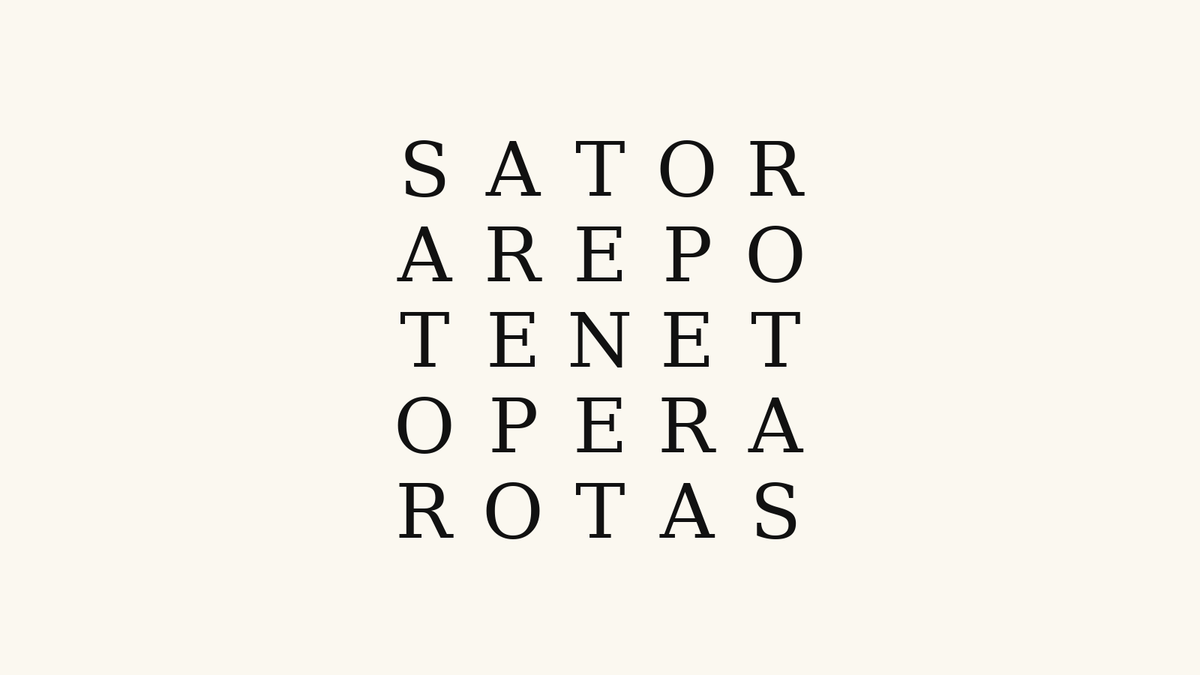
The SATOR square is a grid of five Latin words - SATOR, AREPO, TENET, OPERA, ROTAS - arranged so that they can be read in several directions. Examples of the ROTAS-SATOR form were found at Pompeii and therefore predate the eruption of 79. The exact meaning of the formula remains debated. In the Middle Ages and the modern era, however, the square acquired a clearly magical and protective use: it was inscribed on amulets, houses, objects, and protective recipes.
| Palindrome | How does the SATOR square work? |
|---|---|
| Pompeii | Why are the ancient examples decisive? |
| Pater Noster | What is the Christian cryptogram hypothesis worth? |
| Magic | When did the square clearly become protective? |
| Meaning | Why does AREPO remain a problem? |
How does the SATOR square work?
The five words are arranged on five lines of five letters. The structure allows horizontal and vertical readings, in both directions, with TENET at the center.
This construction transforms an obscure phrase into a graphic and verbal object, which explains its lasting fascination.
Why are the ancient examples decisive?
Two examples found at Pompeii prove that the formula existed before the eruption of 79. Academic research indicates that the older form begins with ROTAS rather than SATOR.
This dating rules out the square being a medieval invention, even though its magical use became much more visible later.
What is the Christian cryptogram hypothesis worth?
In the 20th century, several researchers noticed that the letters can be rearranged into two intersecting PATER NOSTER phrases, leaving two A's and two O's interpreted as Alpha and Omega.
The idea became highly successful, but the examples from Pompeii raise a chronological problem: the Christian use of these formulas at that date remains debated. Recent studies therefore leave the question open.
When did the square clearly become protective?
From Late Antiquity and the Middle Ages onward, the square appears in contexts where its apotropaic function is much clearer.
It was inscribed to protect buildings, accompany amulets, or form part of recipes for healing and protection against evil.
The SATOR thus becomes an excellent example of an ancient formula whose magical uses developed over a very long period.
Why does AREPO remain a problem?
The word AREPO has no certain Latin explanation. Attempts to translate the phrase therefore depend largely on how this term is interpreted.
Researchers have proposed a proper name, a borrowed term, a wordplay, or an element created to make the palindrome possible.
This uncertainty is part of the symbol’s history: its structure is certain, but its original meaning is not.
Sources and historical background
For the oldest examples and the debate over the Christian cryptogram, see Duncan Fishwick, “On the Origin of the Rotas-Sator Square”, Harvard Theological Review. Cambridge University Press also chronicles the long history of interpretations and protective uses of the square.










