



















































































































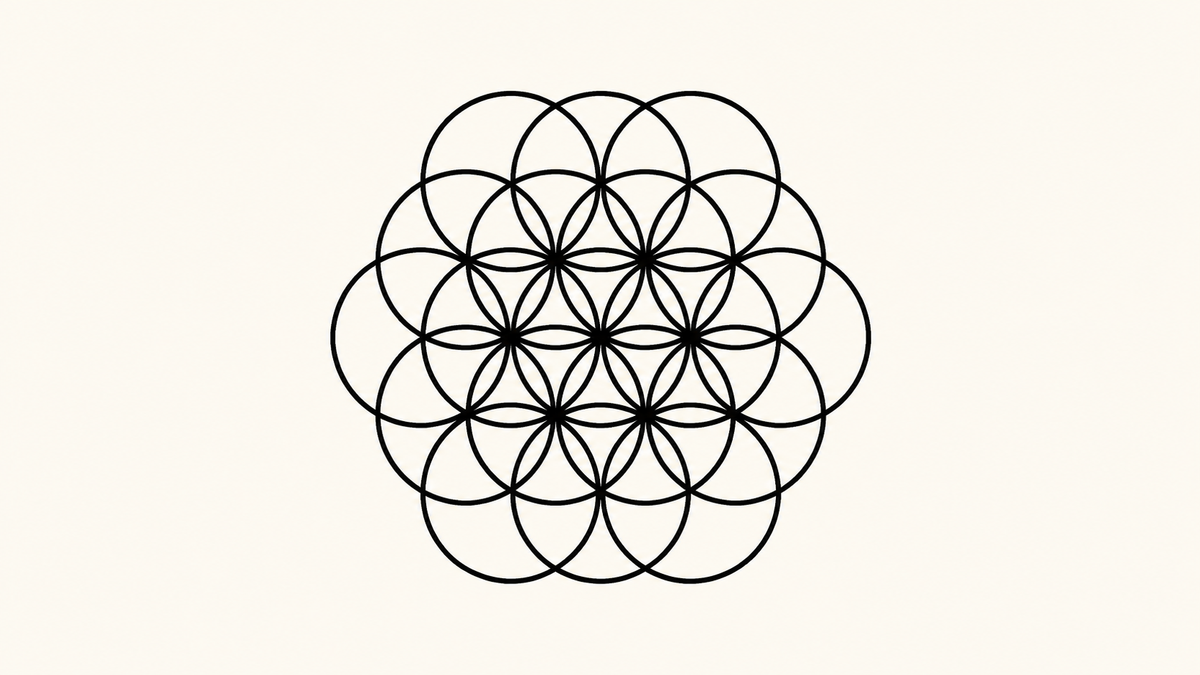
The Flower of Life is a pattern of equal circles whose centers are arranged on a triangular grid. The interlacing draws six-lobed petals and can be extended indefinitely. A highly recognizable contemporary version features nineteen circles, but the geometric principle does not stop at this boundary. Comparable circle networks appear in ancient ornament; however, the expression “Flower of Life” and the idea of a universal diagram of creation were popularized by esoteric literature in the late twentieth century.
| Construction | Congruent circles, centers on a triangular grid |
|---|---|
| Symmetry | Sixfold rotational symmetry |
| Common version | Nineteen visible circles |
| Origin of the design | Interlacing motifs attested in several cultures |
| Current name | Popularized in contemporary sacred geometry |
How do you draw the Flower of Life?
Start with a circle and mark its radius around its circumference, creating six evenly spaced centers. A first ring of six circles forms the Seed of Life; by adding new centers, the motif expands into a hexagonal grid.
The arrangement does not depend on a religious convention: it results from the properties of the circle and the equilateral triangle. Each new circle forms lenses and rosettes with its neighbors.
Where can comparable motifs be found throughout history?
Grids of interlocking circles can be seen on Near Eastern objects and ancient mosaics. MathWorld specifically lists a Phoenician ivory dating from around 900 BCE and Roman examples. Leonardo da Vinci also studied constructions based on the repetition of circles.
The famous motif photographed at the Osireion of Abydos attests to a comparable design, but its exact date and possible religious function cannot be inferred from its location on the monument alone.
Why does it become an emblem of sacred geometry?
Repeating the same shape produces a complex drawing without losing its initial regularity. It is this transition from a simple unit to an organized whole that appeals to authors of sacred geometry.
Interpretations of growth, the relationship between all things, or cosmic harmony belong to this reception. They give the pattern a current spiritual significance, without proving that it had exactly this meaning in every ancient culture.
What are the differences between the Fruit and the Seed of Life?
The Seed of Life retains only seven circles around a center. The Fruit of Life selects thirteen center positions in the grid and prepares the construction called Metatron’s Cube.
The Flower of Life constitutes the general grid. These names organize a modern pedagogical progression; they are not the historical names of these figures on ancient monuments.
Why are the origins attributed to the Flower of Life problematic?
Claims are sometimes made that every ancient civilization knew the same mathematical secret, transmitted without interruption. The surviving drawings are not sufficient to establish such a lineage.
What can be demonstrated is already remarkable: a compass construction produces repeatable structures, visible across different periods and on different media. Their history must be studied case by case.
Sources and historical reference points
Wolfram MathWorld, “Flower of Life” distinguishes the geometric grid from its modern names. “Overlapping Circles Grid” brings together several ancient attestations, including a Phoenician ivory piece and Renaissance examples.










