






























































































The caduceus is the staff of Hermes, Mercury among the Romans. Its best-known form shows two snakes coiled around a staff, with wings in many later representations. Behind this image lies, first and foremost, the attribute of a herald: Hermes is the messenger who moves between realms, accompanies travelers, and presides over exchanges. The history of the caduceus then extends into heraldry, Hermeticism, and alchemy, before a modern confusion placed it in part of medical iconography instead of the staff of Asclepius.
| Greek name | Kerykeion, herald's staff |
|---|---|
| Attribute | Hermes among the Greeks, Mercury among the Romans |
| Classical form | Staff bearing two intertwined snakes; wings are not essential for identification |
| Associated functions | Herald, message, passage, travel, exchange, and commerce |
| To distinguish | Staff of Asclepius: a single snake, without a pair of wings, associated with medicine |
How can you recognize the true caduceus of Hermes?
The caduceus is first recognized by its central axis and its two snakes. Contemporary versions frequently add a pair of wings at the top, but the wings are not the fundamental criterion. Archaic and Classical Greek objects already show the kerykeion ending in two intertwined snakes, without necessarily adopting the perfectly symmetrical silhouette of modern emblems.
The Metropolitan Museum of Art notably preserves a bronze element from the late 6th or early 5th century BCE depicting the pair of snakes surmounting the staff carried by Hermes. An Attic lekythos from the early 5th century also shows the god equipped with his herald's staff. These works place the caduceus within Greek iconography long before Hermetic and alchemical developments.
Modern symmetry tends to transform the snakes into a regular double helix. Ancient forms may be freer. To identify the sign, it is therefore better to look for Hermes's staff and the pair of snakes than to rely on a recent graphic version treated as an absolute standard.
Why does Hermes carry a herald's staff?
Hermes is the messenger of the gods and the protector of several activities connected with movement: travel, roads, commerce, exchange, speech, and transmission. His kerykeion belongs to the world of heralds, figures authorized to travel and carry a message between cities or between camps. The staff therefore marks a function before becoming an abstract symbol.
The Metropolitan Museum recalls that the same type of sign was carried by Greek heralds who traveled from one city to another. This dimension explains an essential part of the caduceus: it accompanies the one who crosses boundaries, negotiates, transmits, and connects.
Hermes himself occupies a mediating position. In Greek tales, he travels between the world of the gods, that of humans, and the realm of the dead. The caduceus thus becomes the ideal attribute of a god who is not assigned to a single realm. This capacity for passage would later nourish Hermetic interpretations of the symbol.
Commerce also belongs to his domain. The modern link between the caduceus, exchange, and commercial activity therefore does not come from nowhere: it extends an ancient function of Hermes-Mercury, even if current institutional uses do not exactly reproduce those of Classical Greece.
What can we actually say about the two snakes?
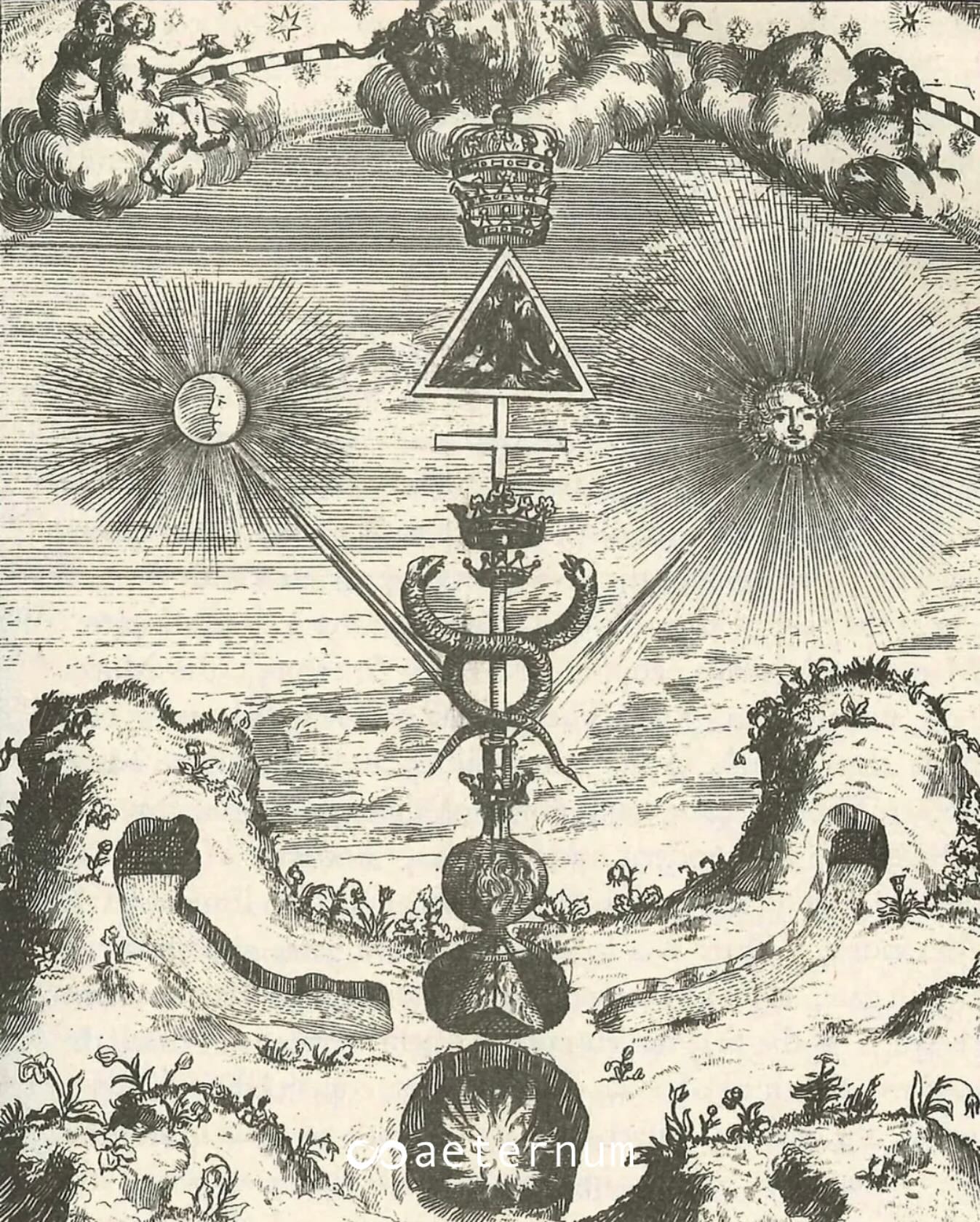
The two snakes have become the most discussed part of the caduceus. Modern interpretations present them as two opposing forces, two currents, masculine and feminine, sun and moon, or principles balancing around an axis. These readings may belong to coherent occult systems, but they should not be projected onto every ancient representation without a source.
The most certain historical fact is their association with the staff of Hermes. Their paired arrangement naturally creates an image of balance, and the snake possesses a broad range of meanings in the ancient world. However, no universal dictionary makes it possible to assert that the two animals “mean” the same duality everywhere.
A later legend tells that Hermes separated two snakes fighting with his staff, after which the animals coiled around the shaft. This story strongly encouraged the reading of the caduceus as a sign of conciliation. It belongs to the tradition of the symbol's reception and should not replace the study of the Greek objects themselves.
The contrast with the ouroboros is useful: the ouroboros depicts a single snake joining its tail and forming a circle; the caduceus arranges two snakes around an axis. Both motifs use the same animal, but their geometry and history are entirely different.
Caduceus and staff of Asclepius: why are they confused?
The caduceus of Hermes bears two snakes and may be winged. The staff of Asclepius shows a single snake coiled around a staff without wings. Asclepius is the Greek god of medicine and healing; his staff is the historical emblem most directly associated with the medical art.
The confusion intensified in the contemporary era, particularly in the United States, when organizations connected with health adopted the caduceus. The Science Museum Group recalls that the institutional use of the caduceus in the United States contributed to blurring the two signs, while medical organizations have also retained or adopted the staff of Asclepius.
This difference is not a graphic detail. Replacing one snake with two and adding wings changes an attribute of Asclepius into one of Hermes. For a guide, piece of jewelry, logo, or historical illustration, the error therefore changes the identity of the symbol.
The caduceus can legitimately appear in a context of commerce, communication, Mercury, or Hermeticism. Presenting it as the “Greek symbol of medicine” without specifying the modern confusion erases the role of Asclepius.
Why does the caduceus enter the alchemical imagination?
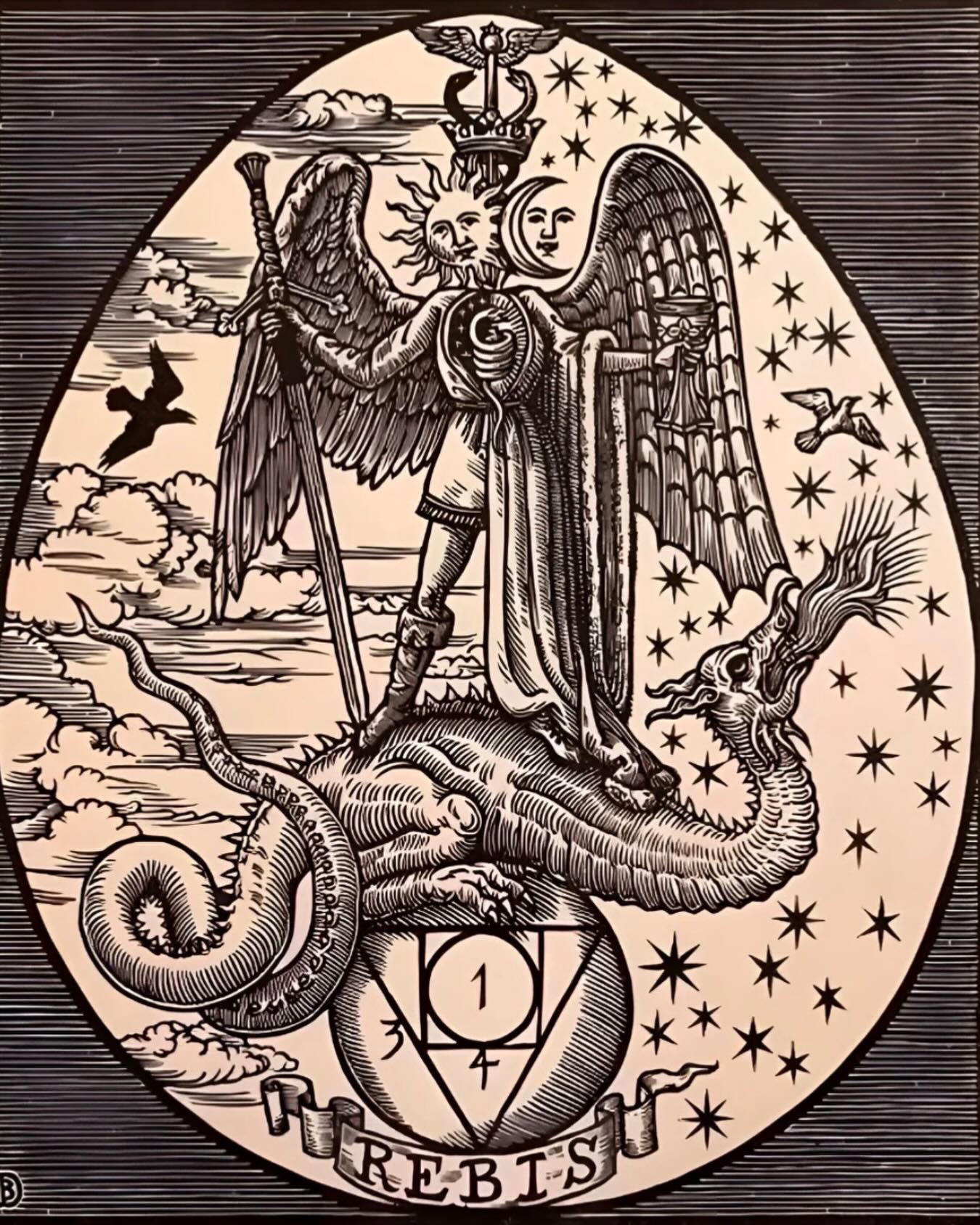
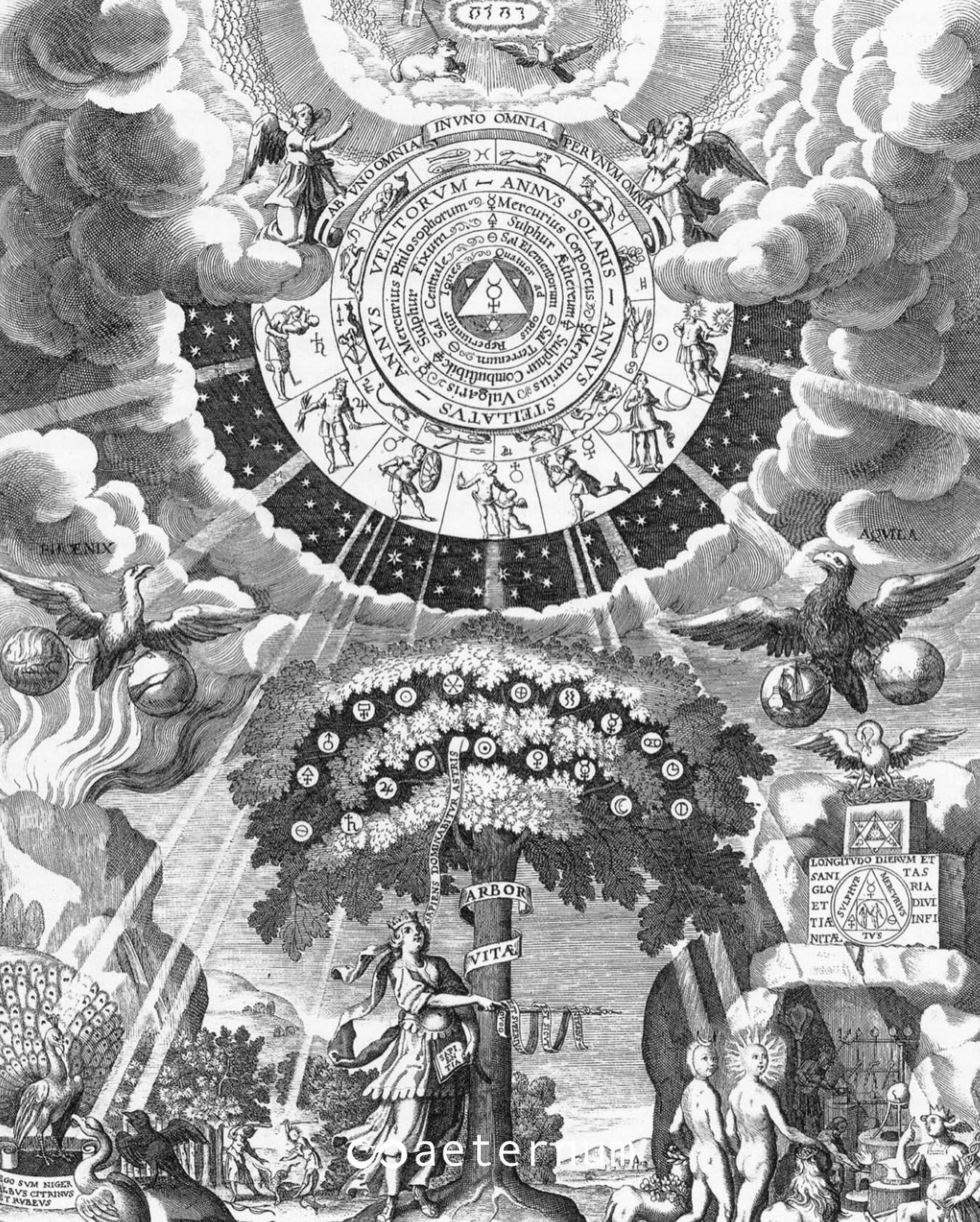
The transition toward alchemy is based first on Mercury. Hermes becomes Mercury in the Roman world; Mercury gives its name to a planet and to quicksilver; the alchemical tradition then makes Mercury a major principle of matter. The caduceus thus becomes connected to a network of correspondences in which mobility, mediation, and transformation occupy a central place.
Hermeticism adds a second path. The texts attributed to Hermes Trismegistus gave the name of Hermes considerable authority in scholarly and occult circles. The god's attribute could then be reread as a Hermetic emblem, even though the Greek caduceus existed long before this reception.
The two snakes surrounding an axis also lend themselves to interpretations of polarity and union. In modern occult compositions, they may represent complementary forces rising toward a point of resolution. This language belongs to later developments and should be presented as such.
The caduceus is therefore a symbol with several layers: a herald's staff, an attribute of Hermes, a sign associated with exchange, a Mercurial emblem, and then a figure reinvested by Hermeticism. Distinguishing them helps avoid shortcuts while preserving the full richness of its history.
Sources and historical references
The Metropolitan Museum of Art preserves a Greek kerykeion element from the late 6th or early 5th century BCE with two intertwined snakes; an Attic lekythos shows Hermes carrying his herald's staff. For the distinction between the caduceus and the staff of Asclepius in medical iconography, see the Science Museum Group.