



















































































































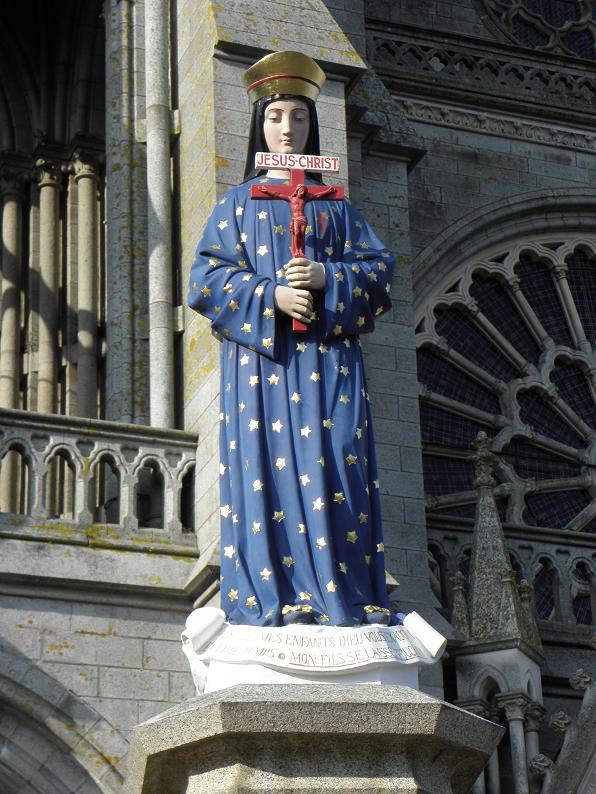
Our Lady of Pontmain is associated with a Marian apparition reported on January 17, 1871, in a village in Mayenne, at a time when the Franco-Prussian War posed a direct threat to the region. Several children said they saw a woman in the sky wearing a blue dress covered with stars. A written message gradually formed before their eyes and called them to prayer. The event, followed with concern by the inhabitants, quickly took an important place in their memory. In February 1872, the Bishop of Laval recognized the apparition. The shrine would later become known under the titles of Our Lady of Prayer and Mother of Hope.
| Location | Pontmain, Mayenne |
|---|---|
| Date | January 17, 1871 |
| Witnesses | Children from the village, notably Eugène and Joseph Barbedette |
| Recognition | February 2, 1872, Bishop Wicart |
| Titles | Our Lady of Prayer, Mother of Hope |
| Feast day | January 17 |
The 1870 War at the Gates of Mayenne
In January 1871, France was engaged in a war against Prussia and its German allies. The French armies had suffered serious defeats, and the region around Laval feared another enemy advance. The inhabitants of Pontmain lived in anxiety: some men had gone to fight, while families awaited news.
The village belonged to a rural world in which communal prayer held an important place. The parish priest, Abbé Guérin, supported the population during the war. It was in this atmosphere of fear and religious mobilization that the event reported on the evening of January 17 took place.
The history of Pontmain must be placed within this precise context. The account of the apparition and the memory of the halt of the military advance became linked in local memory, but their historical relationship requires distinguishing religious testimonies from decisions made on the ground by the armies.
The Lady in the Blue Dress in the Village Sky
On the evening of January 17, Eugène and Joseph Barbedette said they saw a luminous female figure above a house. Other children subsequently confirmed what they said they were seeing. The adults present did not distinguish the same figure and mainly observed the reactions of the young witnesses. The scene unfolded as the inhabitants gathered and began to pray.
The lady was described as wearing a blue dress covered with golden stars, along with a veil or cloak and a crown. This iconography would appear in the statues and stained-glass windows of the shrine. The forms and colors of the image were reported during the investigations and later established throughout the history of the devotion.
The account has a progression: Mary's appearance changed over the course of the evening, while signs and words manifested themselves according to the children. The communal time of prayer occupies an essential place in the memory of the event.
The Written Message That Appears Beneath the Virgin
The witnesses said that a banner formed below the figure and that luminous letters gradually appeared on it. The message called the children to pray, affirmed that God would answer them, and recalled the goodness of Jesus. The wording unfolded during the community's prayer, making the account particularly distinctive.
Unlike Lourdes or La Salette, the message of Pontmain was not conveyed mainly as a long speech heard by the children. It appeared in a visual and written form. This characteristic explains the presence of the banner bearing the words of the apparition in many representations of the shrine.
Tradition understands these words as an invitation to trust and persevere in the face of danger. Their context was that of a community confronted with fear; prayer became a place where the inhabitants sought to preserve their hope.
The Red Crucifix and the End of the Apparition
During the account, the figure of Mary also appeared accompanied by a large red crucifix. This sign placed the Passion of Christ at the center of the scene and connected Pontmain with other apparitions of the 19th century in which the crucifix held an important place, notably La Salette.
The children described several successive stages, until the image disappeared. The time of the apparition is therefore recounted as a prolonged experience, lived in the midst of a group of parishioners at prayer. The community preserved the event as a source of confidence at a time when the military danger seemed very close.
Modern representations of Our Lady of Pontmain sometimes show the Virgin alone with her star-covered dress, and sometimes the message and the crucifix. The different compositions correspond to moments in the account and are not contradictory portraits.
Recognition on February 2, 1872
The witnesses' statements and the circumstances were quickly examined by the diocesan authorities. On February 2, 1872, Bishop Casimir Wicart, the first Bishop of Laval, officially recognized the apparition. This decision came a little more than a year after the events, when their memory had already spread widely throughout the region.
The ecclesiastical judgment allowed a shrine to develop and provided a framework for public devotion. It did not turn the message into a new doctrinal revelation equivalent to Scripture. Recognition of a private apparition is a discernment concerning a particular event and its religious fruits.
The speed of the process helped make Pontmain an important Marian figure in 19th-century France. The Diocese of Laval preserves documents on the history of the recognition and on the development of the village's memory.
Our Lady of Prayer and Mother of Hope
The title Mother of Hope has been associated with Pontmain since its recognition by Bishop Wicart. The title Our Lady of Prayer also gained a major place in the shrine's tradition, particularly through an intervention by Leo XIII at the end of the 19th century. These names express how Christian communities understood the event.
The basilica built at Pontmain gives an important place to the colors and images of the apparition. Pilgrimages and celebrations allow the faithful to reconnect with the memory of that evening in January 1871. Communal prayer remains at the heart of the devotion, in connection with families' anxieties and situations experienced as hopeless.
The shrine is a particularly suitable place for meditation on peace, trust, and fidelity. The presence of the written message recalls that the call addressed to the witnesses was directly embedded in the inhabitants' prayer.
January 17 and the Memory of the Village
The feast of Our Lady of Pontmain is celebrated on January 17. The shrine attracts visitors who come to pray for peace, their families, and people facing anxiety. The memory of the 1870–1871 war remains connected with the site's founding history without exhausting the meaning of the message.
The iconography of the star-covered blue dress, the red crucifix, and the luminous banner makes Pontmain recognizable among the great French Marian shrines. The Our Lady of La Salette page offers another example of the importance assumed by the Passion in Marian images of the same century.
Pontmain thus brings together a body of testimonies, an episcopal decision, and a tradition of prayer that continued across several generations. Discovering these sources helps us understand what the event represented for a village in wartime.
Sources and References
Diocese of Laval, review of the apparition of January 17, 1871, and its recognition by Bishop Wicart in 1872.
Diocese of Laval, presentation of Our Lady of Pontmain and local Marian devotion.
Pontmain Shrine, historical dossier on the witnesses, the basilica, and Marian prayer, to be compared with the documents from the diocesan investigation.
Illustration: GO69, photograph of Our Lady of Pontmain on the basilica forecourt, 2011, Wikimedia Commons. Authentic image source, without artificial generation.










