



















































































































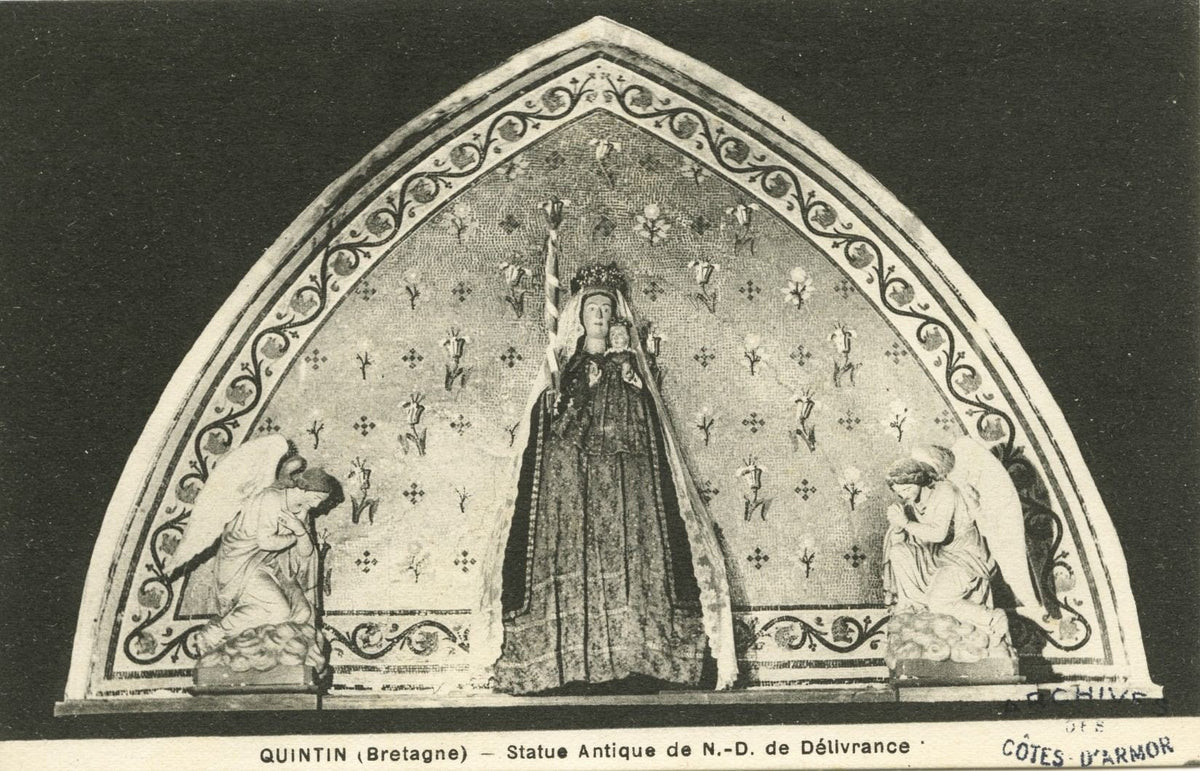
Our Lady of Deliverance is a Marian title used in several regions to ask for Mary's protection amid dangers, trials, and situations of captivity. It does not refer to a single apparition common to all the sanctuaries that bear this name. In Brittany, the basilica of Quintin is one of the most interesting sites of this devotion: it preserves the memory of a relic of Mary's belt, traditionally attributed to a return from the Crusade in the 13th century, and has a history closely linked to wars and the vows of local residents. The name Deliverance thus connects prayer, the memory of help received, and pilgrimage practices.
| Nature | Marian title of protection and aid |
|---|---|
| Sanctuary studied | Basilica of Our Lady of Deliverance, Quintin, Brittany |
| Local tradition | Reliquary of Mary's belt, associated with the 13th century |
| Construction | Current basilica opened for worship in 1887 |
| Coronation | July 29, 1934 |
| Local feast | Pardon on the second Sunday of May in Quintin |
Deliverance in Christian prayer
The word deliverance refers to the idea of being freed from danger, oppression, or trial. The Psalms and the Gospels use this vocabulary extensively to speak of God's help. In the Catholic tradition, Mary may be invoked under this title because the faithful ask her to pray for them and accompany them in situations where the outcome seems uncertain.
This invocation should not be confused with a guarantee of results. Prayer does not replace the steps necessary to protect a person, heal them, or bring them to safety. The title of Our Lady of Deliverance belongs to the language of hope, aid, and trust.
Churches and chapels have received this name in different contexts. Local histories help explain why a community chose a Marian title that particularly expresses its concerns.
Quintin, a Marian sanctuary in Brittany
The town of Quintin, in Côtes-d’Armor, has a long history of Marian devotion. The Basilica of Our Lady of Deliverance lies at the heart of this memory. A tradition links its origins to the arrival in Brittany of a relic of Mary's belt after the Seventh Crusade in the 13th century.
The account mentions Geoffroy Boterel, Lord of Quintin, who left with his brother Henri d’Avaugour on the expedition led by Louis IX. On his return, a relic allegedly given to him in the Holy Land was placed in the castle chapel. Veneration of the site grew, and new buildings were constructed to meet the needs of the faithful.
These episodes have the character of medieval religious tradition. Studying them requires distinguishing the documents preserved at the sanctuary from accounts concerning the relic's origins, whose material authenticity cannot be established by veneration alone.
Mary's belt and the reliquaries
The belt relic holds an important place in the life of Quintin. It is preserved in reliquaries that belong to the material history of the devotion. Christian tradition knows of several belts attributed to the Virgin, located in different sanctuaries; their provenance requires a study specific to each institution.
The belt is a symbol of connection, protection, and faithfulness. In medieval Christian culture, relics are associated with the prayers of the faithful and the memory of holy figures. Their presence in a church can help make it a pilgrimage site and help fund buildings intended for worship.
In Quintin, the history of the reliquaries accompanies that of the successive buildings. It explains the central role given to the Virgin in the memory of the town.
A basilica built in the 19th century
The current basilica opened for worship in 1887. It replaced a medieval collegiate church that had become insufficient for the needs of the parish and pilgrims. The project developed in a context of religious and urban transformations, after periods of war that had deeply affected the residents.
A local tradition refers to a vow made in 1871, when the advance of the Prussian armies alarmed the region. The construction of a new building became a way of expressing the community's gratitude and trust. The stained-glass windows and religious objects evoke several stages of this history, from the Crusades to the contemporary era.
The sanctuary thus offers an example of how a Marian title can bring together a medieval memory and a modern devotion without requiring them to be presented as one continuous and unchanged event.
The 1934 coronation and the Pardon of Quintin
On July 29, 1934, the statue of Our Lady of Deliverance received a solemn coronation. This celebration marked an important stage in the local recognition of the devotion and accompanied the basilica status granted to the building. It bears witness to the place Mary occupies in the prayers of residents and pilgrims.
The Pardon of Our Lady of Deliverance is celebrated each year on the second Sunday of May. This Breton tradition brings together the liturgy, processions, and the memory of a community. It differs from a universal liturgical calendar that would set the same date for all sanctuaries called Our Lady of Deliverance.
The faithful can travel to Quintin to discover the basilica, its stained-glass windows, and its history. The Marian title then takes on a meaning connected to a real place and generations of prayers.
A title found in several communities
Our Lady of Deliverance is found beyond Brittany, with Marian usages specific to other regions. In several traditions, the title accompanies intentions concerning captives, suffering families, or people awaiting help. These forms should not all be attributed to the same historical origin or a single image.
The figure of Mary as protector recalls that of Our Lady of Mercy, whose great mantle shelters the faithful. But the two titles have histories and representations that are not identical.
Discovering Quintin makes it possible to explore a well-documented branch of this history, with its relics, architecture, and calendar. It gives the name Deliverance a heritage and spiritual depth that goes beyond a simple prayer formula.
The stained-glass windows and objects that tell Quintin's story
The Basilica of Quintin has a decorative program that makes it possible to trace several stages of the local devotion. The stained-glass windows and works preserved in the building recall the history of the lords, the presence of the belt attributed to Mary, and the construction of the new church. The sanctuary thus becomes a place where residents can read their own memory through religious scenes.
In a 19th-century church, stained glass serves more than a decorative function. It conveys narratives to generations of the faithful and inscribes an interpretation of the events that shaped the town in the building's light. The stories of crusades, vows, and protection must nevertheless be distinguished according to their sources and age.
The presence of a venerated relic also gives liturgical objects a particular dimension. The reliquaries bear witness to how a community preserves the memory of a Marian title, even when the material provenance of the relic belongs to a tradition that is difficult to confirm.
Visiting Quintin therefore makes it possible to approach Our Lady of Deliverance as a living heritage, connected to architecture, the Breton pardon, and the social history of a town.
Sources and references
Parish of Quintin, history of the basilica, belt, and successive buildings.
Parish of Quintin, 1934 coronation and annual Pardon.
Psalms, Psalm 90, biblical vocabulary of protection and refuge.
Illustration: Old postcard of the statue of Our Lady of Deliverance in Quintin, Archives of Côtes-d’Armor, archival document.










