



















































































































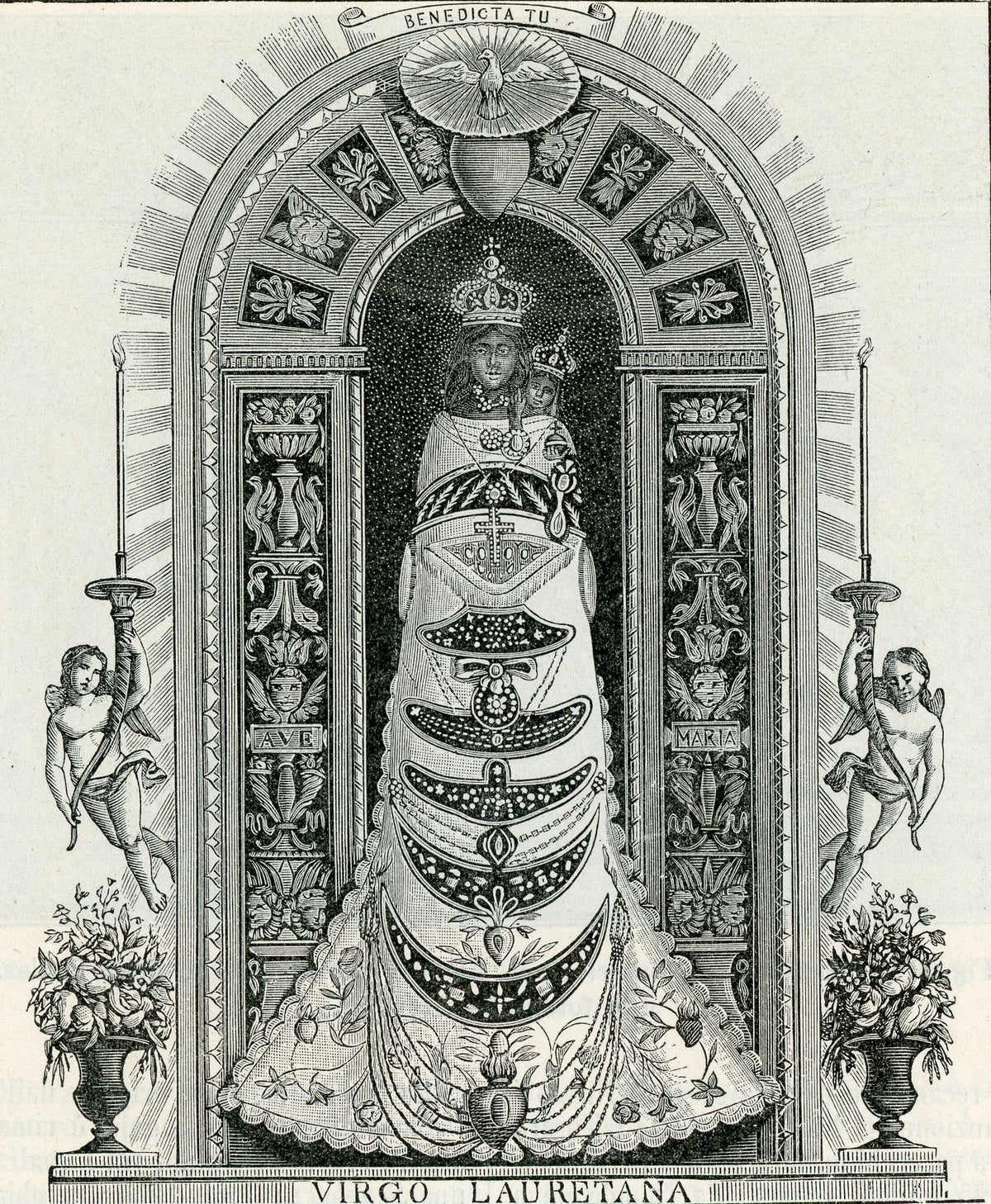
Our Lady of Loreto is associated with the Italian sanctuary of Loreto, in the Marche region, where a small three-walled structure is venerated as the Holy House of Mary. Tradition presents it as part of the home in Nazareth where she is believed to have lived and received the Annunciation. According to the most famous account, angels transported the house from the Holy Land to Italy at the end of the 13th century. Historical explanations also consider the possibility that people transported the stones during the time of the Crusades. The Basilica of Loreto preserves this house at its center and gave rise to a devotion associating the Incarnation, pilgrimage, and the protection of travelers.
| Location | Loreto, Marche, Italy |
|---|---|
| Venerated object | Holy House, three stone walls |
| Tradition | Translation from Nazareth, arrival in 1294 |
| Basilica | Built mainly between 1469 and 1587 |
| Feast | December 10 |
| Patronage | Airmen and travelers in the Catholic tradition |
Mary's house in the memory of Nazareth
The Gospels place the Annunciation in Nazareth, a Galilean town where Mary receives a visit from Gabriel. Luke 1 does not, however, provide an architectural description of the house in which she lives. Christian memory of holy places gradually identified several sites in Nazareth with the story of Mary and the Holy Family.
The Italian sanctuary of Loreto preserves a small structure venerated as the masonry portion of this house. Tradition distinguishes a cave in Nazareth from three walls that are said to have stood in front of it. This representation was developed in the sanctuary's texts and studies.
The connection between the small house and the Incarnation explains the strength of this devotion. The site does not celebrate a figure other than Mary: it seeks to bring closer the everyday setting in which tradition places the reception of the divine word.
The translation from 1291 to 1294
According to the traditional account, the Holy House left the Holy Land at the end of the 13th century, when Christian settlements in the region faced serious threats. A first stage is located in Illyria, particularly at Tersatto, near Rijeka, and the transfer ended in the territory of Recanati on the night of December 9-10, 1294.
The most famous version attributes this journey to angels, who are said to have carried the house through the air. Another interpretation involves people who rescued the materials and transported them by sea. Research has also proposed connections with a noble family whose name, Angeli, may have contributed to the traditions of the translation.
These hypotheses do not all have the same level of documentation. It is important to distinguish accounts of faith, historical possibilities, and the conclusions of material studies. The arrival of a venerated structure in Italy at the end of the Middle Ages does not mean that every detail of a miraculous transport is historically established.
Three walls preserved in a great basilica
The center of the sanctuary of Loreto is a modestly sized house, formed by three walls and surrounded by architectural protections created over the centuries. The basilica that houses it, built mainly between 1469 and 1587, belongs to the history of the Italian Renaissance and preserves a rich collection of works of art.
The contrast between the small structure and the grandeur of the building reflects a logic of pilgrimage: the house remains the central point, while the basilica accommodates crowds and protects the site. Pilgrims come to pray in a space designed as a tangible reminder of Nazareth.
The sanctuary distinguishes the walls attributed to the former house from the parts added to preserve it. This architectural reading is essential for understanding the site's transformations.
Excavations and research on the stones
Archaeological research was conducted in Nazareth in the mid-20th century and beneath the Holy House of Loreto in the 1960s. The studies examined the structure of the walls, the absence of ordinary foundations, and possible relationships between the materials of Loreto and building traditions in Palestine.
The sanctuary regards these observations as elements supporting its tradition. The historian must nevertheless distinguish material similarities, hypotheses about transport, and the certain identification of a specific 1st-century dwelling. No architectural analysis can, by itself, prove that Mary personally lived in a particular house.
The interest of these studies lies in the dialogue between building history, Near Eastern archaeology, and the transmission of relics. They make it possible to move beyond a simplistic opposition between account and material reality.
Our Lady of Loreto and the statue's clothing
The iconography of Our Lady of Loreto frequently depicts Mary carrying the Child Jesus, wrapped in a richly decorated mantle. In some images, the Holy House is carried by angels and crosses the sky above the sea or Italian landscapes. These compositions helped establish the account of the translation.
Artists combine two themes: the Annunciation at Nazareth and the arrival of the house in Italy. The miniature building becomes an attribute that identifies the title of Loreto, just as the column identifies Our Lady of the Pillar.
In modern representations, airplanes and travelers may also appear because of the patronage of airmen associated with Our Lady of Loreto in the 20th century. This reception belongs to an era far removed from the medieval legend, but it symbolically extends the idea of movement.
The Litany of Loreto and Marian prayer
The name of Loreto is also associated with the Litany of Loreto, a series of invocations addressed to Mary and received in the Latin tradition. They became widely disseminated from the modern era onward. The sanctuary contributed to their popularity, but the titles they use belong to a broader liturgical history.
The invocations refer to Mary as mother, virgin, queen, refuge, and help. They do not describe a particular apparition; they bring together themes that have been contemplated by Christian communities. Their use in processions and family prayer helps make known several of the titles found in the Christian Collection.
December 10 remains the traditional feast of Our Lady of Loreto. The basilica and the Holy House bring together the memory of Nazareth, the history of pilgrimages, and devotion to Mary's motherhood.
The patronage of airmen and the changing meaning of Loreto
The tradition of the Holy House being transported through the air took on new meaning when aviation developed at the beginning of the 20th century. In 1920, Benedict XV proclaimed Our Lady of Loreto the patron saint of airmen. The memory of a celestial journey, transmitted since the Middle Ages, thus became a language of protection for a profession and a means of transport that were entirely new.
This recognition does not transform the medieval account of angels transporting the house into technical testimony about an air journey. It shows how an ancient devotion can receive an extension suited to the concerns of another era. Pilots and travelers are invited to entrust their journeys to prayer.
The iconography of Loreto preserves the Holy House carried by angels, while some modern representations add symbols of aviation. The coexistence of these images reminds us that the title developed in successive layers, from the memory of Nazareth to contemporary travel.
Sources and references
Pontifical Sanctuary of Loreto, history of the Holy House, its tradition of translation, and the basilica.
Pontifical Sanctuary of Loreto, sources and hypotheses concerning the transport from Nazareth to Loreto.
Pontifical Sanctuary of Loreto, historical and archaeological research on the walls.
Luke, chapter 1, Annunciation at Nazareth.
Illustration: Engraving of Our Lady of Loreto published in 1898, before the fire of 1921, public domain. Authentic image source, without artificial generation.










