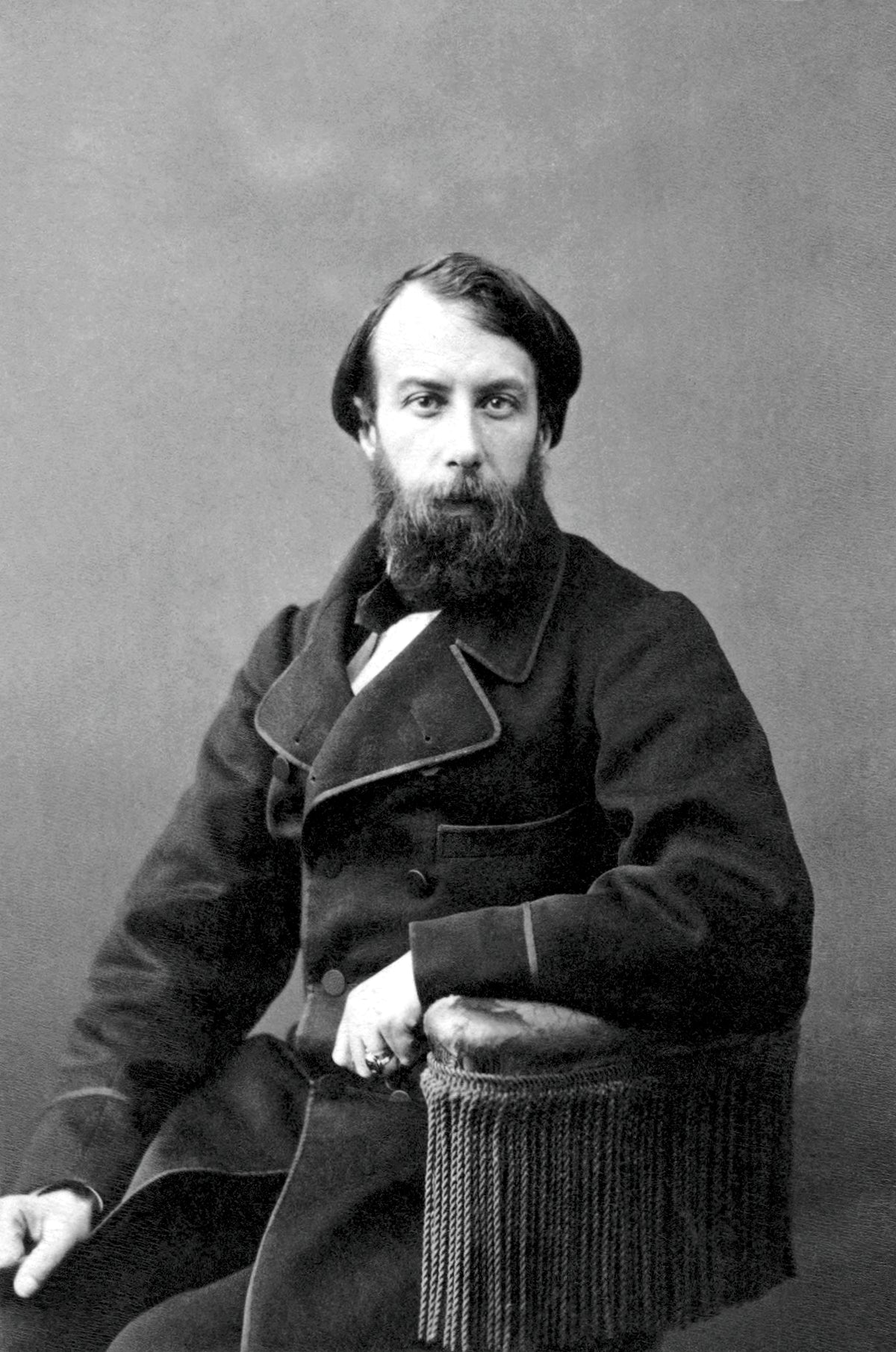
Henri Delaage is one of the most interesting figures of the generation that preceded the great French occultist revival of the Belle Époque. When Papus, Stanislas de Guaita, and Joséphin Péladan began organizing their journals, orders, and schools in the 1880s, Delaage had only just disappeared. Yet much of the ground they would occupy was already present in his books: magnetism, somnambulism, secret societies, initiatory traditions, cartomancy, prophecies, life after death, and the search for a science capable of connecting the visible with the invisible.
His occultism still belonged fully to the romantic 19th century. Delaage associated with Gérard de Nerval, wrote about lucid somnambulists, took part in the vogue for table-turning, and considered magnetism a way of approaching the soul. He did not clearly separate literature, religion, magnetic experience, and the history of initiations. This freedom earned him as many admirers as critics.
The figure is all the more interesting because he came before Allan Kardec. When Delaage published his first works on magnetism in 1847, The Book of Spirits did not yet exist. His research therefore belonged to the world of animal magnetism, somnambulism, and French spiritualism that preceded the formation of Kardecian Spiritism.
Paris, Chaptal, and a Youth Between Journalism and Administration
Henri Marie Jean Baptiste Delaage was born in Paris on June 28, 1825. Civil-status records link him to the Delaage de Bellefaye family. Through his mother, Virginie Chaptal, he was the grandson of Jean-Antoine Chaptal, a chemist, physician, industrialist, and former Minister of the Interior under Napoleon Bonaparte.
This ancestry would play an important role in Delaage’s occultist legacy. Several decades after his death, Papus would claim that Chaptal had known Louis-Claude de Saint-Martin and that a Martinist transmission had passed from Chaptal to his grandson. This lineage would be widely taken up by twentieth-century Martinists. It must nevertheless be distinguished from what the archives directly establish: Delaage was indeed Chaptal’s grandson, but the exact nature of any possible initiatory transmission belongs primarily to later accounts.
Young Delaage initially turned to journalism. He worked in the Parisian press during the 1848 Revolution and was notably associated with L’Événement. Biographical notices also show him later holding a position at the Ministry of the Navy. This civilian career partly explains his distinctive position: he wrote about occult phenomena while being fully part of the administrative and literary society of his time.
He associated with several writers and journalists. A letter from Paul Féval preserved in French collections is addressed to him as a fellow writer. Later, memoirs devoted to Parisian life portrayed him as a man known in salons and spiritualist circles. Delaage was therefore not an isolated occultist working in a closed study: he belonged to the literary Paris of the Second Empire.
1847, magnetism as a gateway to the invisible
In 1847, Initiation into the Mysteries of Magnetism was published. The title already set out Delaage’s program. For him, magnetism was not merely a therapeutic method: it opened onto a much broader question concerning the nature of the human being, the will, sleep, lucidity, and the existence of faculties that seemed to transcend the ordinary senses.
Animal magnetism had by then nearly seventy years of history in France. Mesmer had left Paris long ago, but his successors had transformed the doctrine of the universal fluid. With Puységur and the magnetizers of the early 19th century, somnambulism became the central phenomenon: subjects plunged into a particular state appeared capable of describing their own illness, perceiving things at a distance, or answering questions without having the information normally required.
Delaage belonged to this culture. He interpreted magnetic phenomena as signs of an inner faculty that could not be reduced to the body’s ordinary functioning. For him, the somnambulist represented more than a medical curiosity. The somnambulist became a possible witness to the existence of the soul and an invisible order.
This orientation explains the religious dimension of his books without making him a theologian. Delaage hoped that studying phenomena that were real or considered to be so could lead materialistic minds back toward a spiritual conception of humanity. Magnetism thus served as a passage between experience and metaphysics.
In 1851, he wrote an Introduction to Magnetic Magic for Auguste Lassaigne’s Memoirs of a Magnetizer, a work devoted to the somnambulist Prudence Bernard. The Bibliothèque nationale de France preserves this edition and explicitly classifies it under the subject of animal magnetism. Delaage therefore did not remain at the level of theory: he participated directly in the literature produced around somnambulists and their experiences.
Gérard de Nerval and The Red Devil, when occultism becomes literature
The relationship between Henri Delaage and Gérard de Nerval is one of the most revealing episodes of his life. At the end of 1849, the two men collaborated on the Diable rouge, almanach cabalistique pour 1850. The Bibliothèque Sainte-Geneviève, which devoted an exhibition to hidden knowledge, describes this work as a literary almanac making direct reference to grimoires and containing texts on astrology and the Kabbalah.
The almanac belongs to a hybrid genre. It preserves the traditional calendar, astrological indications, and advice associated with the days of the year, but adds an ironic and fantastic literary culture. The work is illustrated by several artists, including Bertall and Nadar. It should therefore not be read as a clandestine initiatory manual, but as one of the places where occult culture became literary material in 1850s Paris.
This collaboration is important for understanding Nerval himself. Auguste Viatte, in a study devoted to the relationship between esotericism and poetry in Nerval’s work, notes that at the end of 1849 the poet was working with Delaage precisely when his writings on the illuminati were taking on new importance. The historian cannot turn this proximity into evidence of a secret initiation undergone by Nerval, but it does show Delaage’s concrete presence in his intellectual environment.
Nerval and Delaage shared a taste for forgotten traditions, initiatory narratives, and figures situated at the boundary between history and legend. In Nerval’s work, this material became poetry and fiction. In Delaage’s, it became more of an attempt at an occultist synthesis.
When Nerval died in January 1855, Delaage was among those present at the funeral procession. Their relationship therefore extended beyond a one-off editorial collaboration. It belonged to a more enduring literary and personal network.
Alexis Didier, somnambulists, and turning tables
The somnambulist Alexis Didier is one of the most famous figures in 19th-century French magnetism. Born in 1826, he held clairvoyance séances before doctors, writers, aristocrats, and skeptics. Accounts of his experiments mention reading hidden objects, describing things from a distance, and identifying cards or documents placed outside his field of vision.
Delaage devotes considerable attention to him. His Monde prophétique, published in 1853, ends with a biography of the somnambulist Alexis. He also discusses his experiments in other texts devoted to magnetic sleep. In his modern study of Alexis Didier, Bertrand Méheust cites Delaage among the witnesses and authors who documented the famous somnambulist’s séances.
The accounts of performances must naturally be distinguished from their interpretation. Testimonies from the 19th century do not meet current experimental protocols, and the conditions of some séances are difficult to reconstruct. For Delaage, however, the phenomena were not a distraction: they became arguments in favor of psychic faculties extending beyond ordinary perception.
This logic reappears when the vogue for table-turning reached France. In 1853, Delaage wrote an introduction to an Explanatory and Practical Instruction on Table-Turning. The phenomenon was then very recent in European salons. Kardec had not yet published The Spirits' Book. Delaage therefore stood at one of the historical turning points between animal magnetism, talking tables, and the future of French spiritualism.
This position explains the natural connection with the biography of Allan Kardec. A few years later, Kardec would give a structured doctrine to communications attributed to spirits. Delaage still belongs to the preceding phase, in which phenomena were interpreted through magnetism, fluid, somnambulism, and a general philosophy of the soul.
Doctrines of Secret Societies, Freemasonry, and the Martinist lineage
In 1852, one of his most ambitious works was published: Doctrines of Secret Societies. The full title announces a journey through the mysteries of Isis and Mithra, the Knights Templar, the Carbonari, and the Freemasons. Delaage seeks to reconstruct a continuity between ancient initiations and modern secret societies.
This type of genealogy belongs fully to 19th-century occultism. Contemporary scholarship on religion and Freemasonry distinguishes these circles much more clearly and does not confirm a continuous institutional transmission extending from Egyptian temples to modern lodges. For Delaage, however, historical differences conceal a common tradition: initiation, trials, secrecy, symbols, and the moral transformation of the initiate.
His own relationship with Freemasonry warrants caution. An institutional Martinist tradition reports that he was initiated shortly before the publication of Doctrines of Secret Societies and that a Grand Orient jurisdiction suspended him from the lodges for one year for having disclosed certain degrees. This information is repeated in Martinist circles but should still be directly compared with Masonic archives before being considered definitively established.
The question of Martinism is even more interesting. In Martinésisme, Willermosisme, Martinisme et Franc-Maçonnerie, Papus presents Delaage as a link in the transmission between Saint-Martin, Chaptal, and modern Martinism. In particular, he reproduces a letter from Camille Flammarion dated 1899 in which the astronomer recalls that Delaage spoke to him about Chaptal, Saint-Martin, and Jacques Matter’s work on Martinism.
This document proves that Delaage was interested in Saint-Martin and associated this tradition with his grandfather. It does not, by itself, prove the existence of a regular initiatory chain such as the one Papus would reconstruct later. This is an important distinction: the historical Delaage knew the ancient Martinism; Delaage’s role as an “official transmitter” belongs more to the institutional memory of Papus’s Martinism.
This retrospective lineage nevertheless explains why Delaage would occupy an important place among the occultists of the following generation. His work provided a French predecessor capable of linking magnetism, secret societies, the Christian tradition, and the philosophy of the invisible.
Divination, Prophecies, and the Survival of the Soul
With Le Monde prophétique in 1853, Delaage undertook a vast history of the means used to know the future. The subtitle lists sibyls, Pythias, haruspices, witches, fortune-tellers, palmists, and lucid somnambulists. This list shows the book’s ambition: to bring ancient divination, popular traditions, and modern magnetism together in a single history.
The approach is typically occultist. Delaage does not treat each practice as the product of an autonomous historical context. He seeks behind them a common faculty: the possibility for human beings to cross the ordinary limits of time, the senses, and consciousness.
This way of reading history also explains his interest in cartomancy. An author such as Etteilla, in the 18th century, had already sought to transform cards into a structured esoteric system. Delaage places this type of divination within an even broader framework comprising ancient oracles, palmistry, and magnetic clairvoyance.
He then turns his research toward death itself. L’Éternité dévoilée, ou Vie future des âmes après la mort was published in 1854, followed by Les Ressuscités au ciel et dans l’enfer in 1855. Delaage wanted to show that occult phenomena do not concern extraordinary powers alone: they directly raise the question of human destiny.
His approach remained resolutely Christian, but it was not a simple repetition of the catechism. He sought confirmation in religious history, mesmerism, accounts of clairvoyance, and initiatory traditions. This desire to bring several sources together would be taken up by the great French occultism of the late nineteenth century.
Éliphas Lévi, Thirty Years of Silence, and La Science du vrai
Éliphas Lévi knew Delaage’s work and devoted several pages to him in his Histoire de la magie. His judgment is ambiguous. Lévi classed Delaage among the authors he considered too imaginative, presented him as a continuator of Alphonse Esquiros, and made ironic remarks about several of his claims. At the same time, however, he acknowledged the character’s singular force and relayed accounts from acquaintances who attributed extraordinary abilities to him.
This relationship reveals the divisions within French occultism even before the word became firmly established. The authors shared an interest in magic and tradition, but criticized one another over method, evidence, and how phenomena should be interpreted. Delaage was more trusting of accounts of somnambulism and thaumaturgy; Lévi sought instead to construct a symbolic philosophy and a coherent theory of magic.
After 1855, Delaage almost entirely stopped publishing occult works for nearly three decades. This long absence partly explains his historical obscurity. By the time occultist societies began to take shape around Papus in the 1880s, Delaage already belonged to another era.
In 1882, just a few months before his death, he nevertheless returned with La Science du vrai, ou les Mystères de la vie, de l’amour, de l’éternité et de la religion dévoilés. The title resembles an intellectual testament. In it, Delaage brings together the major questions that had already run through his earliest books: the soul, religion, human destiny, and the truth hidden behind visible forms.
Henri Delaage died in Paris on July 15, 1882, at 6 rue Duphot in the 1st arrondissement. He was fifty-seven years old. His biographical file is now preserved at the Bibliothèque nationale de France, while his photographic portrait by the Nadar studio belongs to the collections of the Department of Prints and Photography.
His disappearance comes just before the birth of the occultist movement that would claim him as a precursor. Papus would turn part of his legacy into a Martinist lineage; historians of mesmerism would rediscover him as a witness to Alexis Didier; studies of Nerval would encounter him in Le Diable rouge. Delaage thus becomes a crossroads between several histories that posterity had separated.
This is precisely why he deserves a place in the history of French occultism. He belongs to the generation that connects the magnetism of the first half of the 19th century with spiritualism, initiatory societies, and the occult sciences that would take their modern form a few decades later.
Sources and reference points
The National Library of France holds a biographical file devoted to Henri Delaage and gives the dates 1825-1882. Paris civil registration records make it possible to specify his birth on June 28, 1825, and his death on July 15, 1882.
The BnF also holds Auguste Lassaigne’s Mémoires d’un magnétiseur, published in 1851 with Delaage’s Introduction sur la magie magnétique. This record directly documents his involvement in the literature of animal magnetism.
Auguste Viatte’s study, Mysticisme et poésie chez Gérard de Nerval, published in 1963, recalls Nerval and Delaage’s collaboration on Diable rouge, almanach cabalistique pour 1850 and places this encounter within the development of Nerval’s esoteric interests.
The exhibition booklet from the Bibliothèque Sainte-Geneviève devoted to hidden knowledge describes Diable rouge as a cabalistic almanac combining astrology, Kabbalah, and references to popular grimoires.
For a contemporary view of Delaage, Éliphas Lévi’s Histoire de la magie is indispensable. Lévi devotes an entire section to him among 19th-century authors of magic, combining criticism with fascination.
Claims relating to a Martinist transmission should be read with greater caution. Papus develops them in Martinésisme, Willermosisme, Martinisme et Franc-Maçonnerie, notably producing a letter from Camille Flammarion. This document attests to Delaage’s interest in Saint-Martin but is not, by itself, sufficient to demonstrate the entire initiatory lineage reconstructed by later Martinism.
The cover of this biography reproduces an authentic photographic portrait of Henri Delaage made by the Nadar studio and held at the National Library of France. The file, sourced from Gallica, is now identified as free of known restrictions and placed under the Public Domain Mark.

Par Olivier of Aeternum
Passionate about esoteric traditions and the history of the occult from the earliest civilizations to the 18th century, I share articles exploring these subjects. I am also a co-founder of Aeternum, the online esoteric store.