





























































































Long overshadowed by the famous Marseille tarot, the Besançon tarot nevertheless has a history of its own, shaped by religious tensions, cultural exchanges along the Rhine, and a taste for popular gaming. This tarot, little known today, is in fact one of the most revealing witnesses to the evolution of divination cards between the end of the Renaissance and the 19th century.
A tarot born in a tense religious context
To understand the origins of the Besançon tarot, we must first consider the status of tarot itself at that time. Far removed from any esoteric dimension, tarot was above all a game. It was used in family, social, and festive settings, without any claim to divination or symbolic interpretation. The magical use of tarot would emerge only later, at the turn of the 19th century, particularly under the influence of French occultists such as Court de Gébelin and Éliphas Lévi.
In Alsace and the Upper Rhine territories at the beginning of the 18th century, tarot circulated widely, appreciated for the richness of its trumps and the variety of games it allowed. But this spread encountered a difficulty: two central figures of the classic tarot, the Pope (arcana V) and the High Priestess (arcana II), were poorly accepted in Protestant regions. The Pope was perceived as a symbol of Roman Catholic authority, while the High Priestess was seen as a heretical representation associated with the legend of Pope Joan.
To preserve the use of tarot in a shared confessional space, the card makers of Strasbourg chose a workaround. They replaced these two problematic arcana with figures from Greco-Roman mythology: Juno and Jupiter. This shift was ingenious. It preserved the structure of the game while neutralizing doctrinal tensions. Tarot thus became a ground for compromise, a graphic object that was at once playful, commercial, and diplomatic.
2. The Rhenish birth of an ecumenical tarot
The Besançon tarot therefore emerged in... Strasbourg, at the beginning of the 18th century, in a region marked by the fragile coexistence of different confessions. Juno and Jupiter took the place of the two religious arcana, but everything else in the deck remained unchanged: Italian suits (batons, cups, swords, coins), Roman numerals, woodblock printing, and stencil coloring. The style was inherited from the so-called “Type I” Marseille tarot, with which it shared its formal foundations.
Certain visual details nevertheless reveal an aesthetic specific to the Rhenish region. Cupid on the Lovers card aims directly at the figures, the Moon bears a frontal face, the Devil has a standing, hairy body, and the World figure adopts a contrapposto posture (a way of depicting the standing human body in which the weight rests primarily on one leg while the other is relaxed). These features clearly distinguish the Besançon tarot while linking it to the great iconographic family of southern tarots.
The first printed sheets traveled along the Rhine, from Strasbourg to Colmar, then toward Ulm and the Swiss territories. Woodblock printing, thick paper, and vivid colors appealed to a varied audience. This tarot established itself throughout the Alsatian and southern German regions, becoming the standard model throughout the 18th century.
The Comtois golden age and Swiss influence
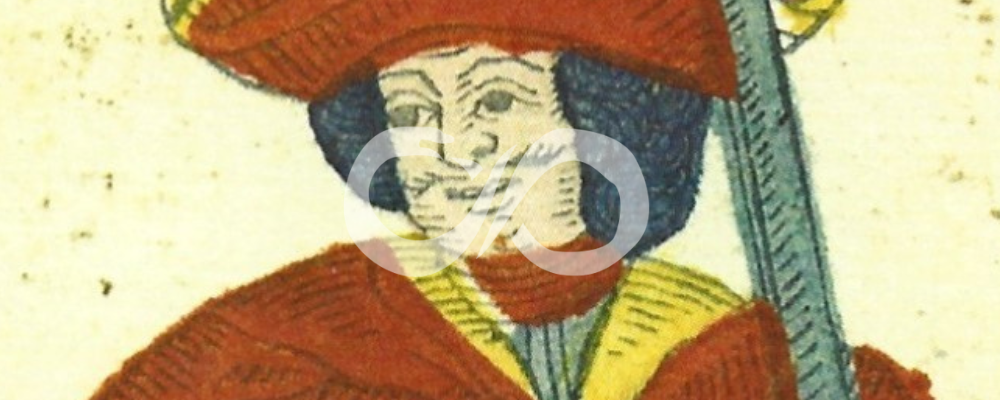
Around 1800, Jacob Jerger, a card maker from Kehl, settled in Besançon and printed the same deck as the one produced in Alsace. He changed neither its figures, its structure, nor its style. From that point onward, however, peddlers from Paris popularized the expression “Besançon tarot,” which eventually became established in common usage. The name took hold, and the deck became rooted in a new city.

Besançon tarot. Source
The influence of the Besançon tarot then extended beyond national borders. In Switzerland, Johann Georg Rauch, followed by his son-in-law Johannes Müller, printed a rigorously identical deck in Diessenhofen, intended for the German-speaking region. Publication ceased in the middle of the 19th century before resurfacing in the 1960s through the A.G. Müller company. The deck was then called “1JJ,” standing for “Juno, Jupiter,” a way of honoring its founding figures. It became the official deck for the traditional Swiss games Troccas and Troggu, which are still played in certain valleys of Graubünden.
Legacy and historians’ perspectives
In the rest of France, the 19th century saw the decline of the Besançon tarot, challenged by a more modern model: the Nouveau tarot (intended exclusively for gaming and not divination), with French suits and easily recognizable figures, designed for cafés, contract games, and quick-play settings. The Besançon tarot, considered too archaic, was relegated to storage rooms and collections.
But in the 20th century, researchers brought this forgotten heritage back to life. The Besançon tarot was no longer merely a regional curiosity: it became an object of study, a witness to cultural exchanges between Catholic and Protestant worlds.
In 2013, collector André Humbert created a tarot deck fully illustrated with Besançon-style figures, a contemporary version that engages with Jerger’s legacy. Exhibitions, facsimile editions, and academic studies continue this history today. The Besançon tarot is not an inferior relative of the Marseille tarot. It is its Rhenish cousin and never truly developed a divinatory career, because it was ultimately its cousin from southern France that was chosen as the medium.

Par Olivier of Aeternum
Passionate about esoteric traditions and the history of the occult from the earliest civilizations to the 18th century, I share some articles on these topics. I am also co-creator of the online esoteric shop Aeternum.