






























































































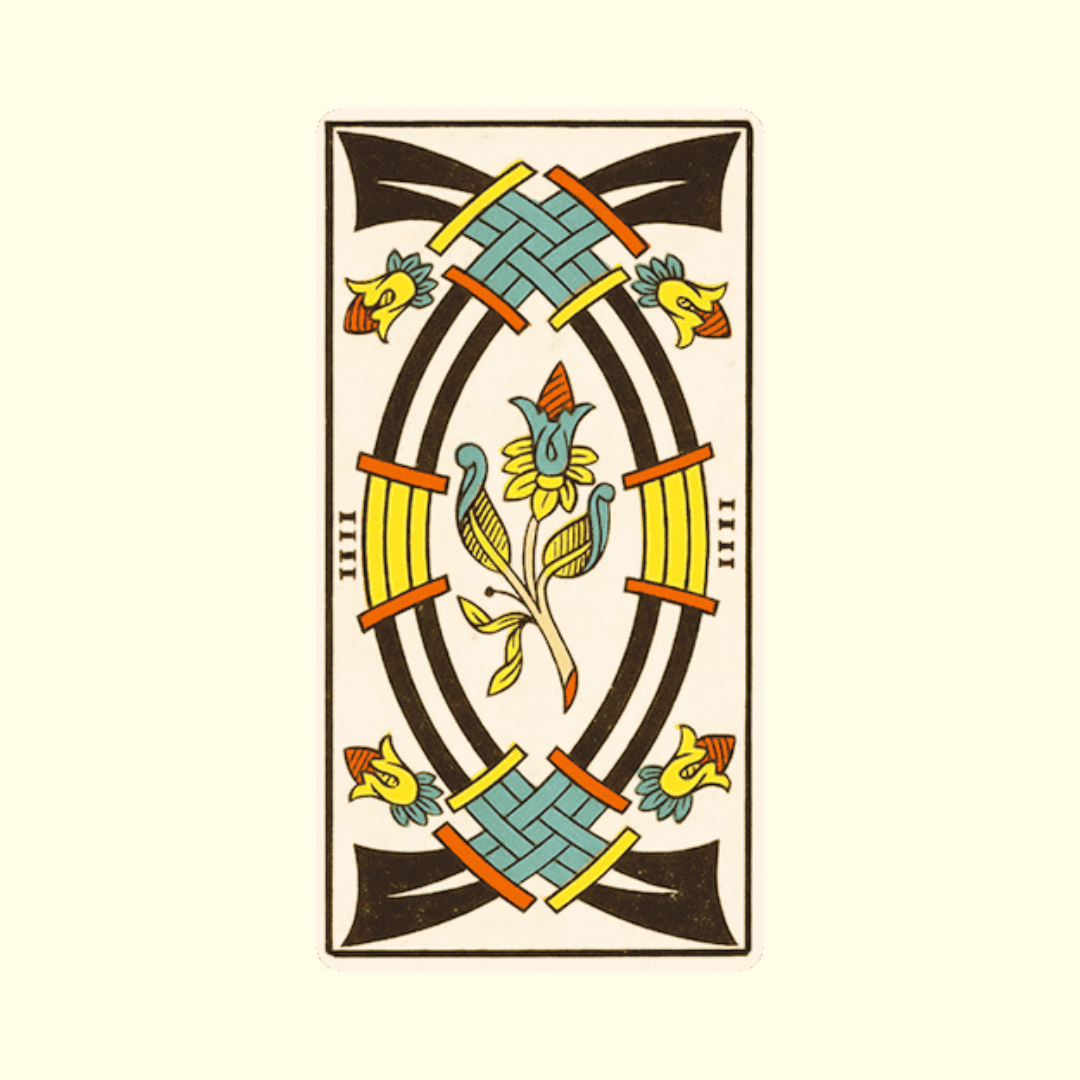

Four swords form an enclosure. In the Tarot de Marseille, their curves answer one another around a vegetal center and give the suit a closed form. In the Waite-Smith, a knight rests in prayer on a tomb, beneath three suspended swords, while a fourth accompanies his body. The Four of Swords marks withdrawal after the struggle: a time of silence, vigilance, and recovery that prepares for resumption rather than abolishing it.
The Four calls for an interruption clear enough for conflict to stop occupying the entire space. It can signal leave, a holding pattern, voluntary retreat, a period of observation, or the need to reduce demands. The card glorifies neither exhaustion nor isolation. It poses a practical question: what conditions allow rest to fulfill its role?
The old sources do not speak only of meditation. Mathers cites solitude, retreat, and abandonment, then economy and regulation of expenses when reversed. Book T describes peace after war and convalescence. Waite adds vigilance, exile, the tomb, and the coffin. These terms call for a measured reading: the funerary effigy is an image of withdrawal and memory, not a literal announcement of death.
From the enclosure of the blades to the knight's rest
In the Tarot de Marseille, four curved blades form a symmetrical structure around a flower or central motif. The space appears protected, contained, almost sealed. No sleeper, monument, or chapel appears. The stability of the number four slows the suit of Swords and converts the blade's movement into a frame.
Smith depicts the effigy of a knight lying on a tomb, with his hands clasped. Three swords hang on the wall, and a fourth is carved into or placed along the monument. A stained-glass window shows a scene of blessing. Waite describes an attitude of prayer and associates the card with vigilance, retreat, solitude, the hermit's rest, exile, the tomb, and the coffin. The figure is not sleeping in a bedroom: he withdraws to a place charged with memory and rule.
Iconographic marker. The reclining knight, the tomb, the stained-glass window, and the swords fixed to the wall belong to the Waite-Smith. Marseille constructs its Four with only the blades and the central motif. The meaning of withdrawal can suit both, but readings of prayer, chapel, or monument depend on the English scene.
Divinatory transmission
Mathers assigns solitude, retreat, abandonment, a solitary state, and the hermit to the Four of Swords. Reversed, he cites economy, precaution, and regulation of expenses. He adds that the neighboring cards should show whether health or money requires attention. This advice invites us not to decide in advance what causes the withdrawal: it may be physical, financial, professional, relational, or strategic.
Book T names the card “Lord of Rest after Strife” and assigns it Jupiter in Libra. Four swords cross around a five-petaled rose that is radiant once again. The text speaks of rest after sorrow, peace after war, relief from anxiety, calm, ease, and convalescence. The restored rose links the Four to the Two: after the division of the Three, a center can take shape again.
Waite emphasizes vigilance, retreat, solitude, the hermit's rest, exile, the tomb, and the coffin. Reversed, the card receives good administration, circumspection, economy, avarice, precaution, and a will. His list does not correspond to the contemporary summary of a simple nap. The Four combines rest, watchfulness, and prudent management of what remains available.
Meaning in a spread
In a favorable reading
The Four of Swords allows for a structured pause. The querent stops responding to every request, suspends a negotiation, reduces the noise, or withdraws long enough to regain the capacity for judgment. The card favors planned rest, reflection without pressure, and protecting a space where no urgent decision needs to be feigned.
Withdrawal becomes fruitful when it has a duration, a place, and an exit rule. It may involve delegating a task, putting a project on hold, sorting priorities, or quietly preparing to resume. With Temperance, the Star, or stable Pentacles, the card may show well-structured recovery.
In a reading of tension
Rest can turn into isolation, avoidance, or immobility protected by good reasons. Someone withdraws without warning, indefinitely postpones a response, or calls something caution when it is actually fear. The card may also show activity continuing beneath the appearance of a pause: the body stops, but the mind remains on alert.
The Four cannot diagnose exhaustion, depression, or illness. However, it may invite you to acknowledge fatigue and seek advice when the situation requires it. The useful question becomes: what must you really withdraw from, until when, and what sign will show that the capacity to act has returned?
Love, work, and finances
The Four suspends action to protect the available resources. It does not promise that the problem will resolve itself. The spread distinguishes useful rest, caution, and withdrawal that prolongs the difficulty.
| Domain | Favorable reading | Tension aspect | Question to ask |
|---|---|---|---|
| Love | Agreed quiet time, stepping back to avoid escalation, respect for the need for space. | Punitive silence, withdrawal without explanation, relationship left in limbo. | Are the duration and rules of this pause shared? |
| Work | Leave, project put on hold, strategic reflection, temporary reduction in workload. | Denied exhaustion, abandoned task, waiting without an owner or deadline. | Who ensures continuity during the withdrawal? |
| Finances | Freezing of expenses, careful review, building up a reserve. | Avarice, money immobilized by fear, postponement of a costly decision. | Which expense can wait, and which requires action? |
| Social life | Chosen solitude, protection from overstimulation, return to calm. | Isolation, disappearance without a word, refusal of all help. | Who knows the reason for and duration of the withdrawal? |
| Decision | Time used to reread, consult, and gain perspective. | Procrastination, superficial caution, inability to set a date. | What specific work will be completed during the pause? |
Reading associations
The Four brings withdrawal, the preservation of strength, and silence. The neighboring card shows what preceded the pause, the quality of the recovery, or the event that will set the blade in motion again.
| Association | Possible dynamic | Point of caution |
|---|---|---|
| Four of Swords + Three of Swords | Withdrawal after a breakup, hurtful words, or separation. | Rest must not become entrapment in the wound. |
| Four of Swords + Five of Swords | A fragile pause in the middle of a conflict that may resume. | Do not confuse the opponents' silence with resolution. |
| Four of Swords + The Hermit | Chosen solitude, study, extended withdrawal, and the search for inner direction. | Maintain a connection with reality and set an end point for the withdrawal. |
| Four of Swords + Temperance | Gradual recovery, measured pace, resumption in stages. | Respect the necessary time without promising a specific result. |
| Four of Swords + The Tower | Interrupted rest, an emergency that forces one to leave seclusion, an untenable situation. | Distinguish a genuine emergency from external pressure. |
| Four of Swords + Judgement | Awakening, summons, news that ends the wait and calls for a response. | Prepare to resume before taking on the full load again. |
Correspondences according to the schools
The former chart associated Jupiter, summer, rose quartz, lavender, and Daleth with the card. Only the attribution of Jupiter in Libra corresponds here to the Golden Dawn's historical system. In this school, Daleth belongs to the Empress, while stone, plant, and season belong to variable modern lists.
| Reference | Attribution | Historical scope |
|---|---|---|
| Family | Minor Arcana, Four of Swords | Fourth numbered card of the suit. |
| Tarot de Marseille | Four curved blades arranged around a botanical motif | Pip card with no knight or tomb. |
| Mathers, 1888 | Solitude, retreat, abandonment, hermit | Reversed: frugality, caution, regulation of expenses. |
| Golden Dawn | Lord of Rest from Strife | Title from Book T. |
| Element | Air | Occult attribution to the suit of Swords. |
| Astrology | Jupiter in Libra | Third decan of Libra in the Golden Dawn framework. |
| Waite-Smith | Figure of a praying knight, tomb, stained-glass window, and four swords | Scene published in 1909. |
| Hebrew letter | No letter specific to the card | Daleth belongs to the Empress in the Golden Dawn system. |
| Stone, plant, season | No shared historical agreement | These additions should remain distinct from the dated correspondences. |
| Reading keywords | Retreat, rest, vigilance, frugality, recovery, waiting | The context distinguishes a fruitful pause from avoidance. |
Reading advice
Define rest as an action. What needs to be stopped, delegated, reduced, or protected? For how long? What appointment, document, or sign will mark the end of the pause? Without these reference points, the Four can keep the querent waiting for something no one takes responsibility for.
In a health-related question, draw no medical conclusion from the reclining figure. In a professional matter, do not present the halt as a complete solution if the conflict remains unresolved. The card helps preserve strength and create an interval; the rest of the spread should show how this interval leads back to action.
Sources and reference texts
For the history of decks and suits: Victoria and Albert Museum, A History of Tarot Cards; British Museum, reproduction of Nicolas Conver’s Tarot de Marseille.
For divinatory and occult texts: S. L. MacGregor Mathers, The Tarot, 1888, card meanings; Liber LXXVIII, “The Lord of Rest from Strife,” publication of material from Book T; Arthur Edward Waite and Pamela Colman Smith, The Pictorial Key to the Tarot, Four of Swords, 1911.