






























































































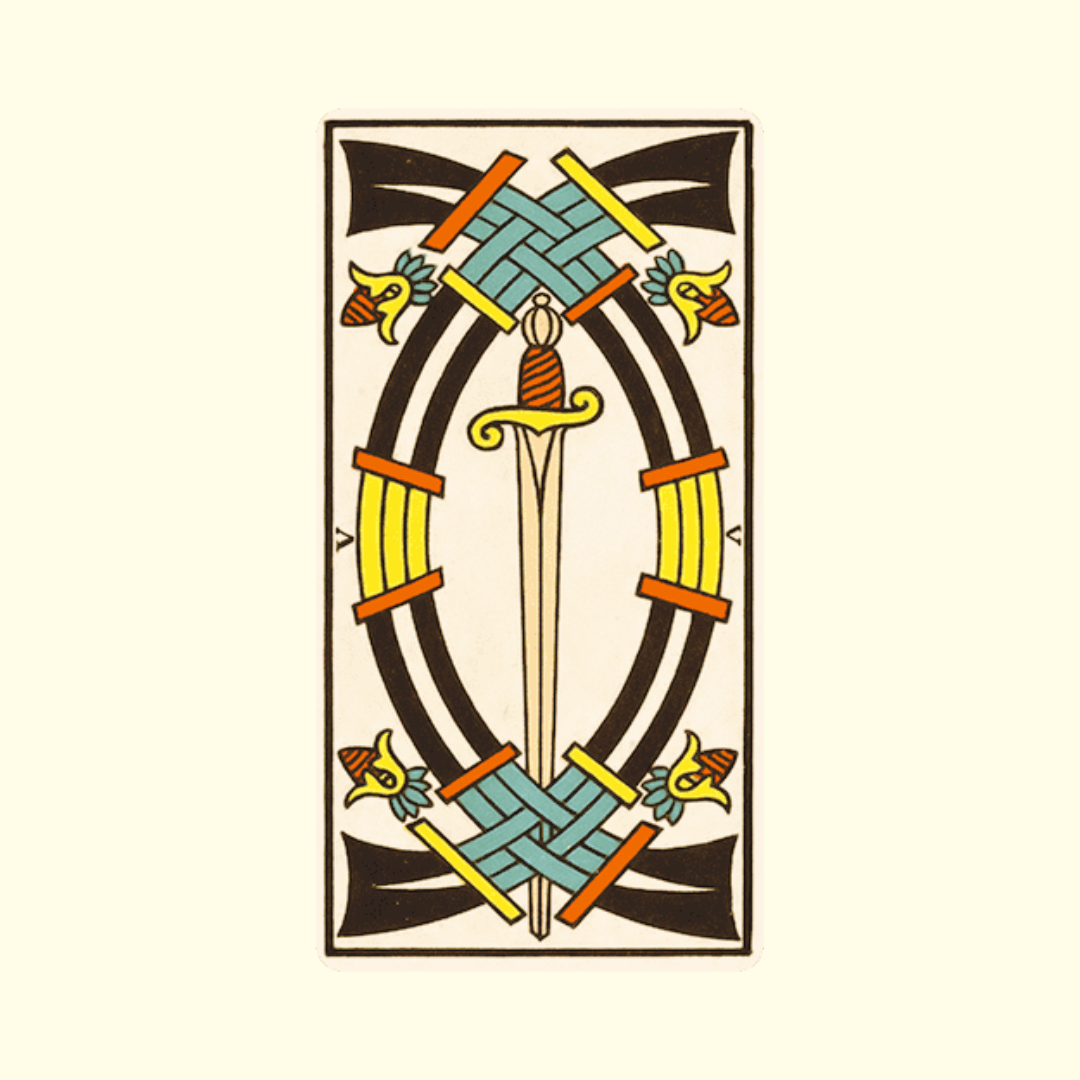

A fifth blade breaks the order of the first four. In the Tarot de Marseille, it crosses the enclosure formed by the curved swords and occupies the center. In the Waite-Smith, a man gathers the weapons while two figures leave the shoreline. The Five of Swords shows a conflict that has reached the point where winning, losing, and preserving one’s dignity no longer mean the same thing.
The Five belongs to the vocabulary of defeat, mourning, and loss. Yet it does not automatically designate the querent as defeated. In a conflict, several positions exist: the one who keeps the weapons, those who withdraw, the one who watches, and the ground that everyone leaves behind. The card’s position and the neighboring cards help identify the position concerned.
Its lesson is not an abstract invitation to “let go.” The card asks you to assess the cost of confrontation. Withdrawing may preserve your strength, victory may destroy a valuable relationship, and an agreement may become impossible after certain words have been spoken. You must therefore identify what has been gained, what has been lost, and what continuing the fight would cost.
From the defeated rose to the abandoned field
In French tarot decks, four curved blades form an enclosure around a straight sword placed along the central axis. Vegetal motifs fill the spaces between them. The fifth blade fights no character: it divides the structure and alters the balance established by the Four. This image allows for a reading of rupture, a force that separates, or a center that has become conflictual, without imposing a battle scene.
Pamela Colman Smith depicts a man holding three swords and watching two figures walk away toward the water. Two other weapons remain on the ground. The sky is turbulent, the silhouettes are hunched, and the central figure’s smile remains difficult to characterize. Waite describes him as master of the field, then assigns the card degradation, destruction, revocation, infamy, dishonor, and loss.
Iconographic reference. The shoreline, the three figures, and the collected swords belong to the Waite-Smith. The Marseille preserves a card with suit symbols, built around a central blade. “Victory at any cost” is a reading of the English scene; it should not be presented as the visible image in every tarot deck.
Divinatory transmission
In The Tarot, published in 1888, S. L. MacGregor Mathers assigns mourning, sadness, and affliction to the Five of Swords. Reversed, it retains loss and difficulties, with an almost identical meaning. This stability contradicts the modern reading that systematically turns a reversal into reconciliation. For Mathers, sorrow does not disappear simply because the card changes direction.
Book T names the card “Lord of Defeat” and assigns it Venus in Aquarius. Two pairs of swords move apart while a fifth blade separates them; the petals of the central rose fall. The text describes a battle against a person brought to an end, failure, anxiety, loss, slander, and the desire to separate friends. It also recognizes rapid thought and speech, whose use can become skillful or harmful.
Waite reinforces the severity of the situation with degradation, destruction, revocation, infamy, dishonor, and loss. Reversed, the card retains these meanings and adds funerals and funeral rites. These words should not lead to announcing a death. They belong to an ancient divinatory list and may refer to the public end of a matter, the loss of status, or the need to acknowledge what will not return.
Meaning in a spread
In a favorable reading
The Five can help recognize a battle that no longer deserves any more resources. The querent stops responding to a provocation, withdraws their name from a destructive project, or accepts that an outcome can no longer be repaired by willpower alone. The card supports clear-sightedness about the cost of conflict and the ability to leave the battlefield without calling that departure a victory.
Its constructive side appears when the loss is measured. Reputation, money, time, connection, and security are distinguished; what can still be protected is safeguarded, and revenge is rejected. An acknowledged defeat allows for an assessment. Sustained humiliation prolongs the adversary's power.
In a tense reading
The conflict may become a power game, a humiliating victory, slander, or a need to keep every weapon. Someone wins the argument and loses trust, spreads information to isolate a third party, or pursues a dispute whose cost exceeds what is at stake. The card may also show a fear of losing that prompts someone to strike before the other person has even attacked.
The Five does not authorize naming a traitor without evidence. It invites you to examine the messages, decisions, witnesses, and observable consequences. The useful question becomes: what victory is being sought, and what will remain of the relationship or project after that victory?
Love, work, and finances
The Five introduces a loss or struggle whose cost must be calculated. It does not confirm dismissal, breakup, or legal defeat. The surrounding cards show the subject of the conflict, the room for withdrawal, and what remains to be protected.
| Area | Favorable reading | Tense aspect | Question to ask |
|---|---|---|---|
| Love | End of a power struggle, protective withdrawal, recognition of an incompatibility. | Humiliating words, the need to be right, a breakup used as a threat. | What would have to be sacrificed to win this argument? |
| Work | Abandoning a harmful project, leaving a rivalry, reviewing the situation after a failure. | Sabotage, credit taken away, hierarchical conflict, attacked reputation. | Which facts and written records protect each party? |
| Finances | Stopping a losing expense, accepting a limited loss, reaching a less costly agreement. | Costly dispute, decision guided by pride, concealed loss. | Does the cost of pursuing this exceed the amount that can be recovered? |
| Social life | Distancing oneself from a conflicted group, refusing to spread a rumor. | A camp formed against one person, gossip, exclusion, or public humiliation. | Who benefits from the group's division? |
| Decision | Choosing to preserve one's strength instead of prolonging a battle. | Vengeance, refusal to admit failure, victory pursued for its own sake. | What concrete result would still justify the fight? |
Reading the associations
The Five shows the cost of the fight. The associated card clarifies what preceded the defeat, the way out, or the institution capable of managing the consequences.
| Association | Possible dynamic | Point of caution |
|---|---|---|
| Five of Swords + Four of Swords | Withdrawal after a confrontation, need for silence and protection. | A pause does not resolve the conflict if no rule for resuming exists. |
| Five of Swords + Six of Swords | Leaving the battlefield, transitioning toward a less exposed solution. | Take only what makes it possible to move forward, not the entire quarrel. |
| Five of Swords + Justice | Dispute, arbitration, official consequence, or structured redress. | Distinguish the desire to punish from the pursuit of a fair decision. |
| Five of Swords + Chariot | Victory achieved through discipline or a swift exit from a confrontation. | Speed and pride can worsen the relational loss. |
| Five of Swords + Devil | Power struggle, blackmail, conflict fueled by dependence or self-interest. | Seek outside help if the coercion or violence is real. |
| Five of Swords + Judgment | The consequences become public, and a decision calls everyone to account for their actions. | A revelation guarantees neither forgiveness nor immediate redress. |
Correspondences according to the schools
The former table combined Venus, spring, amethyst, lemon balm, and He. Only Venus in Aquarius belongs here to the Golden Dawn framework. The stone, plant, season, and letter do not form a common historical table with it.
| Reference | Attribution | Historical scope |
|---|---|---|
| Family | Minor Arcana, Five of Swords | Fifth numbered card of the suit. |
| Tarot of Marseilles | Four curved blades pierced by a central sword | Pip card with no battlefield or figure. |
| Mathers, 1888 | Mourning, sadness, affliction | Reversed: losses and difficulties, a meaning close to the upright position. |
| Golden Dawn | Lord of Defeat | Title from Book T. |
| Element | Air | Occult attribution to the suit of Swords. |
| Astrology | Venus in Aquarius | First decan of Aquarius in the Golden Dawn grid. |
| Waite-Smith | An armed man, two withdrawing figures, swords on the ground, and shoreline | Scene published in 1909. |
| Hebrew letter | No letter specific to the card | It belongs to the Emperor in the Golden Dawn system. |
| Stone, plant, season | No common historical agreement | These recent lists should remain distinct from dated correspondences. |
| Reading keywords | Defeat, loss, conflict, withdrawal, humiliation, cost | The spread position indicates who holds the weapons and who leaves the field. |
Reading advice
Place the participants in the scene. Who holds the weapons, who withdraws, who has dropped theirs, and who is missing from the picture? Then ask what each party calls “winning.” This method reveals incompatible objectives and prevents turning the card into a simple label of betrayal.
If the reading concerns a dispute, violence, or reputational harm, preserve the evidence and seek appropriate advice. If the conflict remains ordinary, set a limit on time, money, and words. The Five reminds us that some battles take more than they give back.
Sources and reference texts
For the history of cards and suits: Victoria and Albert Museum, A History of Tarot Cards; British Museum, reproduction of Nicolas Conver’s Tarot de Marseille.
For divinatory and occult texts: S. L. MacGregor Mathers, The Tarot, 1888, card meanings; Liber LXXVIII, “The Lord of Defeat,” publication of material from Book T; Arthur Edward Waite and Pamela Colman Smith, The Pictorial Key to the Tarot, Five of Swords, 1911.