



















































































































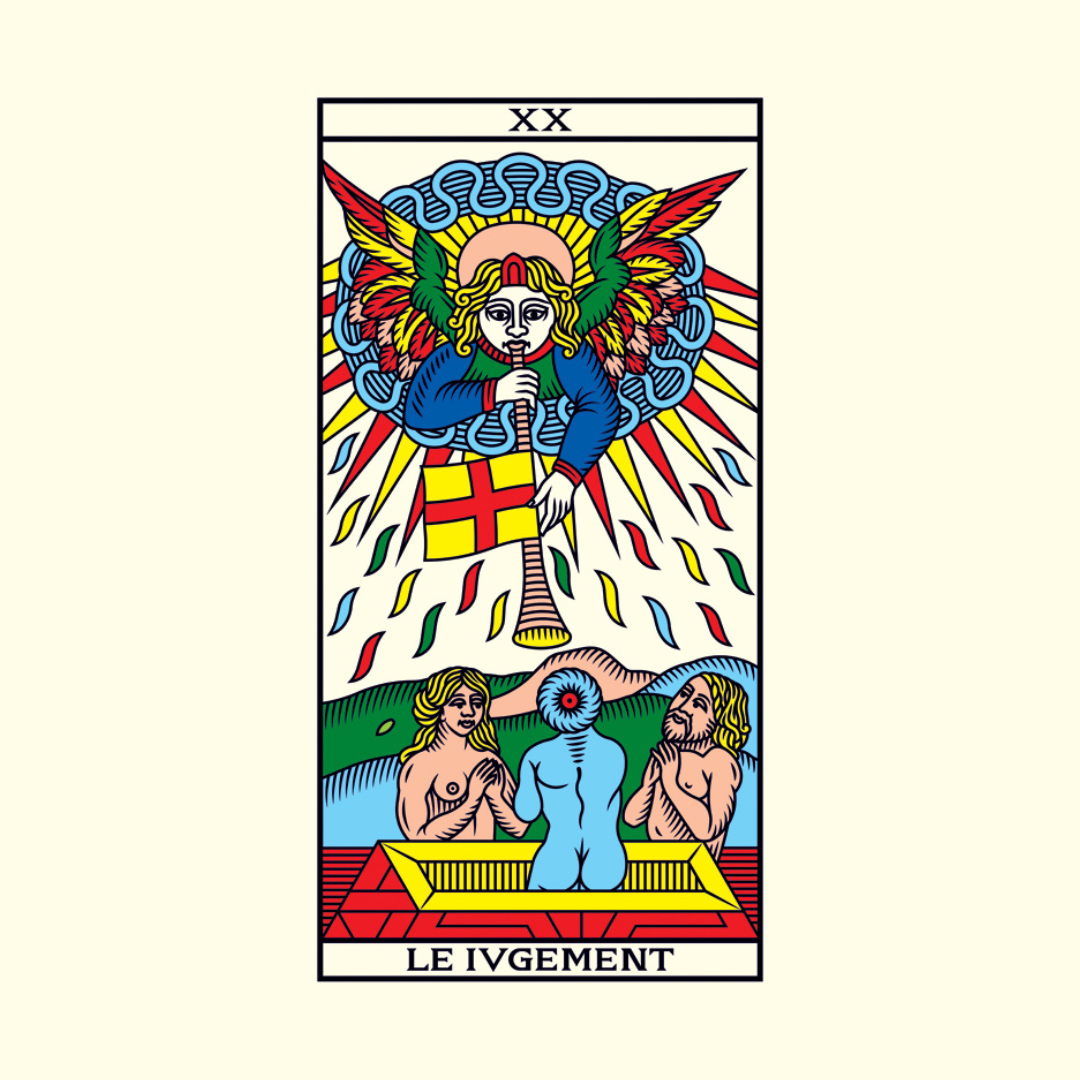

Judgment ends the silence: a trumpet sounds, figures rise, and a situation receives its answer. In a reading, the twentieth card speaks of an announcement, result, call, decision, or reassessment that changes the position of the people concerned. It does not pronounce a moral condemnation. It shows the moment when one hears, responds, and takes responsibility for what becomes public.
Its image comes from the Christian Last Judgment. The Visconti-Sforza depicts the crowned Christ, angels sounding trumpets, and the dead rising. The Tarot de Marseille reduces the scene to one angel and three figures. The Waite-Smith once again expands the group of the resurrected. Modern readings can use the card without religious adherence, but its history gains nothing by erasing this origin.
The Last Judgment in the earliest tarot decks
The Visconti-Sforza card preserved at the Morgan Library shows, in its upper section, the crowned Christ holding a sword and a globe topped with a cross. Two angels play the trumpet at his sides. Below, three figures rise from the dead. The scene clearly refers to the Christian iconography of the Last Judgment and the resurrection of the dead. Notice and reproduction of the Visconti-Sforza Last Judgment, Morgan Library & Museum.
This subject was immediately recognizable in Christian Europe in the 15th century. It evokes the end of time, the calling of the dead, and divine judgment. Court tarot places it among other powers that order the human and cosmic worlds. This origin explains the trumpet and the tombs long before occultists began speaking of personal vocation or inner transformation.
Historical reference. Reading Judgment as a call or an awakening can be fruitful in a consultation. Presenting this reading as the certain original meaning of the image would be anachronistic: the ancient scene initially depicts the Christian Last Judgment.
From the Christian scene to the inner call
The Tarot of Marseille simplifies the composition. An angel emerges from a cloud and sounds a trumpet bearing a cross banner. Three nude figures occupy the bottom of the card: a person seen from behind rises from a space resembling a tomb, between two other figures. The judging Christ disappears, but the trumpet, cross, and resurrected figures maintain the religious reference.
In the Waite-Smith, Pamela Colman Smith multiplies the figures rising from coffins across a stretch of water. The angel remains in the clouds with its trumpet and banner. Waite recognizes the scene of the Last Judgment, then transforms it into an image of a call heard within and a work of transformation brought to fulfillment. This second reading belongs to his 1911 exposition.
The Golden Dawn associates card XX with Shin and Fire. Papus and Wirth place Resh alongside Judgment in their French succession. The difference is important: Shin is not the letter assigned to this card by every school. A reliable reference therefore states the system before using its letters and correspondences.
What the older authors attribute to it
Mathers attributes renewal, the result, and the determination of a matter to Judgment. Reversed, the card suggests delay or a reopened question. Waite repeats change of position, renewal, and outcome; reversed, he gives weakness, deliberation, decision, and sentence. These lists bring the card close to a concrete outcome as much as to an awakening.
Judicial vocabulary does not automatically mean a trial. It may describe an accepted application, a diagnosis being communicated, an administrative response, a report being delivered, a decisive conversation, or the effect of an old choice becoming visible. The neighboring card and the question asked indicate which area receives the announcement.
Meaning in a spread
In a favorable reading
Judgment announces an awaited response, a result that sets things back in motion, recognition, a reminder, a structured second chance, or a clear understanding of what must be answered. It favors honest assessments, announcements, collective decisions, and returns that finally make it possible to conclude.
Il demande moins de se réinventer que de répondre présent. La trompette a déjà sonné : un message, une échéance, un appel ou une conséquence ne peut plus être traité comme une possibilité lointaine. La bonne question devient : quelle réponse dois-je formuler, à qui et dans quel délai ?
Dans une lecture défavorable
In an unfavorable reading
Love, work, and finances
| Area | Favorable reading | Shadow aspect | Question to ask |
|---|---|---|---|
| Love | Decisive conversation, explained return, commitment made explicit. | Old conflict reopened, need for a verdict, guilt kept alive. | What clear response are we expecting from each other? |
| Work | Outcome, recruitment, promotion, recognized assessment, recall to a position. | Delayed decision, dreaded evaluation, referred case. | What criteria will determine the outcome? |
| Finances | Regularization, reimbursement, settled account, response from an organization. | Debt reminder, inspection, ignored deadline, late appeal. | What document or deadline requires an immediate response? |
| Project | Validation, audience response, follow-up based on an assessment. | Endless revisions, waiting for permission, poorly prepared announcement. | What outcome makes it possible to decide what comes next? |
How to read its associations
Judgment calls, announces, and makes an outcome public. The neighboring card indicates whether this outcome comes from a rule, a period of examination, a reversal, an ending, a crisis, a success, or a fulfillment.
| Association | Possible dynamic | Point to watch |
|---|---|---|
| Judgment + Justice | Official decision, regularization, outcome based on criteria. | Read the conditions and avenues of appeal. |
| Judgment + The Hermit | Response after examination, a well-considered calling, a thoroughly prepared assessment. | Do not continue the review after the deadline. |
| Judgment + Wheel of Fortune | Announcement that changes the situation, a matter quickly coming back. | Prepare several possible next steps. |
| Judgment + Death | Irreversible outcome, announced closure, change of status. | Organize what comes next in practical terms. |
| Judgment + The Tower | Public revelation, a decision that brings down a structure. | Reassure people before commenting on the event. |
| Judgment + Sun | Favorable answer, recognition, announcement understood by everyone. | Share the merit and the consequences. |
| Judgment + World | Definitive result, completed cycle, recognized place. | Archive, pass on, and bring to a close before starting again. |
Correspondences according to the schools
| Reference point | Attribution | Historical scope |
|---|---|---|
| Family | Trump or major arcana XX | Penultimate numbered card in the Marseille and Waite-Smith order. |
| Ancient figure | Judging Christ, angels with trumpets, and resurrected figures | Christian iconography of the Visconti-Sforza. |
| Tarot of Marseille | Angel, cross-banner trumpet, and three figures | Simplified form of the Last Judgment. |
| French occultism | Resh; renewal and result | Attribution from the Papus-Wirth succession. |
| Golden Dawn | Shin and Fire | Distinct system from the French suit sequence Resh–Judgment. |
| Waite-Smith | Several figures rising from coffins | Expansion of the scene published in 1911. |
| Element | Fire in the Golden Dawn system | Occult attribution, not medieval. |
| Stone, plant, and season | No attribution shared by the older schools | Contemporary lists vary according to their authors. |
| Reading keywords | Call, announcement, result, answer, review, recognition | Something calls for an explicit answer. |
| Shadow aspect | Delay, guilt, refusal, reopened case, dreaded sentence | Self-judgment does not replace established criteria. |
Sources and reference texts
Morgan Library & Museum, The Last Judgment, Visconti-Sforza Tarot ; Accademia Carrara, Tarocchi. The origins, the cards, the fortune, 2026 ; The Metropolitan Museum of Art, Before Fortune-Telling: The History and Structure of Tarot Cards ; S. L. MacGregor Mathers, The Tarot, 1888 ; Papus, The Tarot of the Bohemians, 1889 ; Oswald Wirth, The Tarot of the Medieval Image Makers, 1927 ; Arthur Edward Waite, The Pictorial Key to the Tarot, 1911, card XX ; Arthur Edward Waite, divinatory meanings of the major arcana.










