

































































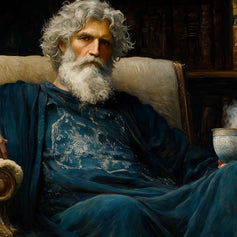

























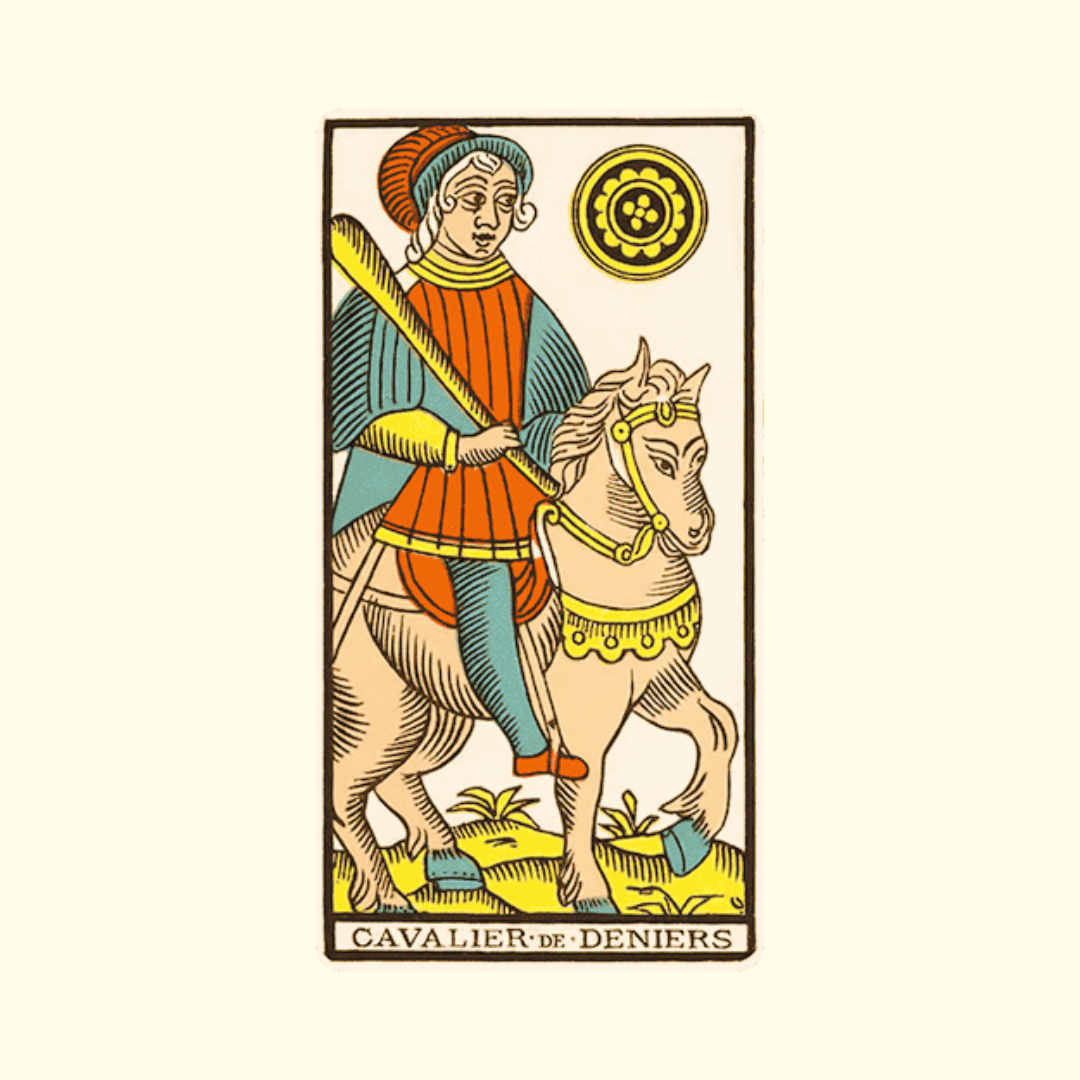

The Knight advances without rushing the outcome. In French tarots, he carries the pentacle on horseback and places matter within movement. In the Waite-Smith, his heavy mount remains almost motionless before cultivated lands while he presents the pentacle. The Knight of Pentacles serves, regulates, and pursues a task with patience; his strength lies in continuity, and his weakness in inertia disguised as prudence.
The earlier article presented it as a dynamic energy destined for financial progress. The texts describe a much slower figure. Mathers gives usefulness, reliability, wisdom, economy, order, and regulation. Waite retains usefulness, service, responsibility, and rectitude. The Golden Dawn speaks of a laborious and patient warrior in material affairs, but heavy, dull, or miserly when the neighboring cards work against it.
The Knight sets a resource in motion, but guarantees neither growth nor success. He may represent a reliable employee, a logistics worker, a farmer, a steward, a craftsperson, an operations manager, or a method that advances through controlled stages. The reading must assess the actual pace, the value of the service, and the moment when constancy ceases to protect and begins to prevent any evolution.
From the court knight to patient service
In a Tarot de Marseille, the Knight of Pentacles is mounted and carries the emblem of his suit. The direction of movement, the position of the pentacle, the costume, and the horse’s bearing vary between decks. The setting remains limited. The figure belongs to the court hierarchy: it connects service, movement, and matter without showing a plowed field or a halted horse.
Smith places an armored knight on a massive horse, facing cultivated lands. The mount appears motionless, and the pentacle is held in front of the body. Waite describes a slow, enduring, heavy horse, matching the aspect of its rider. The latter displays his symbol without contemplating it. The scene gives less the image of a conquest than of a regular presence, capable of carrying a burden over time.
Iconographic reference. The heavy horse, the halt, and the fields belong to the Waite-Smith. The Marseilles knight may move with greater momentum. In both decks, the pentacle remains under the care of a mobile figure: the question concerns the mission, the road, and the responsibility attached to what is being carried.
Divinatory transmission
Mathers describes the Knight of Pentacles as a useful and trustworthy man. He adds wisdom, economy, order, and regulation. Reversed, he speaks of a courageous but unemployed, idle, unoccupied, or negligent man. This list brings the figure’s value closer to a function actually being performed: ability produces nothing if no service gives it form.
Book T names it “Lord of the Vast and Fertile Earth” and “King of the Spirits of Earth.” A winged warrior rides above fertile soil and ripe wheat, holding a scepter and pentacle. The text describes him as industrious, skillful, and patient in material affairs. His difficult aspect becomes heavy, dull, materialistic, miserly, possessive, and jealous. Its formula is Fire of Earth, with a zodiacal domain from the 20th degree of Leo to the 20th degree of Virgo.
Waite attributes usefulness, aptitude for service, interest, responsibility, and rectitude in practical matters to the Knight. Reversed, the card indicates inertia, idleness, stagnation, placidity, discouragement, and negligence. This contrast defines its problem: repeating a steady effort until the result is achieved, while remaining able to correct the course when repetition no longer serves the objective.
Meaning in a spread
In a favorable reading
The Knight supports a mission that requires presence, order, and endurance. A schedule is maintained, checks are carried out, resources arrive at the right place, and the person takes responsibility for what they carry. The card values measurable reliability: meeting a deadline, following a procedure, repaying a debt, tracking inventory, or delivering work to the expected standard.
Its progress remains slow and cumulative. A modest step repeated correctly can produce more than a spectacular beginning. The neighboring cards indicate whether the path leads toward a gain, training, transmission, or simply preserving what already exists.
In a tension reading
The method continues even though the context has changed. Someone remains in a role that no longer uses their abilities, confuses caution with refusing risk, or protects a procedure that has become costly. Discouragement may take the form of calm: nothing collapses, but nothing moves forward, and no one sets a new deadline.
The Knight promises no return and does not advise pursuing something indefinitely. For an investment, a job, or a long-term project, compare the remaining cost, expected benefit, and exit strategy. Perseverance has value only when the path still leads toward a defined result.
Love, work, and finances
The Knight transforms matter into a lasting mission. The reading examines the service provided, a sustainable pace, responsibility, and the point at which the routine must be reviewed.
| Area | Favorable reading | Tension aspect | Question to ask |
|---|---|---|---|
| Love | Stable presence, commitments honored, slow construction through verifiable actions. | Routine without exchange, a relationship maintained out of duty or fear of change. | What regular action still nurtures the connection? |
| Work | Reliable employee, well-managed logistics, long-term mission carried out methodically. | Underutilized position, rigid procedure, invisible effort, or silent discouragement. | What result makes it possible to judge the usefulness of the work? |
| Finances | Regular saving, monitored repayment, orderly management, planned spending. | Capital tied up, a strategy pursued without reassessment, or defensive hoarding. | On what date will the plan be reviewed and compared with the facts? |
| Project | Realistic steps, available resources, continuous and documented progress. | Perfection of the method without delivery, or a schedule that has become empty. | What next step will produce an observable result? |
| Decision | Prudent choice based on duration, maintenance cost, and actual capacity. | Indecision presented as patience or loyalty to an outdated plan. | What event will trigger continuation, correction, or stopping? |
Reading associations
The Knight carries a task over time. The associated card shows the destination, the rule to follow, or the risk that constancy will become stagnation.
| Association | Possible dynamic | Point of caution |
|---|---|---|
| Knight of Pentacles + Eight of Pentacles | Regular work, a profession strengthened through repetition and control. | Set an end criterion to avoid effort without prospects. |
| Knight of Pentacles + Chariot | Slow method placed at the service of a decided movement. | A change of pace requires coordination and appropriate resources. |
| Knight of Pentacles + Temperance | Patient maintenance, regulated flow, stable cooperation among several functions. | Moderation may conceal a delay if there is no deadline. |
| Knight of Pentacles + Four of Pentacles | Strict preservation of a resource, budget, or estate under protection. | Protection can block any useful investment. |
| Knight of Pentacles + Hanged Man | Suspended mission, sustained effort without an immediate return, or imposed waiting. | Assess what can be stopped without losing what has been gained. |
| Knight of Pentacles + Ten of Wands | Long-term responsibility that has become a heavy burden but is still being carried. | Distribute the task before reliability leads to exhaustion. |
Correspondences according to the schools
Mars, autumn, carnelian, oak, and Kaph from the old table do not constitute the historical attribution of the Knight of Pentacles. The Golden Dawn assigns Earth of Fire and a zodiacal sector, while Mathers and Waite emphasize service, order, patience, and the risk of inertia.
| Reference | Attribution | Historical scope |
|---|---|---|
| Suit | Minor Arcana, court figure, Knight of Pentacles | Rank found in French tarot decks. |
| Marseille Tarot | Mounted knight carrying a denarius | Court figure with no imposed cultivated field. |
| Mathers, 1888 | Usefulness, reliability, wisdom, thrift, order, regulation | Reversed: inactivity, unemployment, neglect. |
| Golden Dawn | Lord of the Wide and Fertile Land, Fire of Earth | Title and elemental formula from Book T. |
| Element | Earth for the color; Fire of Earth for the figure | English occult attributions. |
| Astrology | From the 20th degree of Leo to the 20th degree of Virgo | Sector attributed to the figure by the Golden Dawn, not an isolated planet. |
| Waite-Smith | Motionless knight on a heavy horse in front of fields | Scene published in 1909. |
| Hebrew letter | No letter specific to the card | Kaph belongs to the Wheel of Fortune in the Golden Dawn system. |
| Stone, plant, season | No common historical correspondence | Carnelian, oak, and autumn do not come from the cited sources. |
| Reading keywords | Service, reliability, responsibility, order, patience, inertia | Duration must remain connected to a measurable destination. |
Reading advice
Give the mission a measurable form: item transported, task completed, deadline, cost, and person responsible. Note the next step and the review date. This structure makes it possible to distinguish slow progress from a stationary situation that consumes time without bringing you closer to the goal.
If the Knight represents a person, assess their reliability by their actions, not their calm appearance. If it represents a strategy, look for its correction mechanism. The card’s best expression is not to continue at all costs: it is to uphold what deserves to be upheld and change the method when the facts require it.
Sources and reference texts
For the history of the decks and figures: Victoria and Albert Museum, A History of Tarot Cards; British Museum, reproduction of Nicolas Conver’s Tarot de Marseille.
For divinatory and occult texts: S. L. MacGregor Mathers, The Tarot, 1888, card meanings; Liber LXXVIII, “The Lord of the Wide and Fertile Land,” publication of material from Book T; Arthur Edward Waite and Pamela Colman Smith, The Pictorial Key to the Tarot, Knight of Pentacles, 1911.