

















































































































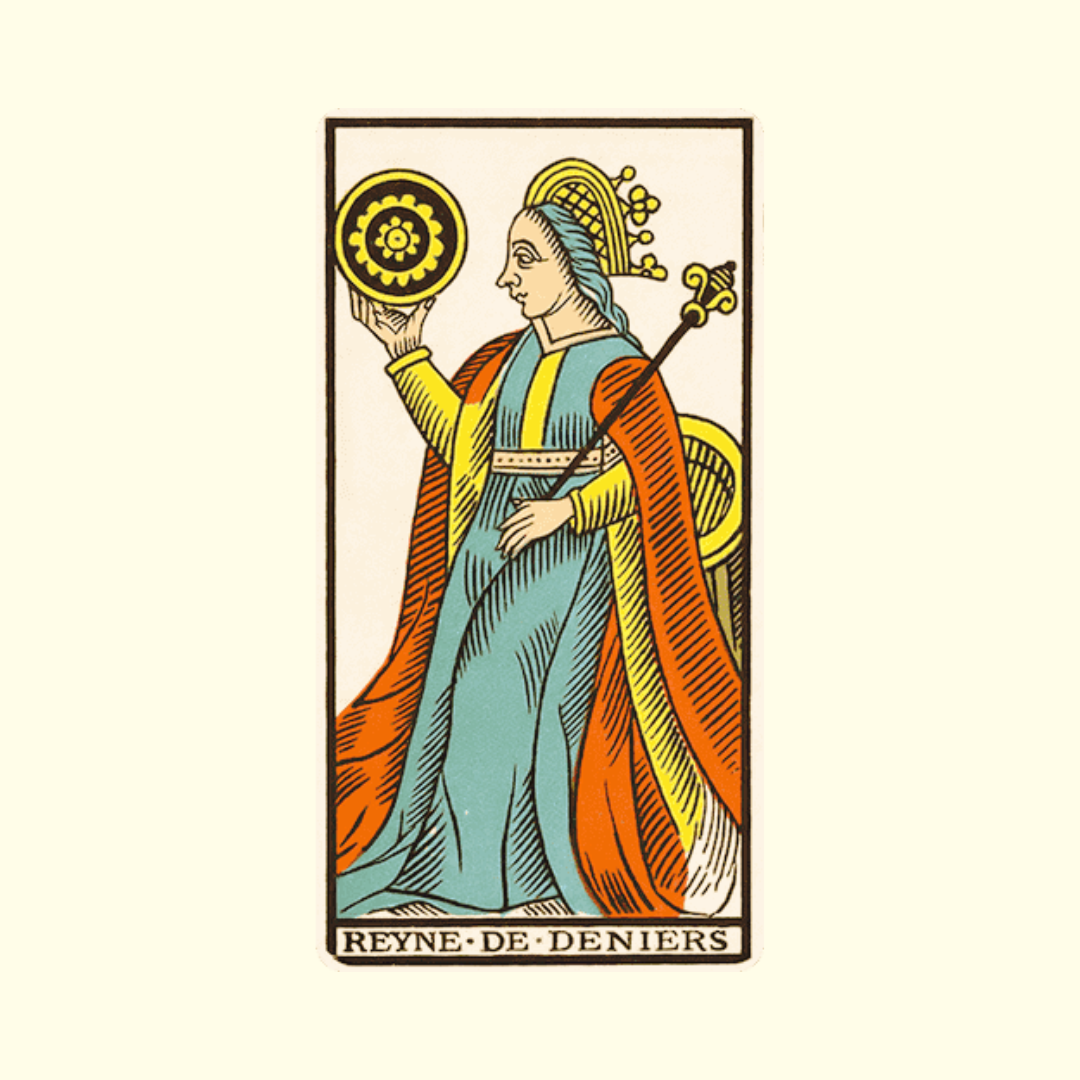

The Queen welcomes the coin onto her lap. In French tarot decks, she bears the emblem of her suit with the dignity of her rank. In the Waite-Smith, she gazes at a pentacle amid abundant vegetation, while a rabbit appears at the edge of the scene. The Queen of Pentacles rules through attention given to beings, resources, and places: she nurtures what has been entrusted to her, but this guardianship becomes troubled when it turns into anxiety, possessiveness, or limitless devotion.
The earlier article reduced the card to a stable, generous, and protective woman. The sources offer a less polished figure. Mathers associates the Queen with liberality and greatness of soul, but her reversal introduces suspicion and distrust. The Golden Dawn describes a benevolent, intelligent, and sincere temperament, while also giving her mood swings and an uncertain side. Waite brings together opulence, security, and generosity, then sets fear and distrust against them.
A court figure determines neither sex nor age. The Queen may represent a person or a welcoming role. Her power does not consist in carrying everything: she creates fertile conditions without taking away the autonomy of those who benefit from them.
From the sovereign to the inhabited garden
In the Marseilles tarot decks, the Queen is seated, crowned, and holds a large coin. The position of the disk varies among workshops. The card shows neither a garden, nor a rabbit, nor fruit. The suit emblem identifies the suit, and the crown places the figure within the hierarchy, without imposing a narrative.
Pamela Colman Smith places the sovereign in a cultivated landscape. Roses form an arch, plants surround the seat, and fields stretch into the distance. The Queen tilts her head toward the pentacle resting between her hands. Goat motifs decorate her throne, while a rabbit appears in the lower-right corner. Waite emphasizes her solemn face, attentive to the symbol, more than modern interpretations of the rabbit.
Iconographic reference. The garden, roses, rabbit, and pentacle held on the lap belong to the Waite-Smith. The Marseilles Queen is a court sovereign holding a coin, with no imposed domestic or maternal role. The English image develops the idea of a living environment for which one must take responsibility; it does not turn the card into an automatic promise of fertility, motherhood, or wealth.
Divinatory transmission
In The Tarot of 1888, Mathers describes a dark-haired woman and assigns her liberality, generosity, and greatness of soul. Reversed, the card indicates certain evil, suspicion, doubt, and distrust. The physical portrait belongs to a nineteenth-century method, not to a reliable means of identifying a person.
Book T calls her “Queen of the Thrones of Earth” and attributes Earth of Earth to her. She carries a cube-topped scepter and a golden orb beside a goat. The text describes her as impetuous, kind, shy, generous, intelligent, and sincere, but changeable. Poorly surrounded, she becomes indecisive, capricious, and unreasonable. Her domain extends from the 20th degree of Sagittarius to the 20th degree of Capricorn.
Waite attributes to her opulence, generosity, magnificence, security, and freedom. Reversed, he lists mistrust, suspicion, suspense, fear, and distrust. Security can make it possible to give, or drive someone to withhold and monitor. The Queen manages a living environment: its quality is measured by what grows without remaining dependent on her.
Meaning in a spread
In a favorable reading
The Queen of Pentacles supports concrete protection. She prepares a place, nurtures a relationship, makes a budget understandable, attends to maintenance, or welcomes someone without erasing their needs. Her attention appears in ordinary acts: meals, rest, pay, tidiness, equipment, availability, and continuity. The card may indicate someone capable of making a resource habitable rather than displaying it.
She encourages authority attentive to working and living conditions. Anyone responsible can fulfill this role. The neighboring cards indicate whether generosity produces autonomy, cooperation, or self-interested attachment.
In a tension reading
Care becomes control. One person gives, then demands gratitude or obedience. They may believe that only they know what is appropriate, or exhaust themselves maintaining comfort that was not requested. Suspicion may arise from fear of losing what has been established.
The Queen proves neither pregnancy, future abundance, nor loyalty. In health matters, she invites consideration of rest, environment, and access to care without making a diagnosis. In finances, managing does not guarantee any return. Specify the resource, the need, the limits of the assistance, and each person’s responsibility.
Love, work, and finances
The Queen arranges, nourishes, and manages. Each area requires distinguishing care that strengthens people from comfort that binds them or exhausts the person providing it.
| Area | Favorable reading | Tension aspect | Question to ask |
|---|---|---|---|
| Love | Affection expressed through welcome, presence, everyday care, and respect for needs. | A gift used as an emotional debt, jealousy, overprotective behavior, or exhausting, killing fatigue. | Does the attention offered leave everyone their place and freedom? |
| Work | Reliable framework, well-distributed resources, manager attentive to actual conditions. | Invisible power concentrated on one person, control through means or comfort that masks inequality. | Who maintains the framework, and is this contribution recognized? |
| Finances | Protective budget, well-maintained assets, expenses tied to needs, and an accessible reserve. | Fear of scarcity, possessiveness, financial aid accompanied by control, or a lifestyle that is difficult to sustain. | What amount truly provides protection without immobilizing everything else? |
| Home and body | Habitable home, respected rest, health practices followed in moderation, and appropriate support. | Exhaustion from caregiving, symptoms minimized in the name of duty, or the pursuit of absolute control. | What concrete need requires competent assistance or a change in daily life? |
| Decision | Choice assessed by its material, human, and lasting effects on the environment concerned. | Decision dictated by fear of losing comfort or by the need to be indispensable. | Does this solution make people more capable or more dependent? |
Reading pairings
The Queen of Pentacles gives care and the management of an environment a tangible form. The associated card reveals what she nurtures, the necessary boundary, and how security circulates or closes in.
| Pairing | Possible dynamic | Point of caution |
|---|---|---|
| Queen of Pentacles + Empress | Creation made viable through structure, resources, and ongoing attention. | Do not reduce the whole matter to motherhood or a pregnancy announcement. |
| Queen of Pentacles + Queen of Cups | Emotional listening accompanied by material support and a stable welcome. | Make sure shared care does not rest on just one person. |
| Queen of Pentacles + Six of Pentacles | Aid distributed with discernment, hospitality supported by available resources. | Name the conditions of the gift and the power gap between giving and receiving. |
| Queen of Pentacles + Four of Pentacles | House, budget, or assets strongly protected. | Prudence can become withholding, control, or fear of any transformation. |
| Queen of Pentacles + Devil | Comfort, desire, and material power closely intertwined. | Examine the dependency, debt, and benefits that make it impossible to say no. |
| Queen of Pentacles + Ten of Pentacles | Transmission of a lasting framework, family, or institution with established resources. | Identify who maintains the legacy and who decides how it is used. |
Correspondences according to the schools
Venus, winter, the emerald, the rose, and Resh appeared in the old table, but they do not form part of the commonly accepted historical attribution of the Queen of Pentacles. In the Golden Dawn, she is assigned Earth of Earth and a domain from Sagittarius to Capricorn. In this system, Resh belongs to the Sun, not to this figure.
| Reference | Attribution | Historical scope |
|---|---|---|
| Suit | Minor arcana, court figure, Queen of Pentacles | Rank found in French tarot decks. |
| Tarot of Marseilles | Crowned sovereign holding a denarius | Court figure with no imposed garden or rabbit. |
| Mathers, 1888 | Liberality, generosity, magnanimity | Reversed: evil, suspicion, doubt, and distrust. |
| Golden Dawn | Queen of the Thrones of Earth, Water of Earth | Title and elemental formula from Book T. |
| Element | Earth for the color; Water of Earth for the figure | English occult attributions. |
| Astrology | From the 20th degree of Sagittarius to the 20th degree of Capricorn | Zodiacal domain of the figure in Book T, not Venus in isolation. |
| Waite-Smith | Queen attentive to the pentacle, garden, roses, throne, and rabbit | Composition published in 1909. |
| Hebrew letter | No letter specific to the card | Resh belongs to the Sun in the Golden Dawn system. |
| Stone, plant, season | No common historical agreement | Emerald, rose, and winter do not come from the cited sources. |
| Reading words | Welcome, care, security, generosity, administration, distrust | The context distinguishes support, possession, and exhaustion. |
Reading advice
Define what lies on the Queen’s lap: money, a home, a team, a relationship, health, time, or expertise. What maintenance does this resource require, who provides it, and at what cost? Fair protection shares the tasks and enables the beneficiary to act.
Distinguish attention from surveillance. What facts justify distrust? What help has been requested? What rest is lacking for the person who holds the framework? The Queen acts rightly when she supports life without becoming the owner of those she welcomes.
Sources and reference texts
For the history of decks and figures: Victoria and Albert Museum, A History of Tarot Cards; British Museum, reproduction of Nicolas Conver’s Tarot of Marseille.
For divinatory and occult texts: S. L. MacGregor Mathers, The Tarot, 1888, card meanings; Liber LXXVIII, “The Queen of the Thrones of Earth,” publication of material from Book T; Arthur Edward Waite and Pamela Colman Smith, The Pictorial Key to the Tarot, Queen of Pentacles, 1911.










