





























































































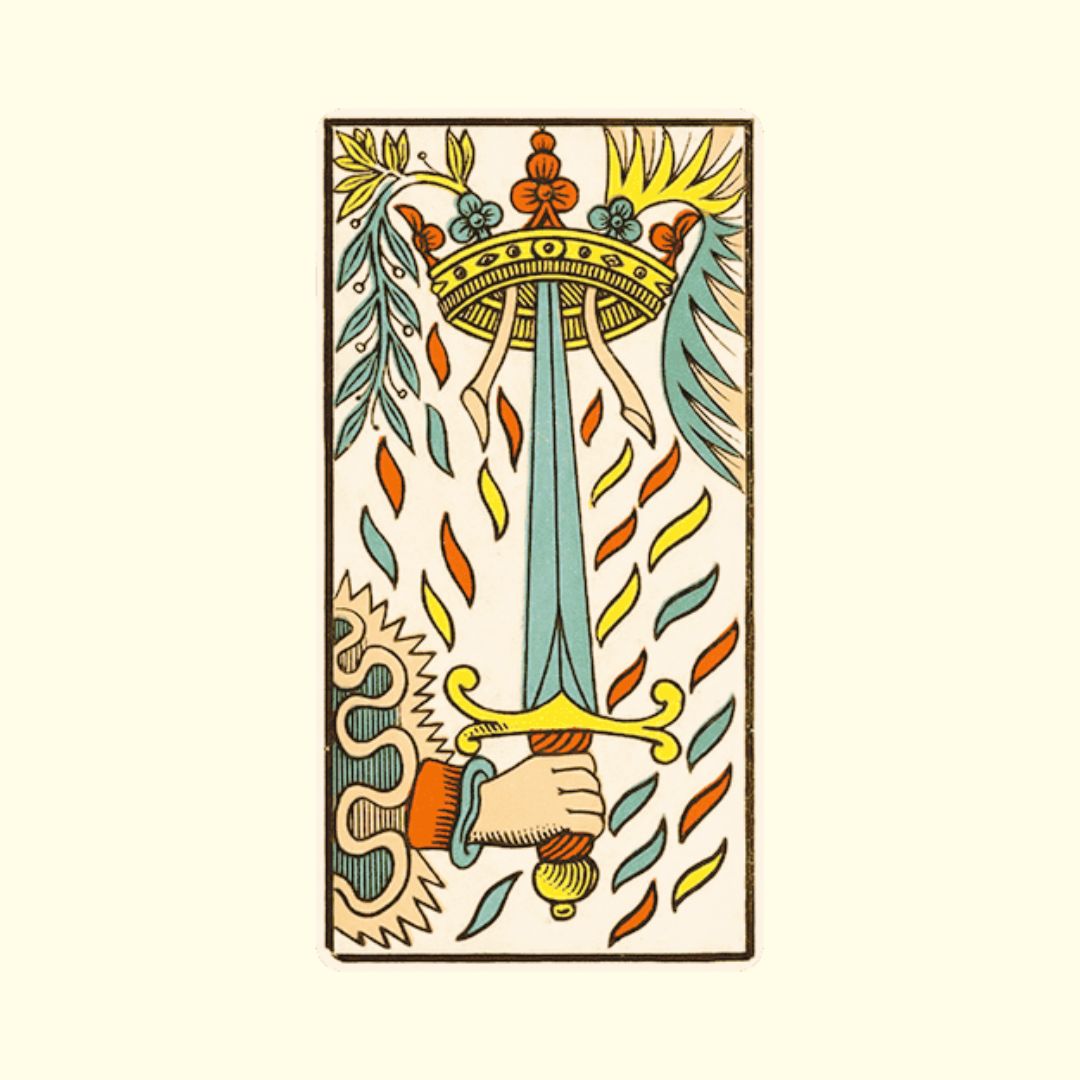

A hand raises a sword toward a crown. In the Tarot de Marseille, the blade occupies the card’s axis and passes through a world of ornaments without depicting a scene. In the Waite-Smith, it emerges from a cloud, bears a crown, and dominates a mountainous landscape. The Ace of Swords opens the realm of judgment, of speech that cuts, and of intellectual force: an available power whose value depends entirely on how it is used.
The Ace gathers the entire suit before a specific situation takes shape. It may signal a decision, a truth articulated, a new rule, an idea that imposes its coherence, or the moment when a conflict must be given a name. The card promises neither perfect justice nor a happy victory. It shows a blade being grasped: it remains to be seen who holds it, what it separates, and under whose authority it acts.
Three layers must remain distinct. French tarots provide the sword, the hand, and the rank of Ace. Mathers transmits a nineteenth-century catalogue linked to triumph and prosperity. The Golden Dawn makes Swords the suit of Air and names the Ace “Root of the Powers of Air.” Smith and Waite ultimately develop the crown, branches, and a reading of conquest. Mental clarity, which has become the modern summary of the card, is a synthesis of interpretation rather than an identical meaning across all schools.
From the Marseille Sword to the Crown Won
In a Nicolas Conver–style Tarot de Marseille, a hand emerges from a sleeve and grips the hilt of a long, upright sword. The central blade rises toward a crown, surrounded by plant-like forms colored according to the workshops. It is not resting on a table: it is held, raised, put into action. The verticality gives the card immediate authority, but the image specifies neither an adversary, nor a trial, nor revealed truth.
Pamela Colman Smith retains the hand emerging from a cloud and the upright sword. A crown encircles the tip, with an olive branch on one side and a palm on the other. Six small flame-shaped signs descend around the blade, while a mountainous landscape stretches below. In the Golden Dawn material, the olive represents peace and the palm suffering; Waite, for his part, emphasizes the triumph of strength and conquest.
Iconographic reference. The upright sword, hand, and crown have precedents in French playing-card decks. The olive branch, palm, detailed cloud, and mountains belong to Smith’s English composition. A reading based on these branches should therefore be presented as a Waite-Smith interpretation, not as a hidden meaning in every Ace of Swords.
The Divinatory Tradition
In The Tarot, published in 1888, S. L. MacGregor Mathers attributes triumph, fecundity, fertility, and prosperity to the Ace of Swords. Reversed, he lists embarrassment, foolish and hopeless love, obstacle, and hindrance. This may surprise readers accustomed only to the words “truth” and “lucidity.” It recalls that nineteenth-century cartomancy inherited traditions from Etteilla that do not correspond to today’s summaries.
Book T names the card “Root of the Powers of Air.” The radiant hand holds a sword supporting a celestial crown, with the olive branch of peace and the palm of suffering. The text contrasts this invoked force with the natural force of the Ace of Wands. It describes a great power capable of serving good or evil, justice or anger, authority or punishment. Air here belongs to late-nineteenth-century English occultism.
Waite revisits triumph, conquest, and excess of force. He specifies that the card acts vigorously in love as well as in hate. Reversed, it retains this intensity, but its results become disastrous; he also mentions another interpretation linked to conception and increase. The Ace therefore cannot be reduced to a clear and beneficial idea. It amplifies the power to cut, define, conquer, or impose.
Meaning in a reading
In a favorable reading
The Ace of Swords appears when a situation demands precise wording. A decision can finally be made, a lie loses its grip, an argument becomes simpler, or a rule provides a framework for the conflict. The card supports the ability to distinguish facts from assumptions, set an intelligible boundary, and defend a position with arguments rather than confusion.
Its best expression combines clarity and responsibility. A truthful statement need not humiliate; a firm decision need not deny what it costs. The crown indicates less an achievement already earned than an authority that must be deserved. With Justice, the Emperor, or well-established Pentacles, the Ace may announce an actionable decision. On its own, it remains a powerful principle that calls for method and evidence.
In a tension reading
The blade can become verbal brutality, hasty judgment, truth used as a weapon, or the will to win at the expense of the bond. It can also show a decision made with too little information, a debate that turns into condemnation, an inflexible rule, or a brilliant idea that does not withstand the facts. The problem does not lie in the reasoning itself, but in the way it exercises its power.
The reversal is not essential for reading this aspect. An obstacle position, the Five of Swords, the Devil, or the Tower can reveal the constraint, escalation, and consequences of an irreversible act. The useful question becomes: what really needs to be decided, and what should instead remain open to examination?
Love, work, and finances
The Ace introduces a judgment or a cut in the area being examined. It certifies neither a legal victory, nor a correct diagnosis, nor financial success. The neighboring cards show whether the decision is based on facts, whether it can be implemented, and who will bear the consequences.
| Area | Favorable reading | Tension aspect | Question to ask |
|---|---|---|---|
| Love | Frank conversation, boundary set, shared decision, or end to ambiguity. | Words that hurt in order to win, ultimatum, coldness, or verdict without listening. | Does the truth being sought serve the relationship or the need to be right? |
| Work | Clarified strategy, contract reread, problem defined, decision taken with full ownership. | Hierarchical conflict, rigid instruction, idea imposed before verification. | What facts support this decision? |
| Finances | Clear-cut arbitration, elimination of an expense, lucid assessment of a commitment. | Impulsive choice presented as rational, overlooked clause, overly risky gamble. | Have the figures and conditions been checked? |
| Creation | Strong concept, clear editorial line, choice that gives the project shape. | Perfectionism, sterile criticism, premature elimination of fruitful avenues. | What constraint makes the work more readable without impoverishing it? |
| Decision | Ability to name the problem and set a criterion. | False alternative, hasty verdict, or refusal to reconsider a mistake. | What information could still change the choice? |
Reading associations
The Ace brings the blade, authority, and possibility of an intellectual beginning. The associated card indicates what must be defined, the institution that gives the decision its force, or the risk produced by overly harsh words.
| Association | Possible dynamic | Point of caution |
|---|---|---|
| Ace of Swords + Two of Swords | A truth or rule must resolve a truce that has become stagnant. | Do not force the decision while crucial information is missing. |
| Ace of Swords + Three of Swords | A word, decision, or finding causes a painful separation. | Clarity authorizes neither cruelty nor dramatization. |
| Ace of Swords + Justice | A decision based on a rule, contract, arbitration, or procedure. | Distinguish legality, fairness, and self-interest. |
| Ace of Swords + The Magician | An idea put into practice, an argument turned into a tool, or new intellectual work. | Skill can become manipulation if the facts are distorted. |
| Ace of Swords + The Devil | Strategic intelligence, persuasive speech, and the will to break free from control. | Threat, obsession, blackmail, or domination through language. |
| Ace of Swords + The Tower | Sudden revelation, breakdown of a system, or decision that changes the entire framework. | Prepare for the consequences before striking what still supports the situation. |
Correspondences by school
The old table in the entry assigned Mercury, spring, amethyst, mauve, and Aleph as though they formed a single transmission. The sources consulted do not provide this set. The table below separates the French image, Mathers's catalog, the Golden Dawn grid, and the Waite-Smith scene.
| Reference | Attribution | Historical scope |
|---|---|---|
| Family | Minor Arcana, suit of Swords, rank of Ace | First numbered card of the suit. |
| Tarot de Marseille | Hand holding a vertical sword pointed toward a crown | Central emblem without landscape or conquest narrative. |
| Mathers, 1888 | Triumph, abundance, fertility, prosperity | Reversed: embarrassment, obstacle, hindrance, hopeless love. |
| Golden Dawn | Root of the powers of Air | Title of Book T. |
| Element | Air | Assignment from the English occult grid to the suit of Swords. |
| Decan and planet | None | Aces represent the root of their element; decans concern the cards from Two to Ten. |
| Waite-Smith | Hand in a cloud, sword, crown, olive branch, palm branch, and mountains | Composition published in 1909, commented on by Waite in 1911. |
| Hebrew letter | No letter unique to the card | Aleph belongs to the Fool in the Golden Dawn framework, not to this Ace. |
| Stone, plant, season | No common historical agreement | Recent lists must be presented as editorial choices. |
| Reading keywords | Decision, distinction, authority, speech, conquest, severance | The context reveals what the blade serves or destroys. |
Reading advice
Begin by asking what the sword separates. Is it a fact and a rumor, two options, a boundary between two people, a clause in a contract, or an inner judgment? Then look for the crown: what rule, authority, or area of competence makes the decision legitimate? Without an answer, the Ace may show a will to decide before establishing the right to do so.
In a love question, the card does not mechanically mean a breakup. In a legal matter, it does not promise victory. In a health question, it does not establish a diagnosis. Its strength lies in making the question more precise, requesting the necessary documents, and distinguishing what can be decided from what requires qualified advice.
Sources and reference texts
For the history of decks and suits: Victoria and Albert Museum, A History of Tarot Cards; British Museum, reproduction of Nicolas Conver’s Tarot of Marseilles.
For divinatory and occult texts: S. L. MacGregor Mathers, The Tarot, 1888, card meanings; Liber LXXVIII, “The Root of the Powers of the Air,” publication of material from Book T; Arthur Edward Waite and Pamela Colman Smith, The Pictorial Key to the Tarot, Ace of Swords, 1911.