































































































The Hanged Man does not fall: he remains held between two positions. His head is below, one foot remains bound, and the world seems inverted around him. This suspension may indicate a willing wait, a constraint, renunciation, or a change of perspective. The card first asks for a simple distinction: who decided on the pause, and for what purpose?
The earliest tarot decks show a hanging by the foot, without a halo or initiatory landscape. Nineteenth-century occultists shifted the image toward sacrifice and knowledge acquired through inversion. The Waite-Smith takes this transformation further: its serene, haloed figure, suspended from living wood, seems to inhabit the pause rather than suffer it.
The Hanged Man in the earliest tarot decks
The Visconti-Sforza card held by the Morgan Library shows a man hanging by one foot from a gallows. His body hangs straight down, his arms appear to be drawn behind him, and no halo transforms the scene into a sacred vision. The image first presents an overturned status and a person deprived of movement. Morgan Library, Visconti-Sforza Tarot, Hanged Man.
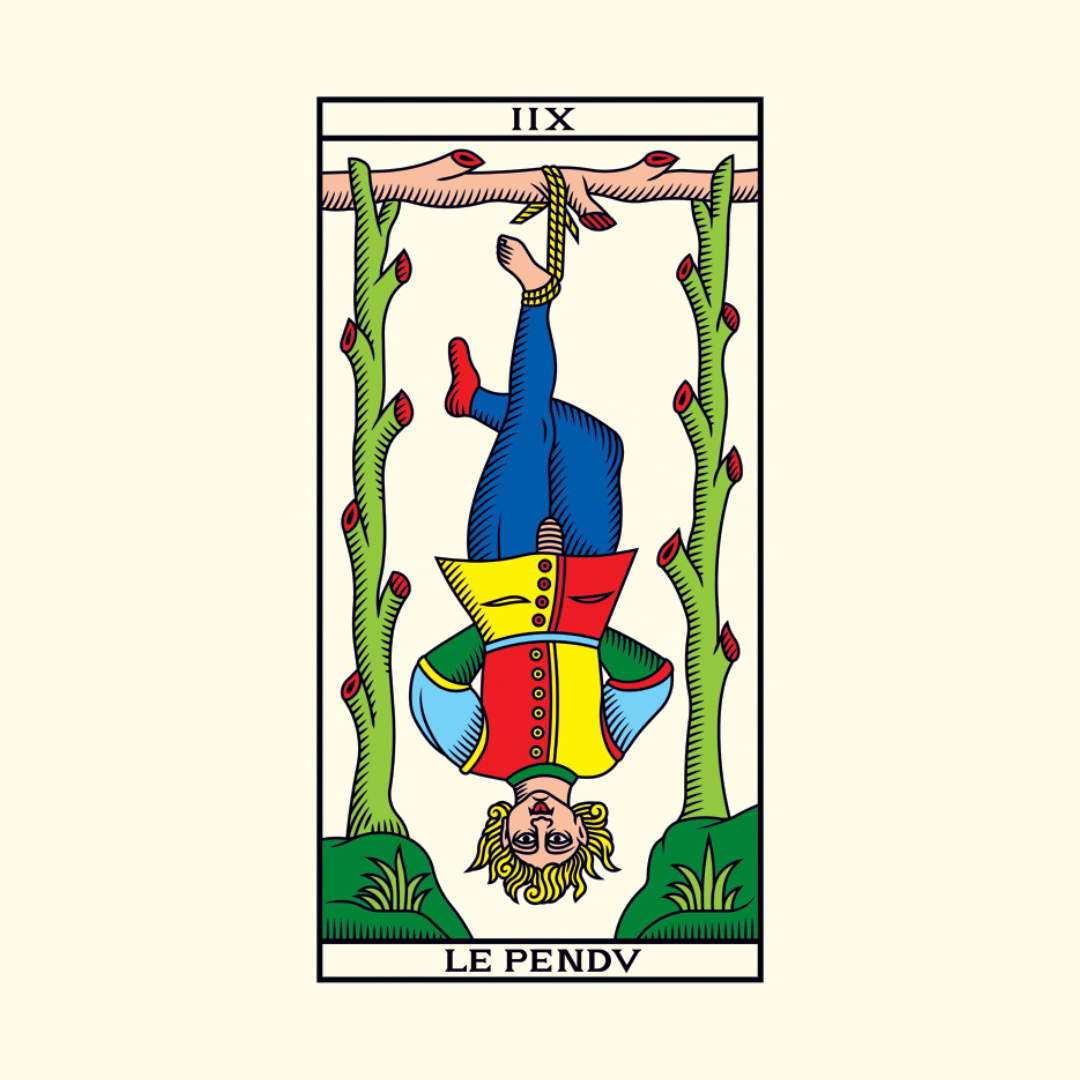
In the Tarot de Marseille, the figure is suspended between two posts whose branches have been cut off. One leg remains straight, while the other bends behind it. The hands disappear behind the back. Nothing allows us to assert that he tied himself up. The drawing therefore supports two readings that must be kept distinct: a chosen pause aimed at achieving a result and immobilization imposed by a situation.
Iconographic marker. The bent leg and hidden arms form an orderly figure, but this geometry does not prove a secret initiation. It primarily serves to make the body legible within the card's narrow space.
From constraint to occultist sacrifice
In the 19th century, Mathers interpreted the twelfth card under the sign of self-sacrifice, devotion, and a change of direction. Papus and Wirth placed it under the letter Lamed in their French sequence. This construction transforms an image of reversal into an intellectual or moral stage. It belongs to occultist commentary, not to a meaning fixed from the creation of the tarot.
The Waite-Smith depicts a figure suspended from a Tau-shaped crossbar, made of wood that still bears leaves. A light surrounds his head. His face shows no pain, and Waite describes a life in suspension. The Golden Dawn associates the card with Mem and Water, whereas French occultism links it to Lamed. These two systems should not be combined in a single column.
The contrast with the Marseille is decisive. In the former, the querent must assess the reality of the constraint. In the latter, they may also read an accepted standstill as a way to understand, wait, or abandon an old position. The neighboring card will indicate whether the suspension protects, prepares, or imprisons.
What the early authors attributed to it
Mathers associates the Hanged Man with self-sacrifice, devotion, and changes in life. Reversed, it indicates selfishness and attachment to material things. This opposition reflects the morality of his era: consenting to lose a position can serve a cause, while refusing any renunciation keeps the individual focused on immediate self-interest.
Waite adds wisdom, prudence, discernment, trials, and divinatory intuition. Reversed, the card is associated with selfishness and absorption into the crowd. His list is broad: it does not replace analysis of the question. In a specific spread, the Hanged Man describes the delay, dependence, and cost of a change in perspective with greater precision.
Meaning in a spread
In a favorable reading
The Hanged Man can indicate a voluntary pause, a step back that avoids a bad decision, acceptance of a delay, or abandoning a method that has become sterile. It invites you to view the situation from the opposite position: that of the other party, the long-term outcome, or a constraint that has so far been overlooked.
Renunciation has value only if it frees a possibility or protects what matters. Postponing action, leaving an advantageous position, listening before responding, or ceasing to fight against an established fact may be acts of wisdom. However, the pause must have an end, a reason, and limits.
In an unfavorable reading
The card may signal powerlessness, indefinite waiting, one-sided sacrifice, dependence, or a martyr posture. The querent then remains suspended by someone else’s choice, an unfulfilled promise, or a rule they have never examined. The useful question becomes: what is really maintaining the connection, and what action remains possible now?
Love, work, and finances
| Area | Favorable reading | Shadow aspect | Question to ask |
|---|---|---|---|
| Love | Time to step back, listening, renunciation of an old relationship pattern. | Waiting for an unavailable person, sacrifice without reciprocity. | Is this pause chosen and limited in time? |
| Work | Observation, training, time put to good use, change of approach. | Blocked career, suspended decision, hierarchical dependence. | What room for action remains during the wait? |
| Finances | Prudent freezing of an expense, review of a commitment. | Immobilized money, deferred income, burden assumed for someone else. | What timeline and conditions are written down? |
| Project | Strategic pause, revised prototype, change of perspective. | Repeated postponement, dependence on an absent validation. | What criterion will determine whether to resume or stop? |
How to read its combinations
The Hanged Man brings suspension, reversal, dependence, and renunciation. The neighboring card clarifies what suspends action, what the pause allows you to see, or how the situation may be resolved.
| Combination | Possible dynamic | Point to watch |
|---|---|---|
| Hanged Man + Justice | Deferred decision, pending case, or need to examine the facts. | Ask for a clear timeline and criteria. |
| Hanged Man + Hermit | Long withdrawal, silent study, maturation away from the public eye. | Isolation must not become abandonment. |
| Hanged Man + Wheel | A blockage that turns around or an external event that restarts the situation. | Prepare for the resumption before it occurs. |
| Hanged Man + Strength | Choosing to hold back action, patience under tension. | Do not call lasting powerlessness mastery. |
| Hanged Man + Death | Decisive renunciation, end of waiting, irreversible detachment. | Name what will not return in its former shape. |
| Hanged Man + Tower | Suspension broken by a sudden event. | Plan a concrete fallback solution. |
| Hanged Man + Star | Restorative pause, trust maintained without forcing the outcome. | Keep verifiable reference points. |
Correspondences according to the schools
| Reference point | Attribution | Historical scope |
|---|---|---|
| Family | Trump or major arcana XII | The twelfth card in the Marseille and Waite-Smith series. |
| Ancient figure | Man hanging by one foot from a gallows | Image from the 15th-century Visconti-Sforza. |
| Tarot de Marseille | Body suspended between two posts, hands behind the back | Image of immobilization and reversal. |
| French occultism | Lamed; sacrifice and change of direction | Attribution from the Papus-Wirth sequence. |
| Golden Dawn | Mem and Water | Distinct system from the French suit sequence Lamed–Hanged Man. |
| Waite-Smith | Living wood in a Tau shape, halo, and serene attitude | The pause takes on a voluntary and initiatory character. |
| Element | Water in the Golden Dawn system | Occult attribution absent from the earliest decks. |
| Stone, plant, and season | No attribution shared by the old schools | Contemporary lists vary depending on their authors. |
| Reading keywords | Suspension, waiting, withdrawal, renunciation, perspective, dependency | The value of stopping depends on its reason and duration. |
| Shadow aspect | Powerlessness, stagnation, futile sacrifice, dependency, martyrdom | A pause without limits can perpetuate the problem. |
Sources and reference texts
Morgan Library, Visconti-Sforza Tarot, Hanged Man ; The Metropolitan Museum of Art, Before Fortune-Telling: The History and Structure of Tarot Cards ; S. L. MacGregor Mathers, The Tarot, 1888 ; Papus, The Tarot of the Bohemians, 1889 ; Oswald Wirth, The Tarot of the Medieval Image-Makers, 1927 ; Arthur Edward Waite, The Pictorial Key to the Tarot, 1911.