




























































































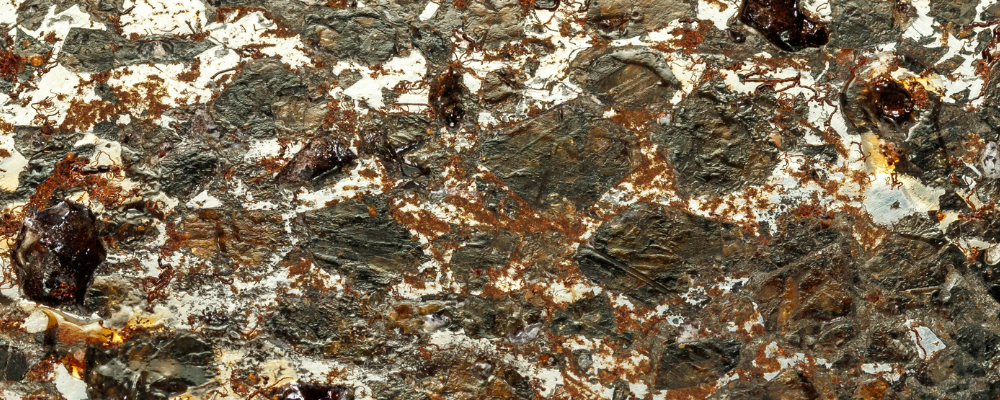
Tektite is Earth transformed by an encounter from the sky. A very high-speed impact melts the rock of the ground, projects it into the air, then lets it fall back in the form of glass. Its magical figure is that of matter struck, set in motion, and returned to the earth with a new form.
This trajectory gives the stone a quality of rupture and recomposition. Mars carries the shock and the decision; Mercury carries flight, the message, and the written trace. Fire changes the state of matter, Air transports it, and Earth receives it.
To place this stone among related minerals, compare it with Obsidian, Snowflake Obsidian, and Obsidian Celestial Eye.
Earth Melted by the Sky
Tektites are natural glasses formed during major impacts. Their substance comes mainly from melted and ejected terrestrial rocks, not from the celestial body itself. Drops, discs, buttons, and irregular masses preserve the memory of their cooling and trajectory.
They are found in vast dispersion zones linked to impact events. The Meteoritical Society presents their formation and major dispersion fields. Their origin alone is enough to explain their power as an image: the sky acts, the earth responds, matter passes through a phase of fire and returns changed.
Tools, ornaments, and lucky stones
Humans collected Tektites long before their origin was understood. Some specimens served as tools or ornaments during prehistory. After the Iron Age, some were worn as lucky stones. This historical journey connects three gestures: using a cutting material, carrying it on oneself, then entrusting it with a protective value.
The glassy form draws the hand because it seems familiar and foreign at once. It resembles volcanic rock, but its history unfolds in the flash of an impact. In the grimoire, it therefore preserves the memory of a break that does not end the story: it changes its direction.
The ink of the Thunder God
Around the 10th century, the Chinese author Liu Sun described black glasses found after rainfall and named them Lei-gong-mo, “ink of the Thunder God.” This mention is the first known written reference to Tektites. Thunder explains their arrival in the language of the time; ink gives them a second symbolic function, that of a message fallen with the storm.
Historical image. The name Lei-gong-mo does not turn Tektite into a meteorite. It unites two images: the sudden power of thunder and the lasting mark of ink. This alliance fuels a talisman for announcing a decision and putting it into action.
Mars, Mercury, Fire, Air, and Earth
The correspondence with Mars comes from impact, heat, and rupture. That with Mercury comes from the journey, speed, and the ancient name for “ink.” This is a contemporary planetary construction based on the formation of glass and its Chinese name, not an ancient Chinese attribution.
Fire dominates the change of state. Air governs movement. Earth provides the original material and receives the glass after its flight. Tuesday is suitable for work involving separation and momentum; Wednesday is suitable for announcements, writing, and itineraries.
Rupture, announcement, travel, and recomposition
Tektite accompanies the moment when a decision must leave thought and enter the world. It can mark the end of a commitment, departure from a place, or resumption of a project after an interruption. Its function is not to sustain the crisis, but to give the event a continuation.
On a desk, it serves as a seal for an action sentence. In work involving movement, it represents the complete journey: origin, launch, passage, and return. For a rite of reconstruction, place it on a scrap of paper bearing what was broken, then on a new sheet bearing what must be built.
The Thunder Ink Rite
On a Tuesday, write in black ink a sentence beginning with “I put an end to…” and a second beginning with “I now commit to…”. Place the Tektite between the two lines. Strike the table once with the flat of your hand to mark the impact, then read the second sentence aloud.
On Wednesday, copy only the commitment sentence onto a card that you will keep for seven days. The first sheet may be torn up and recycled. The rite follows the stone’s birth: rupture, movement, cooling, new form.
Correspondences and reference points
| Domain | Correspondence | Reading |
|---|---|---|
| Planets | Mars and Mercury | Impact, decision, journey, announcement, and writing. |
| Elements | Fire, Air, and Earth | Fusion, movement, and return to matter. |
| Days | Tuesday and Wednesday | Break inertia, then give a name to what follows. |
| Colors | Black, brown, dark green | Trace, memory of impact, and recomposition. |
| Figures | Flash, drop, trajectory | Event, passage, and acquired form. |
| Verbs | Break, launch, inscribe | The talismanic method of Tektite. |
Tektite carries less of the dream of the stars than Earth’s response to their passage. It teaches that an impact can become a trajectory, that a fall can leave an inscription, and that a tested material can receive a new form.