



















































































































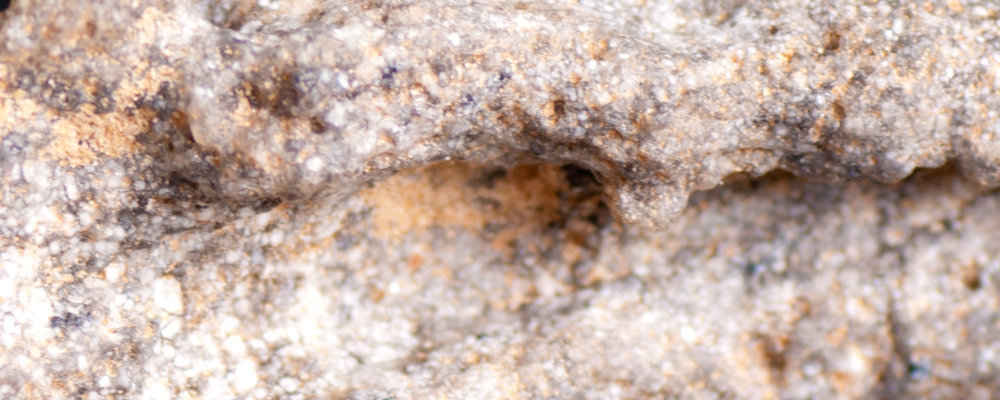
Fulgurite is lightning’s writing in the earth. As lightning passes through sand or rock, it can melt the material along its path; cooling then freezes it into a tube, crust, or branching form of natural glass.
This sudden formation makes it a stone of thresholds, decisions, and consecration. It does not contain the storm: it preserves its trace. Its magical language rests on this very concrete fact, echoed by an ancient Roman idea—the place struck by lightning becomes a separate space.
To place this stone among related minerals, compare it with Obsidian, Snowflake Obsidian, and Obsidian Celestial Eye.
When Lightning Writes in the Ground
Fulgurite is not a mineral species with a fixed formula. Its composition depends on the ground that was struck. In Quartz-rich sand, the heat produces a wall of silica glass, while grains remain fused to the outside. The tubes are hollow, sinuous, and branched like the path of the current.
The Smithsonian National Museum of Natural History preserves sand and rock Fulgurites, as well as similar objects formed by other sources of heat. This distinction is a reminder that clear provenance matters as much as appearance.
The Struck Place Becomes Sacred
In Roman religion, a lightning strike could remove a place from ordinary use. The traces of the event were buried and the site was marked off. This rite was called fulgur conditum, “buried lightning.” A bidental could mark the consecrated space.
A discovery presented by Archaeology Magazine illustrates this principle once again: sealing the traces of the celestial strike and marking the place as sacred. The ritual concerned the spot that had been struck, not a collection of glass tubes. Modern Fulgurite can draw on the appropriate image: acknowledging a boundary created by the event.
Lightning leaves more than a scar: it changes the status of a place. In ritual work, Fulgurite is therefore suited less to agitation than to the moment when a decision becomes irrevocable and a boundary is given a name.
Jupiter and the Thunderbolt
Among the Greeks and Romans, the thunderbolt belonged to Zeus or Jupiter, god of the sky, order, oaths, and authority. The ancient texts and images compiled by Theoi show him with the thunderbolt, scepter, and eagle.
The Jupiter correspondence gives Fulgurite a more specific domain than mere “energy”: public decision, keeping a commitment, justice, authority exercised with moderation, and opening a passage. Thursday, Jupiter’s day, is suitable for requests for favor, legitimacy, or expansion.
Celestial Fire, Air, and Thursday
Fire corresponds to sudden fusion; Air, to the storm and the path arriving from the sky. Earth remains the transformed support. You can therefore work with Fire and Air for the impulse, then close the rite with a gesture of Earth: fold the paper, draw the boundary, or place a stable stone beside the Fulgurite.
A white or dark-blue candle, an eagle motif, an oak branch, and the number four extend Jupiter’s influence without concealing the material. No exposure to flame is necessary: lightning is already inscribed in the form.
Decision, passage, and oath
Fulgurite accompanies a change that has a date: departure, signing, breaking a habit, taking office, or making a promise. It helps separate the before from the after, not provoke chaos for its own sake.
For an oath, write a short sentence, a deadline, and the act that will prove the commitment. For protection, define the exact boundary to be maintained. For a decision, place two options on either side of the stone and remove the one you will no longer support.
Its hollow tube also invites a clear word to pass through. A request addressed to an authority is best phrased without threats or circumlocution, stating the expected result and the responsibility one accepts in return.
The Rite of Crossing the Line
On a Thursday, draw a line on a sheet of paper. On the left, write what you are leaving behind; on the right, what you are committing to. In the center, note the action that can be completed within twenty-four hours and will make the transition visible.
Place the Fulgurite in its box above the line and say: “The stroke has fallen, the way is open, my word takes shape.” Carry out the action before putting away the sheet. Repeat the rite only if the commitment truly changes.
Correspondences and references
| Reference | Correspondence |
|---|---|
| Nature | Vitreous formation created by lightning |
| Ancient image | A place struck, delimited, and consecrated in the Roman rite |
| Deity | Jupiter or Zeus, bearer of lightning |
| Planet | Jupiter |
| Elements | Fire and Air, sealed by Earth |
| Day | Thursday |
| Areas | Decision, oath, threshold, authority, and clear change |
| Ritual gesture | Drawing the line between before and commitment |










