














































































































Volcanic glass, blade, and mirror, obsidian belongs to the stones that cut as much as they reflect. Its ancient uses are both material and ritual: tools, weapons, ornaments, and polished surfaces. In modern magic, it maintains boundaries, reveals what we avoid looking at, and accompanies banishing, grounding, and divination workings.
Not all obsidian is black, but black obsidian dominates magical uses. Its reputation does not need vague stories: the Mesoamerican mirror traditions, John Dee’s mirror, and 20th-century manuals already provide a rich history that should be presented without conflating them.

To place this stone among related minerals, compare it with Snowflake Obsidian, Obsidian Celestial Eye, and Silver Obsidian.
Glass Born from the Volcano
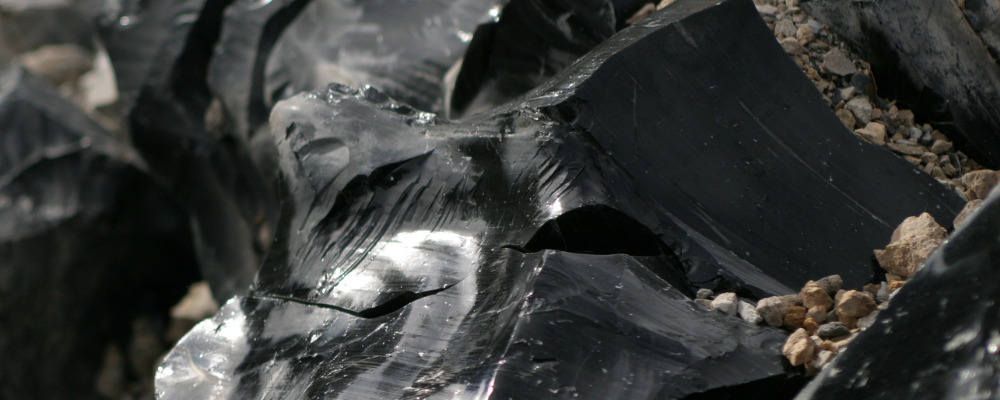
Obsidian forms when silica-rich lava cools so quickly that crystals do not have time to develop. It is therefore a natural volcanic glass. Its conchoidal fracture produces extremely fine edges, a quality that made it a material for tools and blades.
The USGS resources on volcanic materials highlight the importance of obsidian in toolmaking. Its ability to cut and reflect provided two enduring ritual languages: separating what must be separated and showing what remains in the shadows.
The Smoking Mirror of Mesoamerica
In the Aztec world, polished obsidian was associated with Tezcatlipoca, whose name means “smoking mirror.” The mirror is not merely a decorative accessory: it relates to vision, power, destiny, and divine presence. Reflective obsidian surfaces were used as prestige objects and ritual instruments.
This story permits a black-mirror practice, but not the improvised appropriation of a god outside his context. One can honor the material function—a dark surface that reflects an unstable image—without claiming to reproduce a Mesoamerican ceremony.
John Dee’s Mirror
The British Museum holds an obsidian mirror associated with John Dee, a 16th-century scholar and astrologer. The object is of Mexican origin and reached Europe after the conquest. Dee is said to have used it in his scrying operations with intermediaries who described the figures they perceived.
This mirror connects two worlds without making them identical: a Mesoamerican ritual material, followed by a European divinatory use. Its journey also speaks of conquest, the circulation of objects, and reinterpretation. This complexity deserves to remain visible.
A mirror carries its history. Obsidian can serve today for divination and self-examination. This does not turn the session into an Aztec rite or an Elizabethan operation. The current practice must be named as such.
Saturn, protection, and banishing
Scott Cunningham, in 1988, associated Obsidian with Saturn and Fire, then with protection, grounding, divination, and peace. Fire comes from its volcanic origin; Saturn corresponds to its black color, boundaries, and rigor.
An Obsidian placed near the threshold can be given a guarding function. A blunt blade or symbolic point serves to cut a tie, close a period, or trace the boundary of a space. The stone must never be used to injure oneself: the magical gesture remains figurative.
Looking into the shadow with moderation
The black mirror draws people in because it reduces details and lets ambiguous forms appear. This ambiguity can open the imagination, but it can also reinforce fear or expectations. A brief session, a written question, and a return to the facts are therefore essential.
Obsidian is suited to honest examinations: acknowledging anger, dependence, rivalry, or a debt. It does not instruct you to ruminate. After naming what must change, close the session with a precise, achievable action.
The four points of protection
Arrange four small Obsidian stones around a white candle, one in each direction. Name aloud the boundary you are protecting: sleep, home, work, or ritual circle. Light the candle and turn each stone outward.
At the end, extinguish the flame, then place the stones at the four actual boundaries of the space. Once the need has ended, gather them, clean them with a damp cloth, and dissolve their function with a closing formula.
Correspondences and references
| Reference | Correspondence |
|---|---|
| Nature | Natural volcanic glass |
| Planet | Saturn in modern magic |
| Element | Fire by origin; Earth through its grounding use |
| Day | Saturday |
| Areas | Protection, banishing, boundaries, divination, and self-examination |
| Forms | Mirror, point, pebble, or blunted shard |
| Ritual image | Black blade and smoky mirror |
| Ritual gesture | Turn outward, trace a boundary, or contemplate and then close |










