



















































































































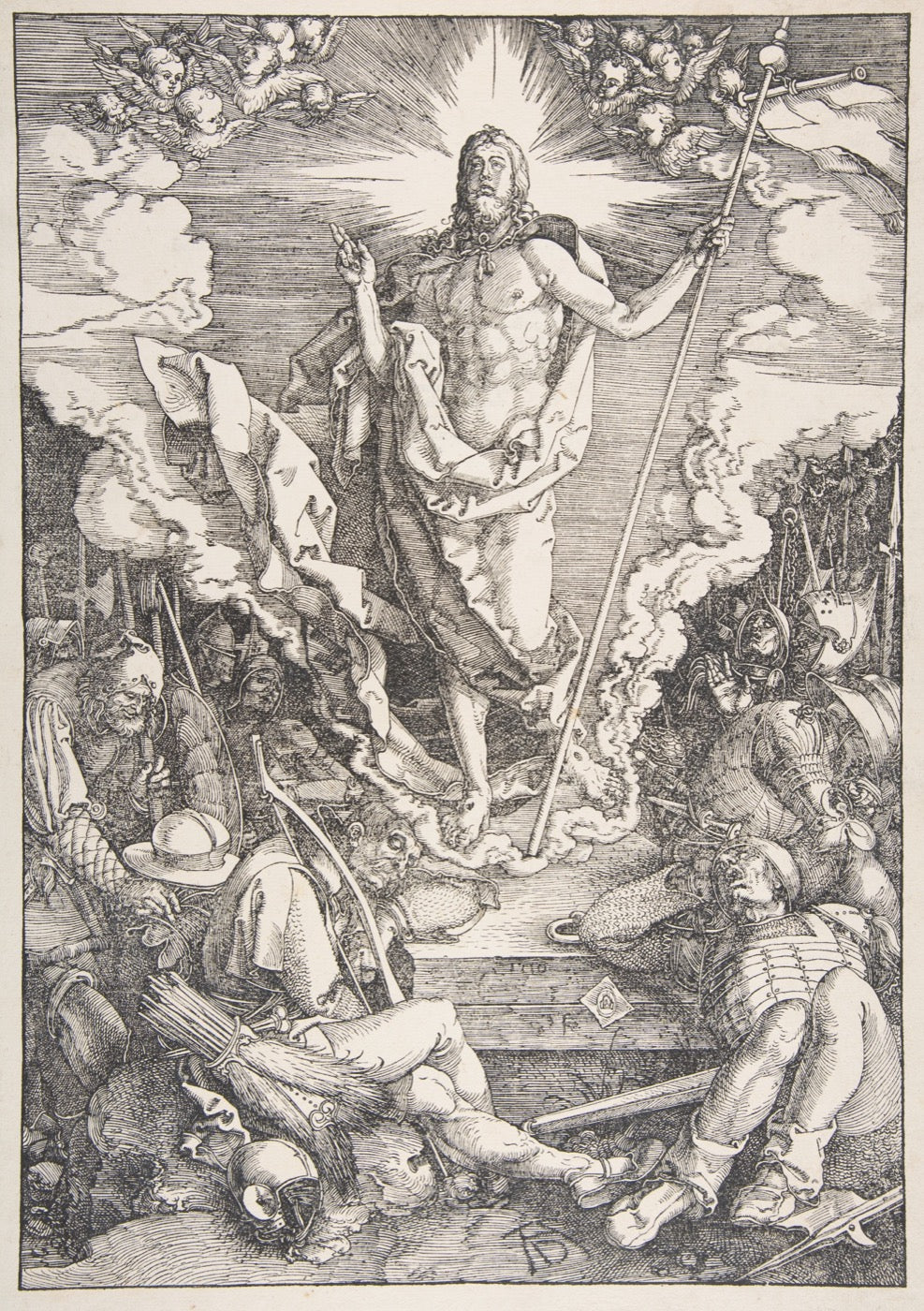
Christian faith approaches death through the Resurrection of Christ and the hope of a new life. Expressions concerning heaven, judgment, or the resurrection of the dead have a theological history that is better understood by relating them to Scripture and the Creed.
The resurrection, a hope for the whole person
Christian faith does not present the body as a prison from which one need only escape. It confesses the resurrection and a life transformed in God. This hope differs from reincarnation, which imagines several successive earthly existences. Ways of speaking about the afterlife frequently use images that should not be turned into a physical map.
Judgment, heaven, and hell
Judgment expresses the truth of a life before God, in his justice and mercy. Heaven refers to complete communion with him. Hell expresses the possibility of definitive separation linked to the rejection of this love. These affirmations do not give readers the power to draw up a list of those who are saved or condemned.
Purgatory
In Catholic teaching, purgatory is a final purification for those who die in friendship with God without being fully purified. It is neither a second chance to choose after death nor a place of reincarnation. Protestant traditions generally reject this doctrine; Orthodox traditions pray for the dead but do not necessarily use the Latin formulation.
Praying for the dead
Christian funerals entrust the person to God and support the living in hope. They do not automatically proclaim canonization and are not limited to a biographical tribute. A Mass, a prayer, or an act of charity may accompany mourning. Spiritist practices intended to obtain messages from the dead belong to another framework and are not a form of the communion of saints.
Supporting those who mourn
Faith forbids neither tears nor the time needed to work through a loss. A bereaved person may need presence, silence, rituals, or professional support. It would be unjust to ask them to make their sadness disappear in the name of religious certainty.
The resurrection of the dead and the fulfillment of life
In 1 Corinthians 15, Paul develops the idea of a resurrection that is not the simple return to the body under the present conditions of existence. The body and the person are not viewed as unrelated realities. Christian hope concerns the fulfillment of the person and of creation, even when theology uses symbolic language to speak of a reality that exceeds ordinary experience.
Doctrines concerning judgment, purification, and communion with God have received different formulations among the Churches. In Catholicism, purgatory is understood as a final purification, not as a second earthly existence. Practices of prayer for the dead are rooted in remembrance of the deceased and in the communion of the Church. Images of the afterlife should not be turned into geographical maps purporting to describe measurable places.
The Resurrection of Christ at the center of hope
The New Testament announces that Christ was resurrected and appeared to his disciples. In 1 Corinthians 15, Paul develops the consequences of this proclamation for the hope of the faithful. He does not present the Resurrection as the simple preservation of an affectionate memory, but as an event concerning human destiny in the face of death.
Christian faith recognizes the dignity of the body and refuses to reduce salvation to the liberation of a soul considered imprisoned in matter. The resurrection of the dead, proclaimed in the Creed, expresses a transformation of the whole person whose manner exceeds ordinary experience.
This hope does not allow anyone to announce to a family the precise circumstances of life after death. It is understood through the risen Christ and the formulations of faith.
Particular judgment and the Last Judgment
In Catholic theology, particular judgment concerns a person's destiny after death. The Last Judgment is connected with the fulfillment of history and the manifestation of divine justice. These notions are presented in the Catechism in relation to the hope of the resurrection and responsibility for one's actions.
The Gospel narratives, especially Matthew 25, use images of separation and encounter with Christ. Their language calls people to live according to charity and justice. Medieval painters gave these scenes an important place on cathedral portals and in representations of psychostasis, in which the archangel Michael holds a balance.
These works should be read as a religious interpretation of judgment, not as a complete material description of what each person will see after death.
Heaven and hell in Catholic doctrine
Heaven is understood as definitive communion with God, not simply as a place located above the clouds. In Catholic doctrine, hell denotes definitive separation from God linked to the free rejection of his love. Biblical texts use powerful images to express these destinies and invite conversion.
Painting and literature have depicted heaven with clouds and angels, and hell with flames and terrifying figures. These motifs have an artistic history that should not be transformed into a physical inventory of the afterlife. Theological formulations seek to express the significance of the human relationship with God.
The Catholic tradition invites hope and reminds us that ultimate judgment belongs to God, not to the personal assessment of an observer who claims to know the destiny of every deceased person.
Purgatory and prayer for the dead
Purgatory is defined in Catholic theology as a purification of people who die in God's grace without yet being fully disposed for heavenly communion. It is neither a second hell nor an ordeal whose duration a believer could calculate from a prayer formula.
Prayer for the dead has an ancient history in Christian communities. The Commemoration of All the Faithful Departed on November 2 gives it a particular place in the Roman calendar, but it continues throughout the year. Mass intentions and acts of remembrance belong to this tradition.
Prayers do not replace the respect due to the deceased or support for their families. They express a communion that Christian faith does not consider destroyed by death.
Funerals and being present with those who mourn
Catholic funeral liturgy places the death and Resurrection of Christ at the center. The readings, prayers, and gestures around the coffin recall the dignity of the deceased person and the hope of new life. Holy water and the Paschal candle refer to baptism, whose promise accompanies the final passage.
Mourning does not follow an emotional timetable that could be imposed on a family. Prayer and the community can offer support, but sadness, silence, and material needs also require human attention. The Gospel narratives show Jesus himself weeping at the death of Lazarus.
The remembrance of the dead in the liturgical year expresses this solidarity. It connects the memory of loved ones with Christian hope without denying the reality of their absence.
Sources and references
Catechism — resurrection, nos. 992–1004
Catechism — heaven, nos. 1023–1029
Catechism — purgatory, nos. 1030–1032
Catechism — hell, nos. 1033–1037
Illustration: Piero della Francesca, The Resurrection (c. 1463–1465), historical public-domain reproduction.










