



















































































































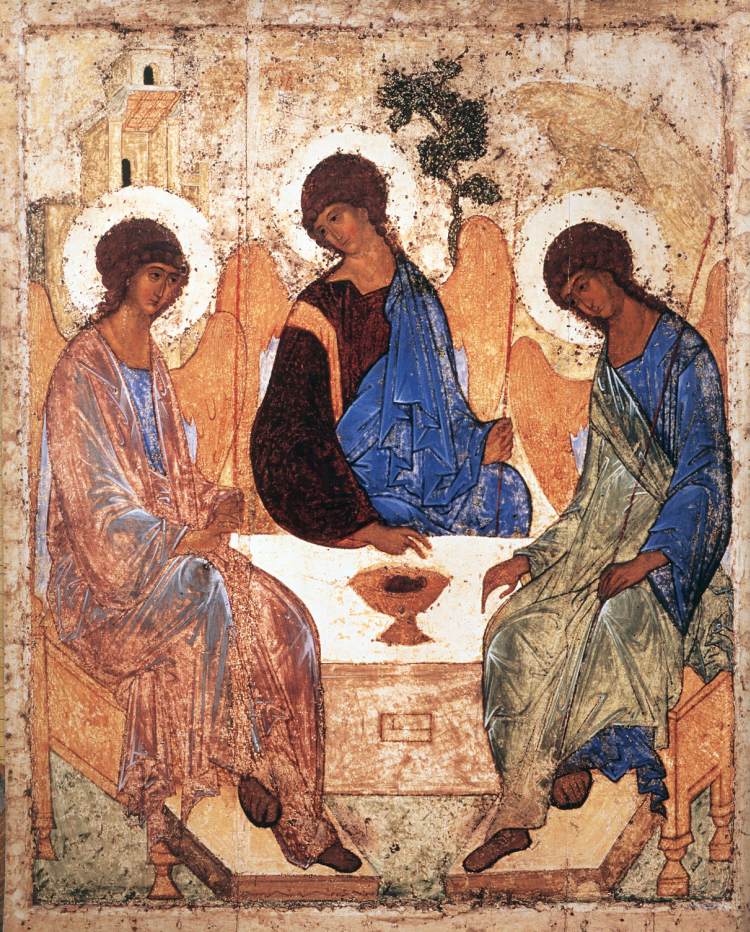
God the Father is the first person of the Holy Trinity in the Christian confession. The word “Father” means neither a god older than the Son and the Spirit nor a simply masculine figure placed at the top of the world. It expresses an eternal relationship: the Father is Father of the Son, and the three persons possess one and the same divine nature. The Scriptures transmit this name in the prayer of Israel, in the words of Jesus, and in the formula of baptism. The councils then clarified its meaning in order to affirm together the unity of God and the real distinction of the Father, the Son, and the Holy Spirit.
| Place in the Creed | I believe in God, the Father almighty |
|---|---|
| Trinitarian relationship | The Father eternally begets the Son |
| Divine unity | A single divine nature shared without division |
| Major texts | Matthew 6 and 28; John 14–17; Romans 8 |
| Important council | Nicaea, 325: the Son is of the same substance as the Father |
| Iconography | Hand emerging from the clouds; an old man in later images |
One God, Father, Son, and Holy Spirit
The Christian faith inherits Israel’s monotheism. The profession of faith in Deuteronomy recalls that the Lord is one. Jesus himself repeats this teaching when he answers the question about the first commandment in Mark 12. Trinitarian doctrine therefore does not add several divinities to the biblical faith. It seeks to account for what the disciples claim to have received from Jesus and the Holy Spirit.
The Creed begins with the Father, then confesses the Son and proclaims the divinity of the Spirit. This order presents the divine relationships without establishing a hierarchy of value among three gods. The Catechism emphasizes that each of the three persons is God in his entirety, without the divine nature being divided into parts. The word “person” takes on a particular theological meaning here, different from a simple human individuality.
The Father is distinguished from the Son by fatherhood, the Son by his relationship to the Father, and the Spirit by his procession. Theology speaks of eternal relations of origin: they do not correspond to a chronology before which one of the persons would have existed without the others.
The name of Father in biblical history
The Scriptures of Israel already know the fatherhood of God. It expresses his care for his people, fidelity to the covenant, and the duty of justice imposed on those who claim him. In Deuteronomy, the prophets, and the psalms, familial language becomes a way of speaking about a God who creates, accompanies, and calls. It does not attribute physical reproduction or biological descent to the Lord.
The Gospels give this name a particular significance. Jesus addresses God as his Father, asks his disciples to pray to the Father, and associates his ministry with fulfilling the will of the one who sent him. The Aramaic term Abba is preserved in Mark 14, during the prayer at Gethsemane. Paul takes it up in Romans 8 and Galatians 4 to speak of the baptized’s relationship with God.
The designation Father thus refers both to Jesus’ unique relationship and to believers’ filial adoption. Theology distinguishes Christ’s eternal sonship from the sonship received by grace, but sees the latter as participation in the life opened by the Son.
Jesus reveals a relationship that does not begin in time
In John 14, Jesus speaks of his relationship with the Father and explains to Philip that knowing the Son makes it possible to know the one who sent him. The dialogue does not present two separate divinities, but a communion in which the Son reveals the Father. The same Gospel emphasizes this relationship in Jesus’ prayer in chapter 17, where he refers to the glory that preceded the creation of the world.
These passages fueled discussions in the early centuries. How can one affirm that Jesus is truly the Son of God without making him a creature of a higher rank? How can one preserve the confession of one God while recognizing the distinction between the Father and the Son? The conciliar answer developed around the words generation and consubstantiality.
The language of eternal generation rejects any idea of bodily conception. The Father is not Jesus’ biological father in the sense of human reproduction: human motherhood belongs to Mary, whereas the Son’s divine relationship to the Father is confessed as eternal. The article devoted to Jesus Christ explores this distinction further from the perspective of the Incarnation.
The Council of Nicaea and the word consubstantial
In 325, the Council of Nicaea met amid disagreements about the nature of the Son. Arius and those who defended his position refused to attribute to the Son the same eternity and the same divine nature as the Father. The bishops gathered at Nicaea adopted a formula according to which the Son is begotten, not created, and of the same substance as the Father.
The Greek term homoousios, rendered as “consubstantial,” affirms a unity of nature that is not based on a mere resemblance. It does not mean, however, that the Father and the Son are two names for a figure without distinction. The formulation seeks to hold together divine unity and the reality of the filial relationship.
The Council of Constantinople in 381 and later theological formulations deepened the confession of the Holy Spirit. The debates did not constitute a sudden invention of the Trinity in the 4th century: they provided precise vocabulary for questions raised by the reading and proclamation of earlier Christian texts.
Why God the Father is not an old man
The Bible uses human images to speak about God: he speaks, extends his hand, protects, or appears as a father. These expressions evoke his relationship with human beings, but they are not an anatomical description. The Christian faith does not confess a masculine God in the biological sense, and the Catechism recalls that God transcends the bodily distinction between man and woman.
Western painting nevertheless represented the Father as a majestic old man, sometimes within a triangle, above Christ, or surrounded by angels. This figure draws on visionary passages and conventions of sovereignty that developed during the Middle Ages and the Renaissance. It should not be taken as a material portrait of the Father.
Other images choose a hand descending from the clouds, a symbol of blessing and divine intervention. The differences between Eastern icons and Western representations reflect theological debates about the limits of representing the invisible divinity. Art therefore requires a historical reading of its conventions.
The Father, creator and freedom of creatures
The Creed calls the Father “almighty, creator of heaven and earth.” Creation is nevertheless the work of the triune God, not an activity reserved for the Father as though the Son and the Spirit were strangers to it. The prologue of John gives the Word a place in the creative act; Christian texts also speak of the presence and action of the Spirit.
Omnipotence does not mean that God would abolish the laws of nature or human freedom at every moment. Theology approaches creation, Providence, and responsibility as related questions: the world has its own reality, and people are called to act within this creation.
The language of fatherhood is therefore understood alongside the themes of care and support. It does not justify authoritarianism or abusive domination in human relationships. Christ’s teaching about the heavenly Father instead emphasizes care, forgiveness, and attention to the needs of those who pray.
The Lord’s Prayer and Christian life
The prayer of the Lord’s Prayer, transmitted by Matthew 6 and Luke 11, begins by addressing the Father. Jesus then asks that his name be hallowed, his kingdom welcomed, and his will followed, before the requests concerning bread, forgiveness, and deliverance. This text connects teaching about God with the concrete necessities of human existence.
The word “our” is important. The prayer is not reserved for an individual who would possess an exclusive relationship with God; it gathers believers called to live as brothers and sisters. In the Catholic liturgy, the Lord’s Prayer holds a central place before Eucharistic communion.
The commentary on this prayer makes it possible to explore its petitions more deeply. Confessing the Father is therefore not merely a matter of doctrinal vocabulary: it nurtures a way of praying, receiving life as a gift, and recognizing the dignity of others.
Sources and references
Catechism of the Catholic Church, paragraphs 232 to 267, revelation and doctrine of the Trinity.
Matthew, chapter 6, prayer to the Father; chapter 28, baptismal formula.
John, chapter 14 and chapter 17, the Son’s relationship to the Father.
Compendium of the Catechism, questions 44 to 49, three persons and the unity of God.
Illustration: Andrei Rublev, Icon of the Trinity, 15th century, historical work in the public domain.










