



















































































































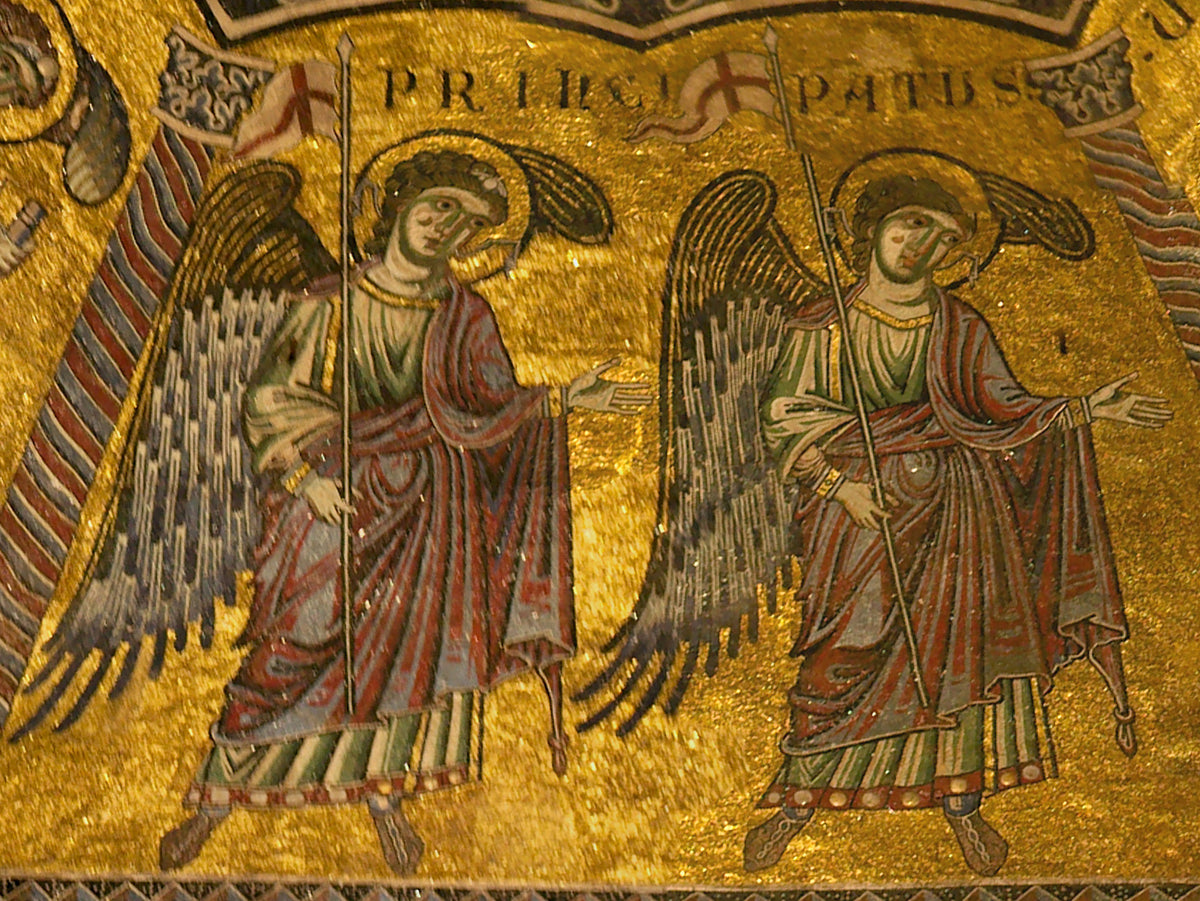
The Principalities occupy a major place in the letters of the New Testament and in the hierarchy of the nine angelic choirs. Their name evokes beginning, authority, and direction, but Scripture uses it in contexts ranging from Christ's sovereignty to images of conflicts between celestial powers. Pseudo-Dionysius places them at the top of the third triad, just before the Archangels and Angels, emphasizing a function of guidance and transmission. Thomas Aquinas also discusses the role that tradition attributes to them among peoples and human communities. These sources gave rise to images of angelic princes bearing a crown, scepter, or banner, whose significance is primarily spiritual.
| Greek vocabulary | Archai, beginnings or principalities |
|---|---|
| Biblical sources | Colossians 1:16; Ephesians 1 and 3; Daniel 10 |
| Position in Pseudo-Dionysius | First choir of the third triad |
| Associated choirs | Archangels and Angels |
| Medieval interpretation | Direction and ordered transmission of the celestial ministries |
| Images | Crowns, scepters, and banners according to tradition |
The principalities in Paul's letters
The Epistles to the Colossians and the Ephesians use the vocabulary of sovereignty to speak of invisible realities. Colossians 1:16 names thrones, dominions, principalities, and powers among the things created in Christ and for him. Ephesians 1:21 affirms that the exalted Christ is above the various forms of authority and power.
The Greek archai is linked to the idea of beginning or principle, but it can also designate authorities and those who command. French translations therefore use terms whose meaning varies according to context. In the apostolic letters, what remains essential is Christ's sovereignty over all powers, whether visible or invisible.
Chapter 3 of Ephesians also refers to the celestial principalities and powers, to whom the wisdom of God is to be made known. This passage gives the vocabulary of cosmic authority a place in the Christian understanding of the divine plan. However, it is not sufficient to establish the exact position of each choir within the three medieval triads.
The celestial princes in the Book of Daniel
The Book of Daniel provides important context for the history of angels associated with peoples. In chapter 10, a messenger mentions the prince of the kingdom of Persia, then the prince of Greece, and refers to the intervention of Michael. In chapter 12, Michael appears as the great prince who watches over the people. These images belong to Jewish apocalyptic literature and describe the celestial dimension of conflicts in history.
The term “prince” helps explain why Christian commentators associated these passages with the Principalities. However, the Book of Daniel does not present Pseudo-Dionysius's hierarchy of nine choirs. Nor does it assert that a complete catalogue of nations and their angels was given to the prophet.
The religious significance of these chapters lies in the relationship between human history and God's plan. Earthly empires do not possess absolute sovereignty, and celestial figures act within an order that transcends them. This idea would later become important for reflection on the ministries of angels.
The Principalities in Pseudo-Dionysius's Third Triad
Chapter IX of the Celestial Hierarchy places the Principalities at the top of the third triad, followed by the Archangels and the Angels. This final hierarchy is presented as the one most directly connected to the revelations that reach human beings. The Principalities fulfill a function of directing and orienting the order, while the other choirs transmit and proclaim according to their rank.
Pseudo-Dionysius interprets their name in terms of an authority that remains entirely oriented toward the divine principle. The Principalities lead other beings toward this higher order; they are not described as independent sovereigns, each occupying a kingdom of which they would be the owner.
This distinction gives meaning to the place of the Principalities in the final triad. After the intermediate orders, associated with the organization and transmission of divine ministries, they open a group closer to proclamation. The Archangels occupy an intermediate position between their leadership function and that of the Angels, whose interventions are presented as more closely connected to the human world.
Why the Archangels Are Not the Principalities
The similarity of the names and attributes can lead to confusion between the Principalities and the Archangels. The two groups belong to the same triad, but their place in Pseudo-Dionysius's system reflects a precise distinction. The Principalities express the direction and orientation of the celestial order; the Archangels occupy a mediating position; the Angels correspond to the level most directly associated with transmitting messages to human beings.
The word “archangel” already denotes a form of authority or preeminence in religious language. Yet this does not mean that the three groups are identical. Chapter IX presents closely related functions that participate in the same movement of transmission, without erasing their differences.
This framework makes it possible to place Gabriel, the messenger of the Annunciation, and Raphael, the companion of the young Tobias, within a biblical history that has its own narratives. The Dionysian hierarchy gives them a theological place, but does not replace the texts that recount their mission.
Thomas Aquinas and the governance of peoples
In question 108 of the Summa Theologica, Thomas Aquinas examines the function of the Principalities and their place among the orders. He adopts Pseudo-Dionysius's classification while discussing the hierarchy proposed by Gregory the Great. The two authors do not assign exactly the same rank to certain categories, particularly the Principalities and the Virtues.
Thomas associates the Principalities with a leadership function, which he illustrates through the leaders of a community or a people. The Book of Daniel informs his reflection on the angels associated with nations. The vocabulary of politics serves here as an analogy for understanding a spiritual hierarchy, in which the authority of angels remains subordinate to God.
It does not follow that a medieval text would provide a list of the angels assigned to each state in the modern world. Borders, forms of government, and the names of peoples have changed throughout history. Thomas's theology interprets biblical passages and develops a reflection on governance, without producing a map of contemporary celestial responsibilities.
The angels of nations and the limits of this image
The connection between angels and peoples appears in several ancient Jewish traditions. Certain readings of Deuteronomy 32 and Daniel 10 fostered the idea of angels associated with nations under divine sovereignty. Pseudo-Dionysius takes up these motifs in chapter IX to explain how different human communities belong to the same providential plan.
This conception must be situated within the history of the texts. It does not confer automatic sanctity on an empire, a border, or a political project. The language of the heavenly princes can shed light on how ancient authors imagined the history of peoples, but it does not justify the domination of one human group over another.
The central teaching of Pseudo-Dionysius remains the unity of the divine source, above all angels and all nations. The celestial figures are not rival national deities; their role forms part of an order intended to lead beings toward God.
Crowns, Scepters, and Banners in Iconography
The Principalities do not have a detailed physical description in Paul's letters. To make their function visible, artists therefore used attributes associated with leadership and dignity: crowns, scepters, banners, or solemn garments. These objects help distinguish certain groups in representations of the nine choirs, but they are not universal attributes established by a biblical account.
In images of divine majesty, the Principalities appear among the orders close to the Archangels and Angels. The classification depends on the theological text followed by the artist. The organization into three triads provides a visual framework for arranging several celestial groups around Christ.
Crowns and banners should not be understood as signs of territorial ownership. They express the notion of leadership and the dignity of angelic service. The same image may have a different meaning if it appears in a cycle of saints, a martyrdom scene, or a political representation.
The Meaning of the Principalities in Christian Angelology
The history of the Principalities brings together three major bodies of documentary evidence. The apostolic letters proclaim Christ's authority over visible and invisible powers. Daniel mentions heavenly princes linked to conflicts between kingdoms. Pseudo-Dionysius and then Thomas Aquinas organize these images within a reflection on the angelic choirs and their mission.
This transmission explains why their name came to be associated with the governance of peoples, leadership, and the protection of communities. These ideas have a precise theological framework: the sovereignty of the angels is always derived from and ordered toward God.
To discover the Principalities, reading Colossians 1, Daniel 10, and Chapter IX of the Celestial Hierarchy offers three complementary perspectives. The texts show how the same family of words can move from biblical proclamation to prophetic vision, and then to the construction of a spiritual hierarchy.
Sources and references
Colossians, Chapter 1, verse 16, the Principalities among the invisible realities created in Christ.
Ephesians, Chapter 1, verse 21 and Chapter 3, verse 10, Christ's authority and the wisdom revealed to the heavenly powers.
Daniel, Chapter 10 and Chapter 12, princes of Persia and Greece, and Michael's role.
Pseudo-Dionysius, Celestial Hierarchy, Chapter IX, Principalities, Archangels, and Angels.
Thomas Aquinas, Summa Theologica, I, Question 108, the function of the Principalities and a comparison of the hierarchies.
Illustration: Mosaic of the Principalities in the Florence Baptistery, photograph by MatthiasKabel, cropped by Sailko, ancient mosaic; photograph under CC BY-SA 3.0 license, unmodified.










